|
Return Create A Forum - Home |
 |
--------------------------------------------------------- |
|
True Left |
 |
https://trueleft.createaforum.com |
|
--------------------------------------------------------- |
|
***************************************************** |
|
Return to: Colonial Era |
|
***************************************************** |
|
#Post#: 3844-------------------------------------------------- |
|
Has Australia Reconciled With Its Colonial Past? |
|
By: guest5 Date: January 30, 2021, 9:25 pm |
|
--------------------------------------------------------- |
|
Has Australia Reconciled With Its Colonial Past? |
|
[quote]Australia Day is observed on January 26 to commemorate |
|
the arrival of the first fleet of ships from Britain in 1788. |
|
While the day is a celebration for many, others especially |
|
Australia's Indigenous peoples, view it as the beginning of |
|
their dispossession and mistreatment. We look back to why the |
|
day has always been one of the most polarizing dates on the |
|
country�s calendar.[/quote] |
|
https://www.youtube.com/watch?v=sPrFc4j4oU8 |
|
#Post#: 8534-------------------------------------------------- |
|
Re: Has Australia Reconciled With Its Colonial Past? |
|
By: 90sRetroFan Date: September 1, 2021, 10:24 pm |
|
--------------------------------------------------------- |
|
We've all heard about: |
|
https://en.wikipedia.org/wiki/White_Australia_policy |
|
Of course, Jews in Australia were "white", just as they were in |
|
all Western colonies: |
|
https://en.wikipedia.org/wiki/History_of_the_Jews_in_Australia |
|
[quote]Eight convicts transported to Botany Bay in 1788 aboard |
|
the First Fleet have been identified as Jewish.[6] There were |
|
probably more, but exact numbers are not possible as the |
|
transportation records did not indicate a convict's religion. |
|
Over a thousand more people of Jewish descent are estimated to |
|
have been sent to Australia as convicts during the next 60 |
|
years.[1] |
|
... |
|
The first move towards organisation in the community was the |
|
formation of a Chevra Kadisha (a Jewish burial society) in |
|
Sydney in 1817.[7] In 1820, William Cowper allotted land for the |
|
establishment of a Jewish cemetery in the right-hand corner of |
|
the then-Christian cemetery. The Jewish section was created to |
|
enable the burial of one Joel Joseph. During the next ten years |
|
there was no great increase in membership of the society, and |
|
its services were not called for more than once a year. The |
|
actual allocation of land for a consecrated Jewish cemetery was |
|
not approved until 1832.[8] |
|
The first Jewish services in the colony were conducted from 1820 |
|
in private homes by emancipist Joseph Marcus, one of the few |
|
convicts with Jewish knowledge.[7] An account of the period is: |
|
In 1827 and 1828 then the worldly condition of the Hebrews in |
|
the colony improved considerably, in consequence of the great |
|
influx of respectable merchants; and this, with other |
|
circumstances, has raised the Hebrews in the estimation of their |
|
fellow colonists. About this period Mr. P. J. Cohen having |
|
offered the use of his house for the purpose, divine worship was |
|
performed for the first time in the colony according to the |
|
Hebrew form, and was continued regularly every Sabbath and |
|
holiday. From some difference of opinion then existing among the |
|
members of this faith, divine service was also performed |
|
occasionally in a room hired by Messrs. A. Elias and James |
|
Simmons. In this condition everything in connection with their |
|
religion remained until the arrival of Rev. Aaron Levi, in the |
|
year 1830. He had been a dayyan, and, duly accredited, he |
|
succeeded in instilling into the minds of the congregation a |
|
taste for the religion of their fathers. A Sefer Torah [scroll |
|
of the Law] was purchased by subscription, divine service was |
|
more regularly conducted, and from this time may be dated the |
|
establishment of the Jewish religion in Sydney. In 1832 they |
|
formed themselves into a proper congregation, and appointed |
|
Joseph Barrow Montefiore as the first president. |
|
... |
|
By 1901 it is estimated there were over 15,000 Jews in |
|
Australia.[1] When Australia was founded as an independent |
|
country in 1901, some of the founders were Jewish. From the |
|
outset, Jews were treated as equal citizens with freedom to |
|
participate in economic and cultural life, and played an |
|
important role in their development. |
|
... |
|
Throughout the 20th century, many Jews served as elected |
|
officials. Among the positions held by a Jew were Mayor of |
|
Melbourne, Premier of South Australia, Speaker of the House of |
|
Representatives, and Speaker of Parliament. Many Jewish elected |
|
officials simultaneously served as the heads of their kehillas. |
|
... |
|
Besides his diverse business interests in Sydney, Sir Saul |
|
Samuel was the first Jew to become a magistrate, to sit in a |
|
colonial Parliament and to become a minister of the Crown.[26] |
|
In 1854 he was appointed to the New South Wales Legislative |
|
Council and subsequently was an elected member of the |
|
Legislative Assembly. He also served periods as Treasurer and |
|
Postmaster General.[26] Vaiben Solomon was Premier of South |
|
Australia for a week in 1899. Leo Port was Lord Mayor of Sydney |
|
between 1975 and 1978. |
|
In 1931, Sir Isaac Isaacs was the first Australian-born |
|
Governor-General, and was the first Jewish vice-regal |
|
representative in the British Empire. Sir Zelman Cowen also |
|
served as Governor-General, between 1977 and 1982. Linda Dessau |
|
has been Governor of Victoria since July 2015,[27] the first |
|
woman and the first Jew to serve in the position. Sir John |
|
Monash, a distinguished Australian Lieutenant-General during |
|
World War I, led Australian troops both in Gallipoli and on the |
|
Western Front. The agent-generalship of New South Wales has been |
|
administered by two Jews: Sir Saul Samuel, one of the most |
|
prominent and successful Jews in Australian politics, and Sir |
|
Julian Salomons. |
|
Several Jews have served as Chief Justices of various states. |
|
Sir Julian Salomons was Chief Justice of New South Wales for a |
|
fortnight in 1886; James Spigelman was the Chief Justice of NSW |
|
from 19 May 1998 to 31 May 2011. Mahla Pearlman was Chief Judge |
|
of the NSW Land and Environment Court from 1992 to 2003, and she |
|
was the first woman chief judge in any (State) jurisdiction in |
|
Australia. Jews are especially prominent in the legal |
|
profession; for example, in Melbourne alone, the Hon. Michael |
|
Rozenes sits as Chief Judge of the County Court of Victoria, |
|
Justice Redlich sits on the Court of Appeal, while Justices |
|
Raymond Finkelstein, Alan Goldberg, Mark Weinberg, Ronald |
|
Sackville and Ron Merkel have all sat in recent years on the |
|
Federal Court of Australia. James Edelman is a justice of the |
|
Federal Court, and is appointed to be a justice of the High |
|
Court of Australia. |
|
David Bennett is a Sydney barrister. He was president of the |
|
Australian Bar Association from 1995 to 1996 and of the NSW Bar |
|
Association from 1995 to 1997. Bennett was president of the |
|
Association of Lawyer Arbitrators and Mediates in 1998 and |
|
President of the Australian Academy of Forensic Sciences from |
|
1999 to 2001. He was Solicitor-General of Australia from 1998 to |
|
2008. Bennett was awarded the Centenary Medal in 2003. His wife, |
|
Annabelle Bennett is a Judge of the Federal Court of Australia. |
|
... |
|
Among the Jews who have figured as business pioneers in |
|
Australia were Joseph Barrow Montefiore (1803�1893)[28] and his |
|
brother Jacob Barrow Montefiore (1801�1895), one of the founders |
|
of the colony of South Australia, as he was selected by the |
|
British government to act on the first board of commissioners, |
|
appointed in 1835 to conduct its affairs. Jacob's portrait hangs |
|
in the Art Gallery of South Australia, and his memory is |
|
perpetuated by Montefiore Hill, a vantage point which overlooks |
|
the city of Adelaide.[29] Their nephew Jacob Levi Montefiore |
|
(1819�1885), whose mother was a first cousin of Sir Moses |
|
Montefiore,[30] and J. B. Montefiore[clarification needed] gave |
|
an impetus to the progress of New South Wales. Jacob owned one |
|
of the largest sheep-runs in the colony, and founded and for |
|
many years acted as director of the Bank of Australasia. The |
|
close connection of these two with the colony is further |
|
evidenced by the township of Montefiore, New South Wales, which |
|
stands at the junction of the Bell and Macquarie Rivers in the |
|
Wellington valley. Joseph Montefiore was the first president of |
|
the first Jewish congregation formed in Sydney in 1832. |
|
V. L. Solomon of Adelaide is remembered for the useful work he |
|
achieved in exploring the vast northern territory of his colony, |
|
the interests of which he represented in Parliament. M. V. |
|
Lazarus of Bendigo, known as Bendigo Lazarus, also did much to |
|
open up new parts in the back country of Victoria. Nathaniel |
|
Levi, for many years urged the cultivation of beetroot for the |
|
production of sugar and spirits owed its brief existence as an |
|
industry to Levi's own interest in raw material for his |
|
distilling company. In his labours on behalf of this industry he |
|
published in 1870 a work of 250 pages on the value and |
|
adaptability of the sugar-beet. In Western Australia, the |
|
townships of Karridale and Boyanup owe their existence to the |
|
enterprise of M. C. Davies, a large lumber merchant. |
|
... |
|
Since the days of European settlement in Australia, Jews have |
|
enjoyed formal equality before the law and have not been subject |
|
to civil disabilities or other forms of state-sponsored |
|
antisemitism excluding them from full participation in public |
|
life. Jews have been active contributors in science, art, and |
|
literature, and in the government of the colonial and |
|
Commonwealth eras, with a number attaining prominent public |
|
offices, including several governors-general.[/quote] |
|
See also: |
|
https://trueleft.createaforum.com/true-left-vs-false-left/jews-have-nothing-in-… |
|
#Post#: 8885-------------------------------------------------- |
|
Re: Has Australia Reconciled With Its Colonial Past? |
|
By: 90sRetroFan Date: September 19, 2021, 3:47 am |
|
--------------------------------------------------------- |
|
https://en.wikipedia.org/wiki/Australian_frontier_wars |
|
[quote]Date |
|
1788�1934[1] |
|
Location |
|
Australia, including Tasmania and other surrounding islands |
|
Result |
|
British/Australian victory |
|
No treaty signed |
|
British/Australian control over Australia established, |
|
Indigenous Australians dispossessed |
|
Indigenous population decline due to killings, starvation, |
|
forced migration |
|
... |
|
The British Government decided to establish a prison colony in |
|
Australia in 1786.[10] Under the European legal doctrine of |
|
terra nullius, Indigenous Australians were not recognised as |
|
having property rights and territory could be acquired through |
|
'original occupation' rather than conquest or consent.[7] |
|
... |
|
The frontier wars were particularly bloody and bitter in |
|
Queensland, owing to its comparatively large Indigenous |
|
population. This point is emphasised in a 2011 study by |
|
�rsted-Jensen, which by use of two different sources calculated |
|
that colonial Queensland must have accounted for upwards of one |
|
third and close to forty percent of the indigenous population of |
|
the pre-contact Australian continent.[71] |
|
Queensland represents the single bloodiest colonial frontier in |
|
Australia.[72][73] Thus the records of Queensland document the |
|
most frequent reports of shootings and massacres of indigenous |
|
people, the three deadliest massacres on white settlers, the |
|
most disreputable frontier police force, and the highest number |
|
of white victims to frontier violence on record in any |
|
Australian colony.[74] In 2009 professor Raymond Evans |
|
calculated the indigenous fatalities caused by the Queensland |
|
Native Police Force alone as no less than 24,000.[75] In July |
|
2014, Evans, in cooperation with the Danish historian Robert |
|
�rsted-Jensen, presented the first-ever attempt to use |
|
statistical modelling and a database covering no less than 644 |
|
collisions gathered from primary sources, and ended up with |
|
total fatalities suffered during Queensland's frontier wars |
|
being no less than 66,680�with Aboriginal fatalities alone |
|
comprising no less than 65,180[76]�whereas the hitherto commonly |
|
accepted minimum overall continental deaths had previously been |
|
20,000.[77][78] The 66,680 covers Native Police and |
|
settler-inflicted fatalities on Aboriginal people, but also a |
|
calculated estimate for Aboriginal inflicted casualties on the |
|
invading forces of whites and their associates. The continental |
|
death toll of Europeans and associates has previously been |
|
roughly estimated as between 2,000 and 2,500, yet there is now |
|
evidence that Queensland alone accounted for an estimated 1,500 |
|
of these fatal frontier casualties.[3][77][78][79] |
|
... |
|
The largest reasonably well documented massacres in south east |
|
Queensland were the Kilcoy and Whiteside poisonings, each of |
|
which was said to have taken up to 70 Aboriginal lives by use of |
|
gift of flour laced with strychnine. Central Queensland was |
|
particularly hard hit during the 1860s and 1870s, several |
|
contemporary settlers mention the "Skull Hole" or Mistake Creek |
|
massacre on Bladensburg station near Winton which in 1901 was |
|
said to have taken up to 200 Aboriginal lives.[84] In 1869 the |
|
Port Denison Times reported that "Not long ago 120 aboriginals |
|
disappeared on two occasions forever from the native |
|
records".[85] Frontier violence peaked on the northern mining |
|
frontier during the 1870s, most notably in Cook district and on |
|
the Palmer and Hodgkinson River goldfields, with heavy loss of |
|
Aboriginal lives and several well known massacres. Battle Camp |
|
and Cape Bedford belong among the best known massacres of |
|
Aboriginal people in Cook district, but they were certainly not |
|
the only ones. The Cape Bedford massacre on 20 February 1879 |
|
alone was reported to have taken as many as 28 lives, this was |
|
retaliation for the injuring (but not killing) of two white |
|
"ceder-getters" from Cooktown.[86] In January 1879 Carl |
|
Feilberg, the editor of the short lived Brisbane Daily News |
|
(later editor-in-chief of the Brisbane Courier), conveyed a |
|
report from a "gentleman, on whose words reliance can be placed" |
|
that he had after just "one of these raids ... counted as many |
|
as seventy-five natives dead or dying upon the |
|
ground."[87][/quote] |
|
"White" methods never change. |
|
See also: |
|
https://en.wikipedia.org/wiki/List_of_massacres_of_Indigenous_Australians |
|
[quote]There were many massacres of Aboriginal people and Torres |
|
Strait Islander people by settlers following the colonisation of |
|
Australia by the British Empire, in 1788. These events were a |
|
fundamental element of the Australian frontier wars,[1] and |
|
frontier massacres were a significant component of Aboriginal |
|
casualties across the continent.[2] |
|
A project headed by historian Lyndall Ryan from the University |
|
of Newcastle and funded by the Australian Research Council, has |
|
been researching and mapping these massacres.[3] Significant |
|
collaborators toward this project include Jonathan Richards from |
|
the University of Queensland,[4][3][1] Jennifer Debenham, Chris |
|
Owen, Robyn Smith and Bill Pascoe. Criteria such as defining a |
|
massacre as the killing of six or more people are used and an |
|
interactive map as an online resource is included.[5][6][2] As |
|
of 3 January 2020, at least 311 frontier massacres over a period |
|
of about 140 years had been documented, revealing "a |
|
state-sanctioned and organised attempt to eradicate Aboriginal |
|
people".[2][failed verification][/quote] |
|
"White" objectives also never change. |
|
One example: |
|
https://en.wikipedia.org/wiki/Gippsland_massacres |
|
[quote]The following list of massacres was compiled by settlers |
|
from white perpetrator sources such as letters and diaries, and |
|
thus does not take into account Gunai Kurnai knowledge of the |
|
history of occupation.[4] |
|
1840 - Nuntin- unknown number murdered by Angus McMillan's men |
|
1840 - Boney Point - "Angus McMillan and his men took a heavy |
|
toll of Aboriginal lives"[5] |
|
1841 - Butchers Creek - 30-35 shot by Angus McMillan's men[5] |
|
1841 - Maffra - unknown number shot by Angus McMillan's men |
|
1842 - Skull Creek - unknown number murdered |
|
1842 - Bruthen Creek - "hundreds murdered" |
|
1843 - Warrigal Creek - up to 150 people shot by Angus McMillan |
|
and his men[6] |
|
1844 - Maffra - unknown number murdered |
|
1846 - South Gippsland - 14 murdered |
|
1846 - Snowy River - 8 murdered by Captain Dana and the |
|
Aboriginal Police |
|
1846-47 - Central Gippsland - 50 or more shot by armed party |
|
hunting for a white woman supposedly held by Aborigines; no such |
|
woman was ever found. |
|
1850 - East Gippsland - 15-20 murdered |
|
1850 - Murrindal - 16 poisoned |
|
1850 - Brodribb River - 15-20 murdered[/quote] |
|
"White" narrative stereotypes never change either..... |
|
Also: |
|
https://en.wikipedia.org/wiki/Mass_poisonings_of_Aboriginal_Australians |
|
[quote]During the British colonisation of Australia, land |
|
ownership was forcefully transferred from the various Indigenous |
|
populations to the colonists. Several military and paramilitary |
|
organisations such as the British Army, Native Police, Border |
|
Police and New South Wales Mounted Police were utilised by the |
|
British to eliminate any Aboriginal resistance to this |
|
acquisition of land. However, it was often the responsibility of |
|
the pioneering colonists themselves to take the initiative in |
|
enforcing land ownership transferral. Usually this was done |
|
violently through the use of firearms to intimidate or kill the |
|
native people. Some colonists though, chose an alternative |
|
approach, using poison concealed in consumables as a method of |
|
extirpating the original custodians of the land. The tainted |
|
consumables were either knowingly given out to groups of native |
|
people, or purposely left in accessible places where they were |
|
taken away and eaten collectively by the local clans. As a |
|
result, incidents of mass deaths of Aboriginal Australians due |
|
to these deliberate mass poisonings occurred throughout the |
|
continent.[1][2] |
|
The mass poisonings were generally done in a secretive manner |
|
but there are many documented cases with some involving police |
|
and government investigations. They appear to have begun as a |
|
colonial method in Australia during the 1820s when toxic |
|
substances utilised in the sheep [s]farming[/s] industry became |
|
readily available. Chemicals such as arsenic, strychnine, |
|
corrosive sublimate, aconitum and prussic acid were all used. |
|
There are no cases of convictions being reported against any of |
|
the perpetrators of these mass poisonings. |
|
... |
|
Some examples of mass poisonings |
|
|
|
This list is incomplete; you can help by adding missing items. |
|
(January 2021) |
|
1824, Bathurst - members of the Wiradjuri people poisoned with |
|
arsenic infused damper.[1] |
|
1827, Hunter Valley - colonists along the Hunter River poisoning |
|
Aboriginal people with corrosive sublimate.[3] |
|
~1833, Gangat - large number of Aboriginal people killed on the |
|
Australian Agricultural Company's million acre land grant near |
|
Gloucester by being given poisoned flour in up to three separate |
|
incidents.[4][5] |
|
1840s, Wagga Wagga - pioneer colonists to the region, William |
|
Best and Alexander Davidson both recounted large scale |
|
deliberate poisonings of local Wiradjuri people in the early |
|
1840s. The poison was delivered via milk or through the |
|
poisoning of waterholes.[6][7] Mary Gilmore, who lived near |
|
Wagga Wagga as child, also documented several cases of mass |
|
poisonings that occurred around the Murrumbidgee River.[8][9] |
|
1840, Glen Innes - reports of deaths of Aboriginal people by |
|
prussic acid poisoning investigated by government authorities |
|
but denied by pastoralists.[10] |
|
1841, Wannon River - at least seven Aboriginal people poisoned |
|
to death on one of the Henty brothers' leaseholds.[11] |
|
1842, Tarrone - at least nine Aboriginal people poisoned to |
|
death near Port Fairy by being given poisoned flour on the |
|
squatting run of James Kilgour.[11] |
|
1842, Mount Kilcoy - a large number of Aboriginal people were |
|
poisoned to death at an outpost of Evan Mackenzie's Kilcoy |
|
property.[12][13] |
|
1844, Ipswich - around a dozen Aborigines were poisoned at the |
|
government-run farm known as Plough Station near Ipswich. A |
|
convict, John Seller, offered them biscuits containing arsenic |
|
after a dispute over him taking a female member of the clan. |
|
Three died and Seller was charged with their murder. He avoided |
|
conviction but as he was already a serving a sentence for a |
|
previous crime, he was transferred south to the Cockatoo Island |
|
prison where he was released two years later.[14] |
|
1846, Tyntynder - between 8 and 20 Aboriginal people killed by |
|
eating poisoned flour given to them by Scottish colonist Andrew |
|
Beveridge near Swan Hill.[15] |
|
1847, Whiteside - at least three Aboriginal people killed by |
|
arsenic-laced flour being placed out for them to take. This |
|
occurred on the Whiteside squatting run of Captain George |
|
Griffin.[16] |
|
1847, Kangaroo Creek - close to 30 Aboriginal people killed by |
|
poison given to them in flour by Thomas Coutts near Grafton. |
|
Coutts was arrested and sent to Sydney but the case was |
|
dropped.[17] |
|
1849, Port Lincoln - five Aboriginal people including an infant |
|
were killed after being given flour mixed with arsenic by |
|
hutkeeper Patrick Dwyer near Port Lincoln. Despite being |
|
arrested with strong evidence against him, Dwyer was released |
|
from custody by Charles Driver, the Government Resident at Port |
|
Lincoln.[18] |
|
1856, Hornet Bank - a number of Aboriginal people killed by |
|
being given strychnine-laced Christmas pudding in the lead-up to |
|
the Hornet Bank massacre.[19] |
|
1860s, Warginburra Peninsula - Edward Hampton "Cranky" Baker |
|
added arsenic to his food stores knowing they would be stolen by |
|
the local Aboriginal people living on his "Peninsula" |
|
land-holding adjoining Shoalwater Bay. The shooting and |
|
poisoning of these people greatly diminished their number.[20] |
|
Baker also had land near the town of Rockhampton in which |
|
supplies of arsenic-laced flour were placed. In 1870 several |
|
South Sea Islanders ate this flour and one died. Baker faced a |
|
magisterial inquiry but the matter was dropped.[21][22] |
|
1874, Bowen River Inn - five Aboriginal people were poisoned |
|
outside the Bowen River Inn on the upper Bowen River. Two were |
|
killed and buried in shallow graves in the riverbed while the |
|
other three recovered.[23] |
|
1885, Florida cattle station - a large number of Yolngu people |
|
became ill and died after being given poisoned horse-meat on |
|
John Arthur Macartney's newly established Florida cattle station |
|
in north-eastern Arnhem Land.[24] |
|
~1890, Dungog - two young Aboriginal people begging near to town |
|
"were easily disposed of" by being given poison in their |
|
food.[25] |
|
1895, Fernmount - six Aboriginal people poisoned to death near |
|
Bellingen by being given aconite to drink by John Kelly. Kelly |
|
was suspected of manslaughter and committed for trial but was |
|
found not guilty and discharged.[26][27] |
|
1896, Lakeland Downs - Arsenic deliberately placed in baking |
|
powder killed a significant number of Aboriginal people near |
|
Lakeland as "just retribution" for the spearing of a Scottish |
|
colonist.[28] |
|
1908, Mt Ida - eight Aboriginal people killed by poison near |
|
Leonora. Explorer William Carr-Boyd described those killed as |
|
dirty, lazy, thieving "human wolves" who "got something more to |
|
eat than they bargained for".[29] |
|
1931 Sandover River There is also a suggestion that William |
|
George Murray participated in another massacre or mass poisoning |
|
of Aboriginal Australians while he was posted at Arltunga.[30] |
|
1936, Timber Creek - five Aboriginal people killed by arsenic |
|
being put in their food near Timber Creek.[31] |
|
1981, Alice Springs - two Aboriginal people were killed and |
|
fourteen others were made ill by drinking from a bottle of |
|
sherry which had strychnine deliberately added to it. The |
|
poisoned bottle was intentionally left by persons unknown in a |
|
place of easy access to this group of Aboriginal people.[32] |
|
2015, Collarenebri - three Aboriginal people, Norman Boney, |
|
Sandra Boney and Roger Adams, were poisoned to death after |
|
buying methanol-laced moonshine from Mary Miller in the town of |
|
Collarenebri. Miller was not charged in relation to the deaths |
|
and only received a $5,000 fine for selling liquor without a |
|
licence from magistrate Clare Girotti.[33][34][/quote] |
|
NEVER FORGIVE. NEVER FORGET. |
|
#Post#: 8893-------------------------------------------------- |
|
Re: Has Australia Reconciled With Its Colonial Past? |
|
By: christianbethel Date: September 19, 2021, 12:07 pm |
|
--------------------------------------------------------- |
|
Of course they haven't. |
|
#Post#: 13546-------------------------------------------------- |
|
Re: Has Australia Reconciled With Its Colonial Past? |
|
By: 90sRetroFan Date: May 22, 2022, 8:03 pm |
|
--------------------------------------------------------- |
|
https://www.bbc.com/news/world-australia-61432762 |
|
[quote]Australia election: Why is Australia's parliament so |
|
white? |
|
Australia is one of the most multicultural nations in the world, |
|
but it's a different story in the country's politics, where 96% |
|
of federal lawmakers are white. |
|
With this year's election, political parties did have a window |
|
to slightly improve this. But they chose not to in most cases, |
|
critics say. |
|
Tu Le grew up the child of Vietnamese refugees in Fowler, a |
|
south-west Sydney electorate far from the city's beaches, and |
|
one of the poorest urban areas in the country. |
|
The 30-year-old works as a community lawyer for refugees and |
|
migrants newly arrived to the area. |
|
Last year, she was pre-selected by the Labor Party to run in the |
|
nation's most multicultural seat. But then party bosses |
|
side-lined her for a white woman. |
|
It would take Kristina Kenneally four hours on public transport |
|
- ferry, train, bus, and another bus - to get to Fowler from her |
|
home in Sydney's Northern Beaches, where she lived on an island. |
|
Furious locals questioned what ties she had to the area, but as |
|
one of Labor's most prominent politicians, she was granted the |
|
traditionally Labor-voting seat. |
|
Ms Le only learned she'd been replaced on the night newspapers |
|
went to print with the story. |
|
"I was conveniently left off the invitation to the party meeting |
|
the next day," she told the BBC. |
|
Despite backlash - including a Facebook group where locals |
|
campaigned to stop Ms Kenneally's appointment - Labor pushed |
|
through the deal. |
|
"If this scenario had played out in Britain or the United |
|
States, it would not be acceptable," says Dr Tim Soutphomassane, |
|
director of the Sydney Policy Lab and Australia's former Race |
|
Discrimination Commissioner. |
|
"But in Australia, there is a sense that you can still maintain |
|
the status quo with very limited social and political |
|
consequences." |
|
[/quote] |
|
We always said Australian Anglo bloodlines were inferior to |
|
their UK/US counterparts. |
|
[quote]At least one in five Australians have a non-European |
|
background and speak a language at home other than English, |
|
according to the last census in 2016. |
|
Some 49% of the population was born or has a parent who was born |
|
overseas. In the past 20 years, migrants from Australia's Asian |
|
neighbours have eclipsed those from the UK. |
|
But the parliament looks almost as white as it did in the days |
|
of the "White Australia" policy - when from 1901 to the 1970s, |
|
the nation banned non-white immigrants. |
|
... |
|
Two decades ago, Australia and the UK had comparably low |
|
representation. But UK political parties - responding to |
|
campaigns from diverse members - pledged to act on the problem. |
|
... |
|
[img width=1280 |
|
height=1011] |
|
https://ichef.bbci.co.uk/news/1632/idt2/idt2/905779b3-c595-47a6-ba65-79f037901f… |
|
At least in the UK we have Operation Gaddafi running. |
|
[quote]Labor has taken small structural steps recently - passing |
|
commitments in a state caucus last year, and selecting two |
|
Chinese-Australian candidates for winnable seats in Sydney. |
|
But it was "one step forward and two steps back", says party |
|
member and activist Osmond Chiu, when just weeks after the |
|
backlash to Ms Le's case, Labor "parachuted in" another white |
|
candidate to a multicultural heartland. |
|
Andrew Charlton, a former adviser to ex-PM Kevin Rudd, lived in |
|
a harbour mansion in Sydney's east where he ran a consultancy. |
|
His selection scuppered the anticipated races of at least three |
|
diverse candidates from the area which has large Indian and |
|
Chinese diasporas. |
|
... |
|
The frustration on this issue has centred on Labor - because the |
|
centre-left party calls itself the "party of multiculturalism". |
|
But the Liberal-National government doesn't even have diversity |
|
as a platform issue. |
|
One of its MPs up for re-election recently appeared to confuse |
|
her Labor rival for Tu Le, sparking accusations that she'd mixed |
|
up the two Asian-Australian women - something she later denied. |
|
But as one opponent said: "How is this still happening in |
|
2022?"[/quote] |
|
The bloodlines from the White Australia era haven't been |
|
eliminated, so why would it not be still happening? |
|
#Post#: 15143-------------------------------------------------- |
|
Re: Has Australia Reconciled With Its Colonial Past? |
|
By: 90sRetroFan Date: August 14, 2022, 9:33 pm |
|
--------------------------------------------------------- |
|
https://www.yahoo.com/news/darkness-down-under-australia-still-034829267.html |
|
[quote]There�s a reason that so many Aboriginal people |
|
identified with George Floyd. Australia�s First Nations |
|
people�twelve times more likely to be incarcerated than white |
|
Australians�continue to see themselves as victims of |
|
state-sanctioned violence, often involving police. |
|
Today, Aboriginal and Torres Strait Islander people make up 3.2 |
|
percent of Australia�s total population, yet they account for |
|
almost 30 percent of the country�s prison population. Their |
|
chances of dying in custody are almost six times greater than |
|
other Australians. |
|
... |
|
more than 500 Aboriginal people have died in custody since the |
|
Commission�s report was handed down. |
|
Given the violent history of Australia�s colonization�Aboriginal |
|
lands were taken without treaty, consent, or compensation�and |
|
the protracted struggle for equality and justice, it�s not |
|
surprising that First Nations people view police with deep fear |
|
and suspicion. For more than 150 years, it was police and their |
|
trackers (both black and white) who were responsible for many of |
|
the massacres of Aboriginal people. It was governments and their |
|
police who often turned a blind eye to the vigilantes who |
|
�cleared� the country of its rightful owners. It was police who |
|
took children from their families and facilitated their |
|
�re-education� in state and religious institutions. And it was |
|
police who represented the brutal imposition of whitefella law |
|
over the laws and cultures of First Nations people. Despite |
|
numerous investigations and inquiries over the years, no police |
|
officer has ever been convicted for the murder of an Aboriginal |
|
person. |
|
In 2019, at Yuendumu, an Aboriginal community in central |
|
Australia, Aboriginal teenager Kumanjayi Walker died after being |
|
shot three times by Police Constable Zachary Rolfe. In a |
|
disturbing echo of the events at Uluru in 1934, Rolfe claimed he |
|
had acted in self-defense when Walker resisted arrest and |
|
attacked him with a pair of scissors. In March this year, an |
|
all-white jury found Rolfe not guilty of Walker�s murder, a |
|
decision that sparked a wave of grief and anger at Yuendumu and |
|
in Aboriginal communities across the country. |
|
Local elders pleaded with police to consult them and respect |
|
their law before entering their homes. They also asked them not |
|
to bring their guns into the community. If racial profiling and |
|
unnecessary deaths were to be avoided, policing, they argued, |
|
must be carried out in collaboration with community elders and |
|
without the need for firearms. |
|
For many Aboriginal people at Yuendumu, the 1928 Coniston |
|
massacre, a wave of indiscriminate killings led by Constable |
|
George Murray (one of Bill McKinnon�s colleagues), was still in |
|
living memory. Similar stories of profound rupture and horror |
|
can be found throughout Australia. |
|
In 2016, esteemed Yolngu elder and respected Indigenous leader |
|
Galarrwuy Yunupingu recalled how his father, Mungurrawuy, was |
|
present �when the massacres occurred in [East Arnhem Land] in |
|
the 1920s and 1930s.� He was also �shot by a man licensed to do |
|
so.� �These events and what lies behind them are burned into our |
|
minds,� he explained. �They are never forgotten. Such things are |
|
remembered. Like the scar that marked the exit of the bullet |
|
from my father�s body.� These scars�memories of forced removal, |
|
murder, frontier warfare, resistance, and survival�are etched |
|
into the bloodlines of Australia�s historical imagination. |
|
... |
|
Like Native Americans, Indigenous Australians suffered the |
|
dispossession of their lands. They were massacred and |
|
�dispersed� at the barrel of a gun. They were denied the wealth |
|
wrought from the white establishment�s appropriation of their |
|
lands. They were long denied citizenship in their own country, |
|
and they struggled against pernicious racial hierarchies and |
|
oppressive legislation, adapting creatively nonetheless, and |
|
ensuring their cultures� survival. Although treaties allegedly |
|
accorded Native Americans the status of nations and sovereign |
|
governments, they were often little more than legitimizing |
|
devices for the colonizer�s appropriation of territory, or part |
|
of a strategy to ward off rival European powers. Indigenous |
|
Australians, however, do not have an established history of |
|
treaty-making to fall back on. More than 230 years after the |
|
first wave of the British invasion began in 1788, they are still |
|
waiting for their sovereignty as First Nations people to be |
|
recognized. |
|
... |
|
Australia has struggled to dispel the myth of peaceful British |
|
settlement�the idea that the land was simply �taken up� by |
|
settlers without fierce resistance from First Nations people. |
|
For many Australians, �war� is something that happened overseas. |
|
In 2003, Prime Minister John Howard told a gathering at the |
|
Supreme Court of Victoria that Australia had �formed a nation |
|
without strife or warfare,� as if the frontier wars were a mere |
|
�blemish� in an otherwise heroic narrative of widening democracy |
|
and material prosperity.[/quote] |
|
See also: |
|
https://trueleft.createaforum.com/enemies/australia/ |
|
#Post#: 15147-------------------------------------------------- |
|
Re: Has Australia Reconciled With Its Colonial Past? |
|
By: guest30 Date: August 14, 2022, 11:02 pm |
|
--------------------------------------------------------- |
|
[quote author=90sRetroFan link=topic=448.msg15143#msg15143 |
|
date=1660530793] |
|
https://www.yahoo.com/news/darkness-down-under-australia-still-034829267.html |
|
[quote]There�s a reason that so many Aboriginal people |
|
identified with George Floyd. Australia�s First Nations |
|
people�twelve times more likely to be incarcerated than white |
|
Australians�continue to see themselves as victims of |
|
state-sanctioned violence, often involving police. |
|
Today, Aboriginal and Torres Strait Islander people make up 3.2 |
|
percent of Australia�s total population, yet they account for |
|
almost 30 percent of the country�s prison population. Their |
|
chances of dying in custody are almost six times greater than |
|
other Australians. |
|
... |
|
more than 500 Aboriginal people have died in custody since the |
|
Commission�s report was handed down. |
|
Given the violent history of Australia�s colonization�Aboriginal |
|
lands were taken without treaty, consent, or compensation�and |
|
the protracted struggle for equality and justice, it�s not |
|
surprising that First Nations people view police with deep fear |
|
and suspicion. For more than 150 years, it was police and their |
|
trackers (both black and white) who were responsible for many of |
|
the massacres of Aboriginal people. It was governments and their |
|
police who often turned a blind eye to the vigilantes who |
|
�cleared� the country of its rightful owners. It was police who |
|
took children from their families and facilitated their |
|
�re-education� in state and religious institutions. And it was |
|
police who represented the brutal imposition of whitefella law |
|
over the laws and cultures of First Nations people. Despite |
|
numerous investigations and inquiries over the years, no police |
|
officer has ever been convicted for the murder of an Aboriginal |
|
person. |
|
In 2019, at Yuendumu, an Aboriginal community in central |
|
Australia, Aboriginal teenager Kumanjayi Walker died after being |
|
shot three times by Police Constable Zachary Rolfe. In a |
|
disturbing echo of the events at Uluru in 1934, Rolfe claimed he |
|
had acted in self-defense when Walker resisted arrest and |
|
attacked him with a pair of scissors. In March this year, an |
|
all-white jury found Rolfe not guilty of Walker�s murder, a |
|
decision that sparked a wave of grief and anger at Yuendumu and |
|
in Aboriginal communities across the country. |
|
Local elders pleaded with police to consult them and respect |
|
their law before entering their homes. They also asked them not |
|
to bring their guns into the community. If racial profiling and |
|
unnecessary deaths were to be avoided, policing, they argued, |
|
must be carried out in collaboration with community elders and |
|
without the need for firearms. |
|
For many Aboriginal people at Yuendumu, the 1928 Coniston |
|
massacre, a wave of indiscriminate killings led by Constable |
|
George Murray (one of Bill McKinnon�s colleagues), was still in |
|
living memory. Similar stories of profound rupture and horror |
|
can be found throughout Australia. |
|
In 2016, esteemed Yolngu elder and respected Indigenous leader |
|
Galarrwuy Yunupingu recalled how his father, Mungurrawuy, was |
|
present �when the massacres occurred in [East Arnhem Land] in |
|
the 1920s and 1930s.� He was also �shot by a man licensed to do |
|
so.� �These events and what lies behind them are burned into our |
|
minds,� he explained. �They are never forgotten. Such things are |
|
remembered. Like the scar that marked the exit of the bullet |
|
from my father�s body.� These scars�memories of forced removal, |
|
murder, frontier warfare, resistance, and survival�are etched |
|
into the bloodlines of Australia�s historical imagination. |
|
... |
|
Like Native Americans, Indigenous Australians suffered the |
|
dispossession of their lands. They were massacred and |
|
�dispersed� at the barrel of a gun. They were denied the wealth |
|
wrought from the white establishment�s appropriation of their |
|
lands. They were long denied citizenship in their own country, |
|
and they struggled against pernicious racial hierarchies and |
|
oppressive legislation, adapting creatively nonetheless, and |
|
ensuring their cultures� survival. Although treaties allegedly |
|
accorded Native Americans the status of nations and sovereign |
|
governments, they were often little more than legitimizing |
|
devices for the colonizer�s appropriation of territory, or part |
|
of a strategy to ward off rival European powers. Indigenous |
|
Australians, however, do not have an established history of |
|
treaty-making to fall back on. More than 230 years after the |
|
first wave of the British invasion began in 1788, they are still |
|
waiting for their sovereignty as First Nations people to be |
|
recognized. |
|
... |
|
Australia has struggled to dispel the myth of peaceful British |
|
settlement�the idea that the land was simply �taken up� by |
|
settlers without fierce resistance from First Nations people. |
|
For many Australians, �war� is something that happened overseas. |
|
In 2003, Prime Minister John Howard told a gathering at the |
|
Supreme Court of Victoria that Australia had �formed a nation |
|
without strife or warfare,� as if the frontier wars were a mere |
|
�blemish� in an otherwise heroic narrative of widening democracy |
|
and material prosperity.[/quote] |
|
See also: |
|
https://trueleft.createaforum.com/enemies/australia/ |
|
[/quote] |
|
Of course, importing the people with "high IQ" and able to read |
|
many pages from a thick book not change a society into a justice |
|
or better society. And only resulting in national-degeneration. |
|
The "colored" refugees enter Europe only resulting economic |
|
drop. But if the "whites" or other "colored" people who behave |
|
like "whites" enter a homeland, it resulting gentrification, |
|
capitalism, free-fight competition, and liberalism. But until |
|
today the ordinary people don't want to know the consequences |
|
from it. Ir. Sukarno, Idi Amin Dada and Hugo Chavez's expulsion |
|
policy on "high IQ" people were correct on that time... |
|
#Post#: 17683-------------------------------------------------- |
|
Re: Has Australia Reconciled With Its Colonial Past? |
|
By: 90sRetroFan Date: January 26, 2023, 7:08 pm |
|
--------------------------------------------------------- |
|
Enemy article: |
|
https://www.amren.com/news/2023/01/the-rise-and-decline-of-anglo-australia/ |
|
[quote]beginning in 1787, Britain shipped convicts to Australia. |
|
The plan was also for them to be the founding population of a |
|
British colony to counter France in the South Pacific. The first |
|
governor, Arthur Phillip, accordingly set the pattern: Once an |
|
exile had served his term he was to be treated as if his record |
|
had been wiped clean. |
|
... |
|
convicts were chosen in part because they were healthy and would |
|
make good settlers.[/quote] |
|
In other words, it's OK for convicts to be "white". |
|
In contrast: |
|
[quote]The first rejection of non-white immigration goes back to |
|
the 1830s. By then, landowners had large holdings and wanted |
|
cheap labor. They petitioned to bring in Chinese coolies, but |
|
both the colonial and British governments refused to consider |
|
admitting people of �an inferior and servile |
|
description.�[/quote] |
|
Because convicts are supposedly superior (but only if they are |
|
"white"). |
|
[quote]It was the gold rushes, starting in 1851, that brought |
|
the first non-whites. Chinese began coming in 1854, and by 1858 |
|
there were 40,000 in the gold fields of Victoria. White miners |
|
disliked their alien habits and complained that when Chinese |
|
were successful they sent their earnings back to China.[/quote] |
|
As if Britain received no revenue from Australia? Oh wait, |
|
that's the point: earnings sent back to China reduced the |
|
revenues gained by Britain! |
|
[quote]Tensions peaked in 1857, when 700 white miners attacked a |
|
camp of 2,000 Chinese. In what is known as the riot of Buckland |
|
River, they looted the camp, burned down a temple, and killed a |
|
handful of Chinese. Other Chinese drowned in the river trying to |
|
escape. It took the police three days to get out to the campsite |
|
and restore order. Thirteen white rioters were arrested, but |
|
juries refused to convict nine of them, and the remaining four |
|
got only nine months of prison. |
|
In 1860, whites in the colony of New South Wales killed two more |
|
Chinese miners, and insisted on complete exclusion. They also |
|
set new words to the popular patriotic song, �Rule Britannia:� |
|
Rule Britannia: |
|
Britannia rules the waves. |
|
No more Chinamen allowed |
|
In New South Wales. |
|
The colonial government found itself spending so much money |
|
protecting Chinese miners that it finally gave in and restricted |
|
Chinese immigration in 1861. In 1888 it passed a bill completely |
|
excluding Chinese. |
|
In 1901, what had been separate British colonies united to form |
|
the Commonwealth of Australia, and its citizens wanted the |
|
commonwealth to stay white. As the first prime minister Edmund |
|
Barton explained, �We are guarding the last part of the world in |
|
which the higher races can live and increase freely for the |
|
higher civilization.� The second prime minister, Alfred Deakin, |
|
was even more explicit: �Unity of race is absolutely essential |
|
to the unity of Australia. It is more, actually more in the last |
|
resort, than any other unity . . . .� |
|
Mr. James points out that this was the overwhelming view. In its |
|
very first year, the commonwealth passed a law to exclude all |
|
non-whites. Britain maintained veto power over some legislation, |
|
however, and could have overruled explicitly racial legislation. |
|
Australia therefore adopted the method pioneered by the South |
|
African colony of Natal and known as �the Natal formula.� This |
|
required prospective immigrants to take a dictation test in a |
|
European language. It could be any European language, so an |
|
English-speaking Indian could be given a dictation test in |
|
Italian, which he would certainly fail. |
|
Labour was the only party that opposed this law; it insisted on |
|
an undisguised racial ban. As was the case in the United States |
|
at the period, spokesmen for working people were open advocates |
|
for whites. When a commonwealth-wide Labour Party was |
|
established in 1900, the number-two plank in its platform was |
|
�Total exclusion of coloured and other undesirable races.� For |
|
Australians, non-white immigration was unthinkable. |
|
... |
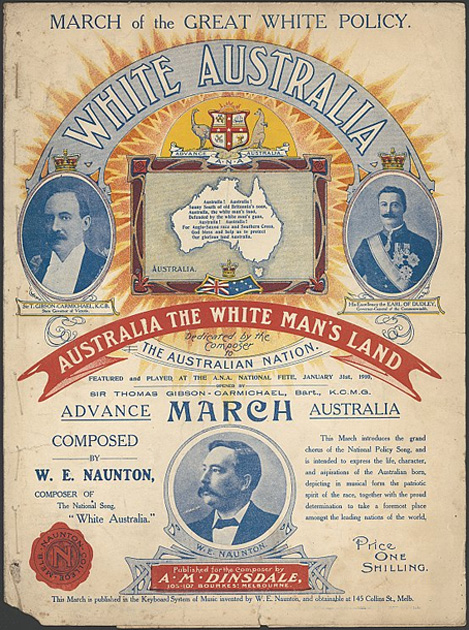
|
�Australia, the White Man�s Land,� was a piece of music |
|
published and first performed in 1910. It included such words |
|
as: |
|
Sunny south of Old Britannia�s sons, |
|
Australia the white man�s land, |
|
defended by the white man�s guns. |
|
God bless and help us to protect our glorious land |
|
Australia. |
|
https://www.amren.com/wp-content/uploads/2013/02/WhiteAustralia.jpg |
|
In 1919, Australian Prime Minister Billy Hughes attended the |
|
Paris Peace Conference. During the negotiations to draft the |
|
covenant of the League of Nations, Japanese proposed a |
|
declaration of racial equality. Hughes successfully led the |
|
opposition to what he saw as an assault on the White Australian |
|
Policy. |
|
... |
|
Mr. James is proud of his British heritage, just like the |
|
Australian majority. He sees �ethnic diversification� as an open |
|
assault not just on white Australia but British Australia. |
|
Unlike the United States, Australia did not have to fight for |
|
independence and for generations maintained ties to Britain that |
|
verged on veneration. When the British general, Charles |
|
�Chinese� Gordon was killed in Khartoum in 1885, a British |
|
expeditionary force was formed to avenge him. No fewer than 770 |
|
volunteers sailed from Sydney to join it, and two-thirds of the |
|
city�s population is said to have seen them off. Sixteen |
|
thousand Australian volunteers fought for the British in the |
|
Boer War and other wars in Southern Africa. Australian |
|
volunteers wanted to help put down the Boxer Rebellion but |
|
arrived too late to take part. An astonishing 60,000 men � all |
|
volunteers � died for Britain in the First World War. Mr. James |
|
sees these sacrifices as entirely natural for men who believed |
|
they were fighting for their kinfolk and for the empire. |
|
... |
|
Mr. James looks back with nostalgia on Anglo-Australia. He notes |
|
that until the 1970s, school children in the state of Victoria |
|
saluted the Australian flag every day, and listened to �God Save |
|
the Queen.� Until the 1960s, cinema played �God Save the Queen� |
|
before the movie � and everyone rose. The queen�s portrait was |
|
in government buildings, scouting halls, schools, and council |
|
chambers, but these began to disappear in the 1970s.[/quote] |
|
#Post#: 17758-------------------------------------------------- |
|
Re: Has Australia Reconciled With Its Colonial Past? |
|
By: antihellenistic Date: February 1, 2023, 6:44 pm |
|
--------------------------------------------------------- |
|
"Australia" were guilty to the Nusantarans for their assistance |
|
to the Netherlands on keeping them in power to enforce their |
|
colonialism. |
|
[quote]The Dutch surrendered to the Japanese on 8 March 1942. |
|
(Minute 01.34) |
|
... |
|
However, a number of key personnel in the Dutch East Indies |
|
government as well as some aircraft and crew managed to escape |
|
to Australia to establish an interim administration. (Minute |
|
01.39) |
|
... |
|
The Australian government had offered to help with reorganising |
|
and re-equipping surviving forces and gave assistance. (01.51) |
|
... |
|
Dutch refugees and material assets including aircraft and |
|
merchant shipping were initially concentrated in Sydney, (Minute |
|
02.02) |
|
... |
|
On 7 March 1942, just prior to the fall of Java to the Japanese, |
|
the Lieutenant-Governor general of the Dutch East Indies Herbert |
|
van Mook and 14 officials flew to Australia to establish an |
|
administration to continue the struggle. (Minute 07.29) |
|
... |
|
The Dutch East Indies Government-in-Exile undertook important |
|
work. It negotiated the acquisition of civil relief supplies |
|
with the Australian Government and the United Nations Relief and |
|
Rehabilitation Administration. (Minute 07.57) |
|
... |
|
It sought Commonwealth permission for the basing in Australia of |
|
a 30,000-strong liberation army being raised in the Netherlands |
|
(Minute 08.04)[/quote] |
|
https://www.youtube.com/watch?v=Qgn43EILwZU |
|
Never Forgive Never Forget. Retribution, not Progress |
|
#Post#: 22788-------------------------------------------------- |
|
Re: Has Australia Reconciled With Its Colonial Past? |
|
By: colonial Date: October 14, 2023, 9:11 pm |
|
--------------------------------------------------------- |
|
https://www.france24.com/en/asia-pacific/20231014-australians-vote-to-reject-co… |
|
It's OK for voting to be white |
|
Australians vote to reject constitutional �Voice� for Indigenous |
|
people |
|
[quote] |
|
Australians have roundly rejected greater rights for Indigenous |
|
citizens, scuppering plans to amend the country's 122-year-old |
|
constitution after a divisive and racially-tinged referendum |
|
campaign. |
|
The reforms would also have created a consultative body -- a |
|
"Voice" to Parliament -- to weigh in on laws that affect |
|
Indigenous communities and help address profound social and |
|
economic inequality. |
|
Despite support from the country's centre-left government, the |
|
"yes" campaign had trailed in opinion polls for months, and a |
|
defeat was widely expected. |
|
Despite pre-referendum polls pointing to a defeat, Indigenous |
|
Australians expressed anger and anguish that the white majority |
|
had rejected calls for a reckoning with the country's bloody |
|
colonial past. |
|
"This is a difficult result, this is a very hard result," said |
|
Yes23 campaign director Dean Parkin. |
|
"We did everything we could and we will come back from this," he |
|
said. |
|
More than 230 years since the first British penal ships anchored |
|
in Sydney, Prime Minister Anthony Albanese proposed the reforms |
|
as a step towards racial reconciliation. |
|
But instead, it has sparked a deeply rancorous and |
|
racially-tinged debate that exposed a gulf between First Nations |
|
people and the white majority. |
|
Polls have consistently shown that voters -- most of whom are |
|
white -- rank Indigenous issues far down their list of political |
|
priorities. |
|
[/quote] |
|
Whites are genetically programmed to suppress and silence the |
|
voice of non-whites |
|
***************************************************** |
|
Next Page |