|
Return Create A Forum - Home |
 |
--------------------------------------------------------- |
|
True Left |
 |
https://trueleft.createaforum.com |
|
--------------------------------------------------------- |
|
***************************************************** |
|
Return to: Ancient World |
|
***************************************************** |
|
#Post#: 18879-------------------------------------------------- |
|
Buddhism |
|
By: SirGalahad Date: April 15, 2023, 12:04 am |
|
--------------------------------------------------------- |
|
I saw someone quote this section of the Lotus Sutra, and it |
|
immediately didn�t sit right with me: |
|
�After the buddhas attained parinirvāṇa, |
|
All those who paid homage to the relics, |
|
Who made myriads of koṭis of stupas |
|
Extensively and beautifully adorned with gold, silver, Crystal, |
|
mother of pearl, agate, ruby, |
|
Lapis lazuli, and pearl; |
|
Those who made rock stupas, |
|
Stupas out of sandal, aloe, deodar, and other woods, As well as |
|
brick, tile, mud, and other materials; |
|
All those who made buddha stupas |
|
Out of piles of earth in desolate places; |
|
And even children in play |
|
Who made buddha stupas out of heaps of sand� |
|
All such people have certainly attained |
|
The path of the buddhas. |
|
And all those who made images of the buddhas |
|
Carved with their extraordinary marks |
|
Have certainly attained the path of the buddhas. |
|
All those who made buddha images |
|
Out of the seven treasures, |
|
Decorated with brass, copper, pewter, lead, |
|
Tin, iron, wood, mud, glue, lacquer, and cloth, |
|
Have certainly attained the path of the buddhas. |
|
All those who made or had others make buddha images Painted with |
|
the one hundred embellishing |
|
Marks of merit, |
|
Have certainly attained the path of the buddhas. This even |
|
includes children in play |
|
Who have drawn a buddha image |
|
With a blade of grass or a twig, |
|
Brush or fingernail. |
|
Such people, having gradually accumulated merit |
|
And perfected great compassion, |
|
Have certainly attained the path of the buddhas. |
|
Leading and inspiring the bodhisattvas, |
|
They save countless sentient beings. |
|
All those who paid homage to stupas, |
|
Sculpted or painted images, |
|
Honoring them with flowers, perfumes, |
|
Banners, and canopies; |
|
Those who paid homage with all kinds of sweet music� With drums, |
|
horns, conches, pipes, flutes, lutes, harps, Mandolins, gongs, |
|
and cymbals; |
|
Those who joyfully praised the qualities of the buddhas With |
|
various songs or |
|
Even with a single low-pitched sound, |
|
Have certainly attained the path of the buddhas. |
|
Those who, even with distracted minds |
|
Have offered a single flower to a painted image |
|
Will in time see innumerable buddhas. |
|
Or those who have done obeisance to images, |
|
Or merely pressed their palms together, |
|
Or raised a single hand, or nodded their heads, |
|
Will in due time see immeasurable buddhas. |
|
They will attain the highest path |
|
And extensively save innumerable sentient beings. |
|
They will enter nirvana without residue |
|
Just as a fire goes out after its wood is exhausted. |
|
Those who, even with distracted minds, |
|
Entered a stupa compound |
|
And chanted but once, �Homage to the Buddha!� |
|
Have certainly attained the path of the buddhas.� |
|
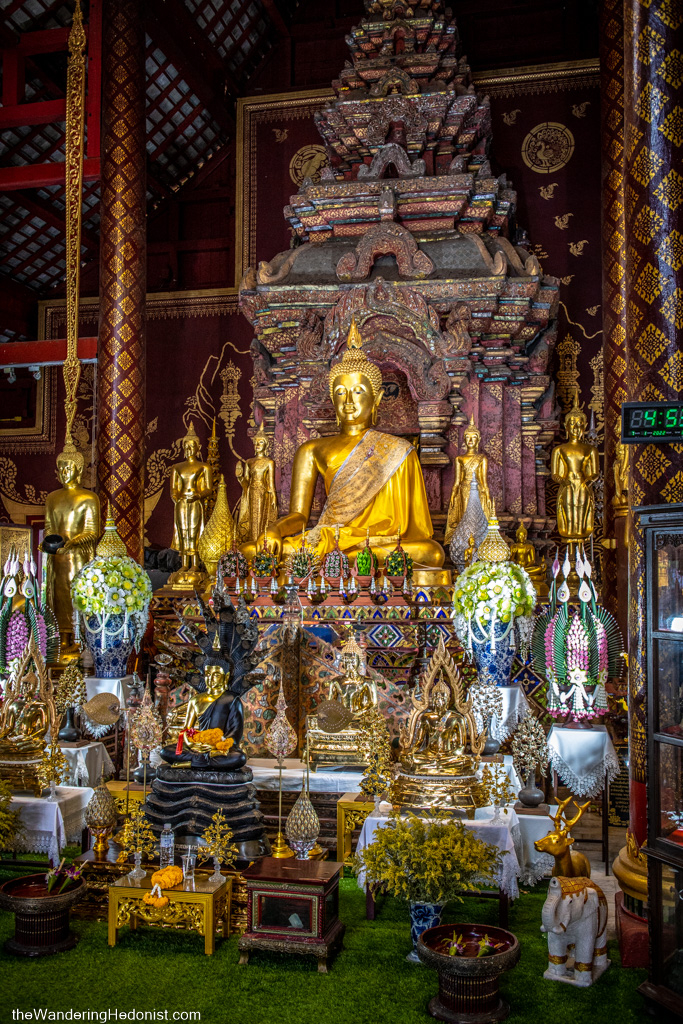
I dislike how so many historical and recently constructed |
|
Buddhist temples are lavishly decorated in gold and other |
|
priceless materials. That seems to fly completely against the |
|
strict anti-materialism that the Buddha espoused. Much in the |
|
same way that Homo Hubris Christians respect their |
|
anti-materialist and anti-wealth prophet by creating gaudy |
|
churches that ultimately serve as monuments to both materialism |
|
AND accumulated wealth in the form of architecture. Could you |
|
imagine the Buddha sitting in any one of these temples?: |
|
https://www.thewanderinghedonist.com/wp-content/uploads/2022/02/IMG_7335.jpg |
|
[img] |
|
https://media.istockphoto.com/id/1255625182/photo/lavish-gold-buddha-temple-in-… |
|
https://openbuddhism.org/wp-content/uploads/2019/07/shutterstock_1230439834-114… |
|
And I won�t even get into the, pardon my language, atrociously |
|
ugly art that a lot of these temples have. The space-filling art |
|
in some of these temples impressively rival many similar white |
|
western monuments. My other issue with this section of the Lotus |
|
Sutra, is that it exalts not just creating such lavishly adorned |
|
monuments, but also paying obeisance to monuments, statues, and |
|
Buddha images, and claims that these actions can accumulate |
|
merit for a person. As opposed to actually doing the work that�s |
|
involved in following the Buddha�s example and taking the path |
|
that he took |
|
TLDR: This is likely what happens when people with incompatible |
|
blood memory convert to Buddhism |
|
#Post#: 18896-------------------------------------------------- |
|
Re: Buddhism |
|
By: 90sRetroFan Date: April 16, 2023, 12:15 am |
|
--------------------------------------------------------- |
|
"I dislike how so many historical and recently constructed |
|
Buddhist temples are lavishly decorated in gold and other |
|
priceless materials. That seems to fly completely against the |
|
strict anti-materialism that the Buddha espoused." |
|
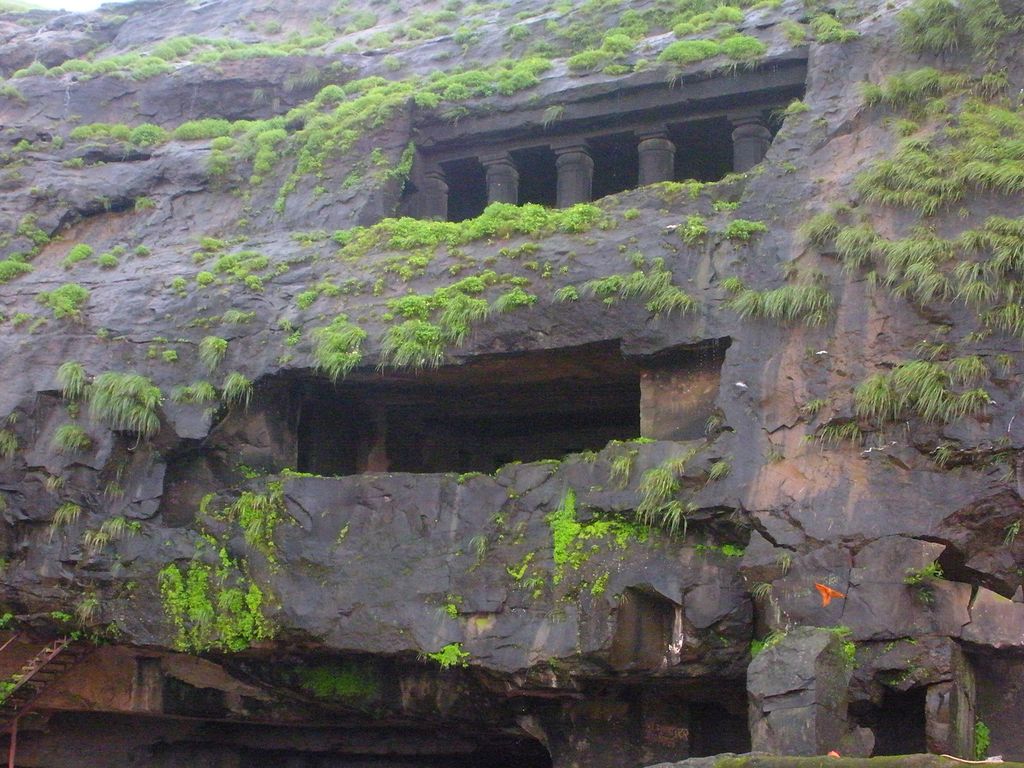
Contrast with early Buddhist architecture: |
|
https://en.wikipedia.org/wiki/Vih%C4%81ra |
|
[quote]Vihāra generally refers to a Buddhist monastery for |
|
Buddhist renunciates, mostly in the Indian subcontinent. The |
|
concept is ancient and in early Sanskrit and Pali texts, it |
|
meant any arrangement of space or facilities for dwellings |
|
.[2][3] The term evolved into an architectural concept wherein |
|
it refers to living quarters for monks with an open shared space |
|
or courtyard, particularly in Buddhism. |
|
... |
|
Vihara or vihara hall has a more specific meaning in the |
|
architecture of India, especially ancient Indian rock-cut |
|
architecture. Here it means a central hall, with small cells |
|
connected to it, sometimes with beds carved from the stone. Some |
|
have a shrine cell set back at the centre of the back wall, |
|
containing a stupa in early examples, or a Buddha statue |
|
later.[/quote] |
|
I posted some photos here: |
|
https://trueleft.createaforum.com/issues/indian-attitudes/msg17802/#msg17802 |
|
Here are a few more: |
|
https://upload.wikimedia.org/wikipedia/commons/thumb/6/64/KarlaCavesExtView.jpg… |
|
https://upload.wikimedia.org/wikipedia/commons/thumb/1/1a/045_Vihara_Cave_on_Se… |
|
https://upload.wikimedia.org/wikipedia/commons/thumb/c/c5/Ellora_Caves%2C_India… |
|
https://upload.wikimedia.org/wikipedia/commons/d/db/Barabar_caves_Sudama_inside… |
|
https://upload.wikimedia.org/wikipedia/commons/thumb/2/2c/038_Cave_10%2C_Interi… |
|
https://upload.wikimedia.org/wikipedia/commons/thumb/0/00/028_Inside_one_of_the… |
|
https://upload.wikimedia.org/wikipedia/commons/thumb/6/69/034_Small_Chaitya_%28… |
|
https://upload.wikimedia.org/wikipedia/commons/2/27/Kanheri6.jpg |
|
https://upload.wikimedia.org/wikipedia/commons/5/59/Kanheri-vihara.jpg |
|
[img] |
|
https://upload.wikimedia.org/wikipedia/commons/thumb/e/e2/Kanheri_Caves_-_Hall.… |
|
At least there were some later attempts to re-simplify: |
|
https://en.wikipedia.org/wiki/Baizhang_Huaihai#Monasticism |
|
[quote]According to traditional Chan/Zen accounts, Baizhang |
|
established an early set of rules for Chan (Chinese Zen) |
|
monastic discipline, the Pure Rules of Baizhang (Chinese: |
|
百丈清規; pinyin: Bǎizh�ng |
|
qīngguī; Wade�Giles: Pai-chang |
|
ch'ing-kuei,[10][11][12]Korean: |
|
백장청규[13]) It was practiced in |
|
Ta-chih shou-sheng ch'an-ssu (Jp. Daichijusho-zenji), founded by |
|
Baizhang. This monastery contained a monks hall, an innovation |
|
which became typical for Ch�n: |
|
During periods of ascetic practice the monks would sleep on the |
|
same straw mat on which they sat in meditation and on which, |
|
according to defined ritual, they took their meals. Both the |
|
lifestyle Pai-chang spelled out as well as the architectural |
|
form of his monastery became models for later Zen |
|
monasteries".[14][/quote] |
|
Modern example: |
|
https://commons.wikimedia.org/wiki/Category:Nung_Chan_Monastery<br |
|
/>(many photos) |
|
"paying obeisance to monuments, statues, and Buddha images, and |
|
claims that these actions can accumulate merit for a person." |
|
The original point of obeisance is to remind yourself how badly |
|
you suck compared to how you should be. This in itself is |
|
actually a good thing to remind yourself about. Where it got |
|
corrupted is when people started doing it with expectation of |
|
reward in mind. If you sincerely believe you suck, you should |
|
think that you do not deserve to be rewarded! |
|
"As opposed to actually doing the work that�s involved in |
|
following the Buddha�s example and taking the path that he took" |
|
Done properly (7:32, 7:47), obeisance is a demanding ascetic |
|
exercise which can certainly be considered a reiteration of one |
|
part of Siddhartha's path. The following scene (unfortunately |
|
the audio is muted towards the end) from Journey to the West |
|
(note also the relatively undecorated shrine composition at 1:20 |
|
and 10:40; the story is set loosely during the Tang dynasty, |
|
which was Baizhang's era) provides a classic demonstration: |
|
https://www.youtube.com/watch?v=vUfEeDyZti0 |
|
#Post#: 22330-------------------------------------------------- |
|
Re: Buddhism |
|
By: rp Date: September 23, 2023, 6:33 pm |
|
--------------------------------------------------------- |
|
https://x.com/dharma__vijay/status/1692944303704649840?s=20 |
|
[quote] |
|
Vijay |
|
@dharma__vijay |
|
1. Buddhism becoming indistinguishable from Vedic Hinduism. With |
|
Mahayana and Tantrayana, Buddhism became filled with deities, |
|
yajna and rituals. |
|
2. Decadence in the monastic order. Every lazy bum ended up as a |
|
monk to enjoy 2 free sumptuous meals a day. Collapse from |
|
within. |
|
3. |
|
https://twitter.com/MonaADhar/status/1692625765492199477 |
|
[quote]What do you think is the reason of decline of Buddhism in |
|
India ?? |
|
[/quote] |
|
[/quote] |
|
#Post#: 22489-------------------------------------------------- |
|
Re: Buddhism |
|
By: rp Date: September 30, 2023, 6:11 pm |
|
--------------------------------------------------------- |
|
During the inception of the Republic (of India), there was an |
|
attempt by pacifists to appropriate Ashoka as a "pacifist" |
|
(hence the Ashoka Chakra on the flag). However, now that the |
|
facts are coming out: |
|
https://twitter.com/prachyam7/status/1633818063635087361 |
|
[quote] |
|
Prachyam |
|
@prachyam7 |
|
The 'Not So Great' Ashoka! 💔 |
|
The entire 'conversion-to-Buddhism-due-to-remorse' story of |
|
Ashoka is a blatant lie, created to send Hindus on a guilt trip |
|
👇👇 |
|
[/quote] |
|
Replies: |
|
https://x.com/prachyam7/status/1633818063635087361?s=20 |
|
[quote]So now the Ashoka was cruel just because he patronised |
|
Buddhism and waged wars. LOL. By that yardstick every ruler of |
|
of India was a cruel person. |
|
RWs!!! Don't make a fool out of yourself.🤣[/quote] |
|
#Post#: 22498-------------------------------------------------- |
|
Re: Buddhism |
|
By: 90sRetroFan Date: September 30, 2023, 8:39 pm |
|
--------------------------------------------------------- |
|
[quote]Ashoka had converted to Buddhism more than two years |
|
before the Kalinga War.[/quote] |
|
I told you so. Now let the entire nominally Buddhist world |
|
contemplate that if not for Ashoka's willingness to use war to |
|
expand his empire, Buddhism would never have reached the rest of |
|
the world: |
|
https://slideplayer.com/slide/13687702/84/images/6/Ashoka+helped+to+spread+Budd… |
|
https://live.staticflickr.com/8390/8570400564_e4dc131da1_c.jpg |
|
and indeed might even have died out altogether following its |
|
decline within India. |
|
Can any historical pacifist claim to be anywhere near as |
|
successful a promoter of Buddhism as Ashoka was? Thus the |
|
correct Buddhist attitude to politics is not pacifism, but |
|
Ashokism. This approach was always present in authentic Buddhism |
|
(which the pacifist nominal "Buddhists" somehow manage to |
|
ignore): |
|
https://en.wikipedia.org/wiki/Vajrapani |
|
[quote]Vajrapāṇi (Sanskrit; Pali: |
|
Vajirapāṇi, meaning, "Vajra in [his] hand") is one of |
|
the earliest-appearing bodhisattvas in Mahayana Buddhism. He is |
|
the protector and guide of Gautama Buddha and rose to symbolize |
|
the Buddha's power. |
|
... |
|
Acharya-Vajrapani is Vajrapani's manifestation as Dharmapala, |
|
often seen sporting a third eye, ghanta (bell) and |
|
pāśa (lasso). He is sometimes represented as a yidam |
|
with one head and four hands in a form known as |
|
Nilambara-Vajrapani, carrying a vajra, and treading on personage |
|
lying on snakes. Mahacakra-Vajrapani, also a yidam, is depicted |
|
with three heads and six arms, carrying a vajra and snakes |
|
whilst treading on Brahma and Shiva. |
|
... |
|
Vajrapāni's expression is wrathful, and is often symbolized |
|
as a yaksha, to generate "fear in the individual to loosen up |
|
his dogmatism."[6] |
|
... |
|
Vajrapani always present in the scenes where Buddha is |
|
converting people; his presence is shown when the Buddha |
|
confronts the opponents of the dharma like Mara before his |
|
enlightenment. Scenes of Sakyamuni competing with the heretics |
|
are also part of this art tradition. Scenes of Buddha using the |
|
vajra of Vajrapani as the "magic weapon" to perform miracles and |
|
propagate "superiority of his doctrine" are also common.[17] |
|
... |
|
The Pāli Canon's Ambattha Sutta, which challenges the rigid |
|
nature of caste system, tells of one instance of him appearing |
|
as a sign of the Buddha's power. At the behest of his teacher, a |
|
young Brahmin named Ambatha visited the Buddha. Knowing the |
|
Buddha's family to be the Shakya clan, who are Kshatriya caste, |
|
Ambatha failed to show him the respect he would a fellow |
|
Brahmin. When the Buddha questioned his lack of respect, Ambatha |
|
replied it was because the Buddha belongs to a "menial" caste. |
|
The Buddha then asked the Brahmin if his family was descended |
|
from a �Shakya slave girl�. Knowing this to be true, Ambatha |
|
refused to answer the question. Upon refusing to answer the |
|
question for a second time, the Buddha warned him that his head |
|
would be smashed to bits if he failed to do so a third time. |
|
Ambatha was frightened when he saw Vajrapāni manifest above |
|
the Buddha's head ready to strike the Brahmin down with his |
|
thunderbolt. He quickly confirmed the truth and a lesson on |
|
caste ensues.[25] |
|
... |
|
A popular story tells how Vajrapāni kills Maheśvara, a |
|
manifestation of Shiva depicted as an evil being.[26][6] The |
|
story occurs in several scriptures, most notably the |
|
Sarvatathāgatatattvasaṅgraha and the |
|
Vajrāpanyābhiṣeka Mahātantra.[27] The story |
|
begins with the transformation of the bodhisattva Samantabhadra |
|
into Vajrapāni by Vairocana, the cosmic Buddha, receiving a |
|
vajra and the name "Vajrāpani".[28] Vairocana then requests |
|
Vajrapāni to generate his adamantine family in order to |
|
establish a mandala. Vajrapāni refuses because |
|
Maheśvara "is deluding beings with his deceitful religious |
|
doctrines and engaging in all kinds of violent criminal |
|
conduct".[29] Maheśvara and his entourage are dragged to |
|
Mount Meru, and all but Maheśvara submit. Vajrapāni |
|
and Maheśvara engage in a magical combat, which is won by |
|
Vajrapāni. Maheśvara's retinue become part of |
|
Vairocana's mandala, except for Maheśvara, who is killed |
|
... |
|
"To those who can be conveyed to deliverance by the body of the |
|
spirit who grasps the vajra (Vajrapāni) he preaches Dharma |
|
by displaying the body of the spirit who grasps the vajra."[37] |
|
He was historically worshiped as the progenitor of their famous |
|
staff method by the monks themselves. A stele erected by Shaolin |
|
abbot Wenzai in 1517 shows the deity's vajra-club had by then |
|
been changed to a gun staff,[38] which originally "served as the |
|
emblem of the monk".[39] Vajrapāni's yaksha-like Narayana |
|
form was eventually equated with one of the four staff-wielding |
|
"Kinnara Kings" from the Lotus Sutra in 1575. His name was thus |
|
changed from Narayana to "Kinnara King".[40] One of the many |
|
versions of a certain tale regarding his creation of the staff |
|
method takes place during the Yuan-era Red Turban Rebellion. |
|
Bandits lay siege to the monastery, but it is saved by a lowly |
|
kitchen worker wielding a long fire poker as a makeshift staff. |
|
He leaps into the oven and emerges as a monstrous giant big |
|
enough to stand astride both Mount Song and the imperial fort |
|
atop Mount Shaoshi (which are five miles apart). The bandits |
|
flee when they behold this staff-wielding titan. The Shaolin |
|
monks later realize that the kitchen worker was none other than |
|
the Kinnara King in disguise.[41] Shahar notes the part of the |
|
kitchen worker might have been based on the actual life of the |
|
monk Huineng (638-713).[41] In addition, he suggests the |
|
mythical elements of the tale were based on the fictional |
|
adventures of Sun Wukong from the Chinese epic Journey to the |
|
West. He compares the worker's transformation in the stove with |
|
Sun's time in Laozi's crucible, their use of the staff, and the |
|
fact that Sun and his weapon can both grow to gigantic |
|
proportions.[42][/quote] |
|
See also: |
|
https://trueleft.createaforum.com/true-left-vs-false-left/true-left-breakthroug… |
|
https://trueleft.createaforum.com/counterculture-era/the-archetype-of-the-warri… |
|
#Post#: 22506-------------------------------------------------- |
|
Re: Buddhism |
|
By: rp Date: October 1, 2023, 7:32 am |
|
--------------------------------------------------------- |
|
https://en.m.wikipedia.org/wiki/Ashoka#Kalinga_war_and_conversion_to_Buddhism |
|
[Quote] |
|
Ashoka's inscriptions mention that he conquered the Kalinga |
|
region during his 8th regnal year: the destruction caused during |
|
the war made him repent violence, and in the subsequent years, |
|
he was drawn towards Buddhism.[89] Edict 13 of the Edicts of |
|
Ashoka Rock Inscriptions expresses the great remorse the king |
|
felt after observing the destruction of Kalinga: |
|
Directly, after the Kalingas had been annexed, began His Sacred |
|
Majesty's zealous protection of the Law of Piety, his love of |
|
that Law, and his inculcation of that Law. Thence arises the |
|
remorse of His Sacred Majesty for having conquered the Kalingas |
|
because the conquest of a country previously unconquered |
|
involves the slaughter, death, and carrying away captive of the |
|
people. That is a matter of profound sorrow and regret to His |
|
Sacred Majesty.[90] |
|
On the other hand, the Sri Lankan tradition suggests that Ashoka |
|
was already a devoted Buddhist by his 8th regnal year, converted |
|
to Buddhism during his 4th regnal year, and constructed 84,000 |
|
viharas during his 5th�7th regnal years.[89] The Buddhist |
|
legends make no mention of the Kalinga campaign.[91] |
|
Based on Sri Lankan tradition, some scholars, such as Eggermont, |
|
believe Ashoka converted to Buddhism before the Kalinga war.[92] |
|
Critics of this theory argue that if Ashoka were already a |
|
Buddhist, he would not have waged the violent Kalinga War. |
|
Eggermont explains this anomaly by theorising that Ashoka had |
|
his own interpretation of the "Middle Way".[93] |
|
Some earlier writers believed that Ashoka dramatically converted |
|
to Buddhism after seeing the suffering caused by the war since |
|
his Major Rock Edict 13 states that he became closer to the |
|
dhamma after the annexation of Kalinga.[91] However, even if |
|
Ashoka converted to Buddhism after the war, epigraphic evidence |
|
suggests that his conversion was a gradual process rather than a |
|
dramatic event.[91] For example, in a Minor Rock Edict issued |
|
during his 13th regnal year (five years after the Kalinga |
|
campaign), he states that he had been an upasaka (lay Buddhist) |
|
for more than two and a half years, but did not make much |
|
progress; in the past year, he was drawn closer to the sangha |
|
and became a more ardent follower.[91 |
|
[/Quote] |
|
https://en.m.wikipedia.org/wiki/Middle_Way |
|
#Post#: 22515-------------------------------------------------- |
|
Re: Buddhism |
|
By: 90sRetroFan Date: October 1, 2023, 2:40 pm |
|
--------------------------------------------------------- |
|
[quote]Eggermont explains this anomaly by theorising that Ashoka |
|
had his own interpretation of the "Middle Way".[93][/quote] |
|
Even the standard interpretation of the Middle Way: |
|
[quote]the Middle Way which steers clear of the extremes of |
|
sensual indulgence and self-mortification:[3][/quote] |
|
would only classify as indulgence positively relishing war (e.g. |
|
as Achilleans/Faustians/Nietzscheans do, seeing in war the |
|
opportunity for glory/conquest/overcoming) instead of preferring |
|
the enemy to never have existed in the first place. If anything, |
|
to not wage war despite the enemy existing would be classified |
|
as self-mortification. |
|
#Post#: 22521-------------------------------------------------- |
|
Re: Buddhism |
|
By: rp Date: October 1, 2023, 4:21 pm |
|
--------------------------------------------------------- |
|
That is the difference between Arihant/foe-destroyer and |
|
ubermensch/overman |
|
#Post#: 22842-------------------------------------------------- |
|
Re: Buddhism |
|
By: rp Date: October 16, 2023, 8:50 pm |
|
--------------------------------------------------------- |
|
I have noticed that there are mainly three different schools of |
|
thought with regard to meat-eating/animal sacrifices: |
|
Jainism - Anti animal sacrifice and anti meat eating |
|
Hinduism - Pro animal sacrifice but anti-meat eating |
|
Buddhism - Anti animal sacrifice but pro meat eating |
|
This is not to say that the second and third schools of thought |
|
cannot be purified. For example, we have established that Buddha |
|
only ate meat that was not made for him. Similarly, in Hinduism, |
|
while animal sacrifice is sanctioned according to the |
|
scriptures, renunciates/monks (who are forbidden to even pluck |
|
the fruit of trees, let alone perform animal sacrifice), are |
|
held as the ideal and being superior to the one who sacrifices |
|
animals. |
|
#Post#: 22848-------------------------------------------------- |
|
Re: Buddhism |
|
By: 90sRetroFan Date: October 16, 2023, 9:04 pm |
|
--------------------------------------------------------- |
|
Calling Buddhism "pro meat eating" is a terrible wording. That |
|
makes it sound like meat was positively recommended! |
|
"Buddha only ate meat that was not made for him." |
|
Be logical! If everyone would only eat meat not made for |
|
themselves, would any meat be made in the first place? |
|
***************************************************** |
|
Next Page |