|
Return Create A Forum - Home |
 |
--------------------------------------------------------- |
|
True Left |
 |
https://trueleft.createaforum.com |
|
--------------------------------------------------------- |
|
***************************************************** |
|
Return to: Mythical World |
|
***************************************************** |
|
#Post#: 1187-------------------------------------------------- |
|
Uneducable Gentiles |
|
By: 90sRetroFan Date: September 16, 2020, 5:38 am |
|
--------------------------------------------------------- |
|
OLD CONTENT |
|
sciencenordic.com/first-stone-age-farmers-norway-gave-after-shor |
|
t-period-time |
|
[quote]the first farmers in Norway appear to have given up |
|
relatively early. They stopped growing crops after a relatively |
|
short period of time and returned to hunter-gatherer-fisher |
|
lifestyle. |
|
... |
|
However, settlements in the coastal areas grew and were strongly |
|
linked to the sea, where food was plentiful. |
|
Characteristic ceramic objects tell the story of a maritime |
|
culture. |
|
Nielsen says the arguments have gone back and forth as to why |
|
people returned to a fishing culture or gave up farming. Some |
|
think its an obvious way to live, given the country's huge |
|
coastal resources. On the other hand, why would the people who |
|
introduced agriculture end it?[/quote] |
|
Because it wasn't us; it was those whom we tried to teach - |
|
without success. |
|
--- |
|
www.thevintagenews.com/2019/06/27/neolithic-city-overcrowded/ |
|
[quote]Archaeologists recently discovered that the transition |
|
from foraging to a communal farming lifestyle caused problems |
|
for people who lived at a 32-acre site in southern Turkey that |
|
was occupied from 7100 B.C. to 5950 B.C. �atalh�y�k was home to |
|
as many as 8,000 people at its peak. |
|
... |
|
�The scientists found that the number of injuries, evident in |
|
skeletons, increased when the community was at its largest, |
|
suggesting that as �atalh�y�k�s population boomed, violence |
|
became more frequent,� said Live Science. �About 25 percent of |
|
the 95 examined skulls showed healed injuries made by small |
|
spherical projectiles, probably a clay ball flung by a |
|
slingshot. Many of these clay spheres were also preserved around |
|
the site, according to the study.�[/quote] |
|
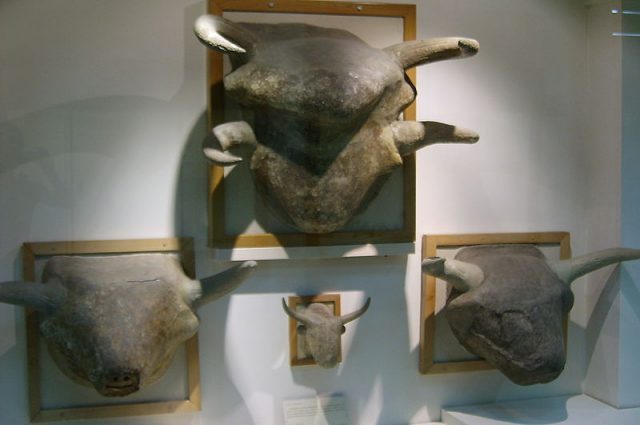
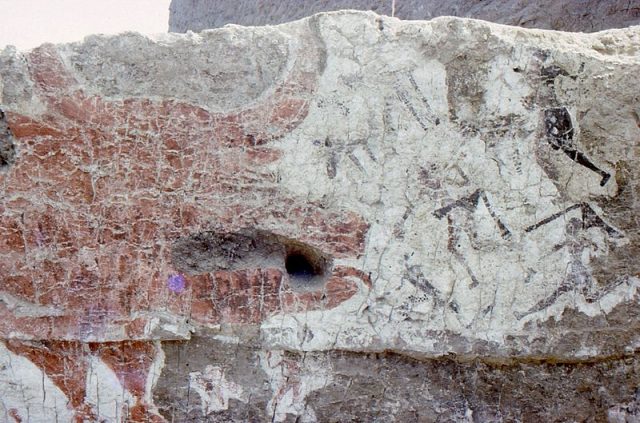
But were these Aryans? No: |
|
[quote] |
|
https://www.thevintagenews.com/wp-content/uploads/2019/06/800px-catal_huyuk_bul… |
|
Bull (Auroch) heads from Catalh�y�k in Angora Museum. Photo by |
|
Stipich B�la CC BY 2.5 |
|
https://www.thevintagenews.com/wp-content/uploads/2019/06/mural_from_catalhoyuk… |
|
Neolithic hunters attacking an auroch, Museum of Anatolian |
|
Civilizations. Photo by Omar Hoftun CC BY-SA 3.0[/quote] |
|
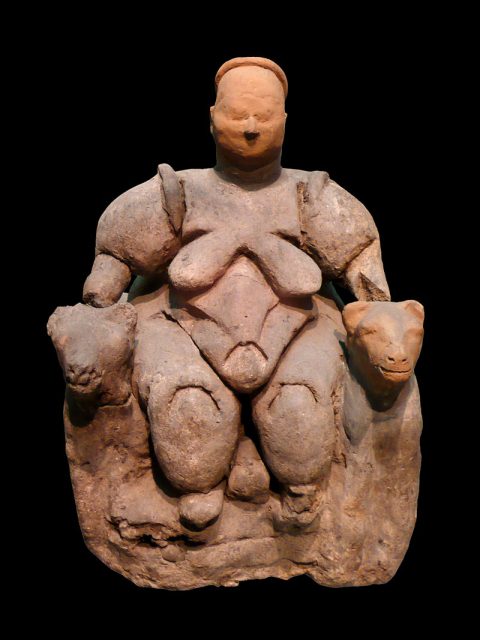
Besides the absence of respect towards cows (a distinguishing |
|
Aryan characteristic) another dead giveaway is their worship of |
|
high sexual dimorphism: |
|
[quote] |
|
https://www.thevintagenews.com/wp-content/uploads/2019/06/museum_of_anatolian_c… |
|
Mother Goddess from �atalh�y�k flanked by two feline lionesses, |
|
neolithic age (about 5500-6000 BC), today in Museum of Anatolian |
|
Civilizations in Ankara. Photo by Nevit Dilmen CC BY-SA |
|
3.0[/quote] |
|
These were the Gentiles we tried and failed to teach. |
|
--- |
|
I told you so: |
|
www.genomeweb.com/genetic-research/anatolian-hunter-gatherers-ad |
|
opted-farming-practices-ancient-dna-study-suggests |
|
[quote]An international team of researchers has generated |
|
genome-wide SNP data on eight prehistoric individuals, including |
|
an Epipaleolithic Anatolian hunter-gatherer, five early |
|
Neolithic Aceramic Anatolian farmers, and two early Neolithic |
|
farmers from the Levant. As they reported in Nature |
|
Communications today, the researchers found that the Neolithic |
|
Anatolians derived a large portion of their ancestry from the |
|
Epipaleolithic Anatolian, indicating genetic continuity in the |
|
region. |
|
... |
|
When they modeled the Neolithic Aceramic Anatolian farmers' |
|
ancestry, they noted the best fit suggested that Anatolian |
|
hunter-gatherers provided the most � about 90 percent � of their |
|
ancestry. This, the researchers added, indicates there was |
|
long-term genetic stability in central Anatolia, even as the |
|
subsistence strategy changed. |
|
The later Neolithic Ceramic Anatolian farmers, though, shared |
|
more alleles with the early Holocene Levantines than the |
|
Neolithic Aceramic Anatolian farmers did. Still, the researchers |
|
noted that the Neolithic Aceramic Anatolian farmers contributed |
|
about three-quarters of the Neolithic Ceramic Anatolian farmers' |
|
ancestry.[/quote] |
|
~75% of ~90% is still at least ~68% Gentile. Hence the atrocious |
|
behaviour as mentioned in the previous post. |
|
--- |
|
This has been a growing enemy narrative recently: |
|
www.northcoastjournal.com/humboldt/our-worst-mistake-part-1/Cont |
|
ent?oid=13669919 |
|
www.northcoastjournal.com/humboldt/our-worst-mistake-part-2/Cont |
|
ent?oid=13801092 |
|
Discuss. I will respond later. |
|
--- |
|
The exaltation of the Paleolithic lifestyle by those such as |
|
Christopher Ryan (Gentile?) stems primarily from the fact that |
|
those societies were more allowing of sexual promiscuity among |
|
women. This caters to the PC, and hence False Left worldview |
|
that women have the "right" to be as equally promiscuous as men. |
|
Moreover, his criticism of Neolithic societies as being |
|
patriarchal is only applicable to Gentiles who adopted the |
|
practice of farming without changing their behavior, and is thus |
|
intellectually dishonest. This is no doubt designed to |
|
facilitate the backlash to patriarchy as manifest in the present |
|
day far-right movements. |
|
--- |
|
Yea that "patriarchy started in the Neolithic" bullshit got |
|
brought up in my history class a few weeks ago. As if the |
|
Hunter-Gatherer lifestyle doesn't REQUIRE gender-roles, and as |
|
if farming DOES... |
|
--- |
|
www.zmescience.com/science/gender-inequality-neolithic-emergence |
|
-22062019/ |
|
[quote]Archaeologists at the University of Seville in Spain have |
|
studied prehistoric societies in the Neolithic Period in the |
|
Iberian Peninsula from the perspective of gender. They looked at |
|
two types of evidence: biological and funerary. |
|
In the first category, the team focused on demographic |
|
proportions between men and women, as well as other clues such |
|
as diet, genetic data, and common diseases. For the funerary |
|
evidence, they analyzed how �important� a burial site was � |
|
whether it was an individual or collective burial, the position |
|
and orientation of the body, as well as any goods placed in the |
|
tomb. |
|
They found that at the start of the Neolithic, there was no |
|
significant difference between men and women in this regards, |
|
suggesting a generally equal society. However, as things |
|
progressed, it started to change. A key indicator is the growing |
|
association of men with violence. Male bodies started exhibiting |
|
more arrow wounds, their tombs featured more weapons or |
|
projectiles, and men were increasingly depicted in fighting |
|
scenes in cave paintings, whereas women were not. Hunting and |
|
warfare were a masculine business. Conversely, women�s� burial |
|
sites were more likely to contain ceramic pots, indicating a |
|
separation of gender roles. |
|
Interestingly, out of all the aspects considered in this study, |
|
the ones that show the greatest difference between males and |
|
females are related to violence: projectiles, trauma including |
|
impact by arrowheads, and graphic depictions of war and |
|
hunting.[/quote] |
|
The absence of patriarchy at the beginning of the Neolithic |
|
(a.k.a. Golden Age) fits our model of innately anti-sexist |
|
Aryans. The subsequent emergence of patriarchy could be |
|
accounted for, as rp suggests, as merely the behaviour of the |
|
Gentiles who had learned farming from us. This is reinforced by |
|
the cave paintings which clearly indicate that these people were |
|
hunting alongside farming, as we would expect Gentiles to do. |
|
Indeed we have noted in the past that Gentiles who learned |
|
farming usually left their women to do most of the actual farm |
|
work while their men hunted just as they always did. This would |
|
also mean that the selective pressure (for Aryan traits) exerted |
|
by farm work would have been mostly avoided by the Gentile men. |
|
This then ties back into the present-day observation that more |
|
men than women retain certain traits adaptive to hunting but |
|
maladaptive to farming: |
|
https://trueleft.createaforum.com/human-evolution/non-aryan-adhd/ |
|
(This is on top of the selective pressure (for other Aryan |
|
traits) exerted by diet being avoided by Gentiles of both |
|
genders (since the men would probably share their hunted meat |
|
with the women).) |
|
--- |
|
scifare.com/science-news/article/european-inequality-traced-back |
|
-to-the-neolithic-age/ |
|
[quote]After analyzing the teeth from more than 300 |
|
Neolithic-age skeletons, a team of researchers from across |
|
Europe have found links between access to prime farming lands � |
|
along with their fruits � and hereditary inequality. |
|
... |
|
The team found those people buried with a prestigious Neolithic |
|
tool, known as an adze, had substantially less variation in the |
|
ratio of the element strontium � it incorporates into the enamel |
|
of teeth, like calcium � compared to people buried without one. |
|
... |
|
They also found that those with higher than expected variation |
|
in strontium ratio levels, almost exclusively, were buried |
|
without an adze � of the 41 samples, only one was buried with |
|
the stone tool. |
|
�We think that�s because there�s a particular kind of soil type |
|
those farmers preferred, called loess soils,� Bentley said. |
|
For Neolithic farmers, it was land that drained water well, was |
|
easy to work and because loess soils are found primarily along |
|
the river valleys of central Europe, it was fertile land that |
|
was great for growing crops. |
|
Considering how varied strontium signatures can be, the |
|
incredibly narrow variation seen in skeletons with the Neolithic |
|
tool implies their diets were sourced, almost exclusively, from |
|
a narrow region that�s closely related to the loess soil |
|
regions. |
|
�Individuals who weren�t buried with adzes were probably farming |
|
further afield or obtained their food further away, from |
|
slightly less preferred soils,� Bentley said. �It�s a real hint |
|
at a system of inequality that surely got magnified over the |
|
generations.�[/quote] |
|
If you ask me what is going on here, the people buried with |
|
adzes were Aryans who loved farming, whereas the people buried |
|
without were Gentiles who had learned farming but who were not |
|
sentimentally dedicated to it and thus did not care for being |
|
buried with their adzes. |
|
We already know that the Aryans migrated following the rivers, |
|
so it is no surprise that they farmed on the valley land. On the |
|
other hand, the Gentiles on lower-quality land could still have |
|
produced enough food so long as they had been willing to keep |
|
their population down. But they were not: they were outnumbering |
|
the Aryans 41:1! So of course they didn't have enough food to go |
|
round! |
|
Moreover, what the data shows is that Aryans have less variation |
|
in strontium than farming Gentiles, in other words all Aryans |
|
had similarly high strontium whereas some farming Gentiles had |
|
high strontium and other farming Gentiles had low strontium. In |
|
other words Aryans were sharing food fairly, whereas it was the |
|
farming Gentiles who were not sharing food fairly. |
|
Now read carefully: |
|
[quote]The researchers also found a similar difference when they |
|
compared genders. Men, on average had substantially less |
|
variation in strontium ratios than women. They also found that |
|
approximately eight of every ten individuals with higher than |
|
expected ratios of strontium were female.[/quote] |
|
Did you catch it? In the second sentence the author is talking |
|
about variation in strontium ratios. In the third sentence, |
|
however, the author subtly switched to talking about the |
|
strontium ratios themselves! A less careful reader primed by the |
|
claim of a "similar difference" in the first sentence would |
|
easily misread that women had higher variation in strontium (ie. |
|
more women have low strontium), when in fact more women had high |
|
strontium! |
|
#Post#: 1188-------------------------------------------------- |
|
Re: Uneducable Gentiles |
|
By: 90sRetroFan Date: September 16, 2020, 6:23 am |
|
--------------------------------------------------------- |
|
https://www.scientificamerican.com/article/when-the-first-farmers-arrived-in-eu… |
|
[quote]Eight thousand years ago small bands of seminomadic |
|
hunter-gatherers were the only human beings roaming Europe's |
|
lush, green forests. Archaeological digs in caves and elsewhere |
|
have turned up evidence of their Mesolithic technology: |
|
flint-tipped tools with which they fished, hunted deer and |
|
aurochs (a now extinct species of ox), and gathered wild plants. |
|
Many had dark hair and blue eyes, recent genetic studies |
|
suggest, and the few skeletons unearthed so far indicate that |
|
they were quite tall and muscular. Their languages remain |
|
mysterious to this day. |
|
Three millennia later the forests they inhabited had given way |
|
to fields of wheat and lentils. Farmers ruled the |
|
continent.[/quote] |
|
Before we get back to the main topic, here is a sidetrack about |
|
something that is new to me: |
|
[quote]the LBK farmers reached the Rhine within just a few |
|
centuries, around 7,300 years ago. |
|
... |
|
On the southern route, the farmers leapfrogged along the |
|
Mediterranean coast from Italy to France and on to the Iberian |
|
Peninsula. After reaching French shores, 7,800 or so years ago, |
|
they migrated northward toward the Paris Basin, the plain |
|
between the Rhine and the Atlantic Ocean that forms a kind of |
|
continental cul-de-sac. It was there that the two great streams |
|
of farmers met, around seven millennia ago. By then their |
|
cultures had diverged to some extent�they had been separated for |
|
more than 500 years�but they would still have recognized their |
|
own kind. They mingled both biologically and culturally.[/quote] |
|
Aesir-Saturnian reunification! It must have been wonderful! Now |
|
back to the main topic: |
|
[quote]Sooner or later the immigrant farmers must have met the |
|
resident hunter-gatherers�and when it happened, it must have |
|
been a shock. Approximately 40,000 years had elapsed since their |
|
common ancestors split paths on their way out of Africa�long |
|
enough to distinguish them physically, culturally and |
|
linguistically. Comparisons of their genes with those of modern |
|
Europeans indicate that the farmers were shorter than the |
|
Western hunter-gatherers who occupied most of the continent. |
|
They also had dark hair, dark eyes and, probably, lighter skin. |
|
There is no evidence of violence between the two groups in the |
|
earliest encounters�although the archaeological record is |
|
incomplete enough that violence cannot be ruled out. Yet in |
|
large parts of Europe, the hunter-gatherers and their Mesolithic |
|
culture simply vanished from both genetic and archaeological |
|
records the moment the farmers arrived. Where did they go? |
|
For decades archaeologists have wondered whether, in the face of |
|
this massive influx, the hunter-gatherers retreated�into the |
|
hills, perhaps, where the soil was less fertile and hence less |
|
suitable for farming, or deep into the forest, where the farmers |
|
were unlikely to interfere with them. �Maybe there were massive |
|
pockets of hunter-gatherers surviving there, not for a |
|
generation but for 1,000 or 2,000 years after the farmers |
|
arrived,� suggests Ron Pinhasi, an archaeologist and |
|
anthropologist at the University of Vienna in Austria.[/quote] |
|
Yes, there were. Hence the Giant myths. |
|
[quote]The hunter-gatherers must still have been there somewhere |
|
because modern Europeans carry their genes, and Europe-wide |
|
surveys of ancient DNA have highlighted a so-called Mesolithic |
|
resurgence that started 6,500 years ago. Hunter-gatherer genetic |
|
elements accounted for more and more of the farmers' genomes as |
|
time went on�but the resurgence was not just genetic. �Around |
|
the same time, we see the reemergence in the archaeological |
|
record of Mesolithic ways of doing things,� says archaeologist |
|
Thomas Perrin of the Jean Jaur�s University of Toulouse in |
|
France. The hunter-gatherers themselves were no longer there, |
|
except for possible pockets of them hiding deep in the |
|
forest�but their genes, and their technology, were. |
|
By the time the farmers started moving out again from that hub |
|
of the Paris Basin, they were no longer the same people who had |
|
set out from Hungary or beached on Europe's prehistoric Riviera. |
|
They carried a little bit of the old Europe within them.[/quote] |
|
They were no longer Aryans. |
|
[quote]There may even have been rare exceptions to the rule that |
|
the two groups did not interbreed early on. The Austrian site of |
|
Brunn 2, in a wooded river valley not far from Vienna, dates |
|
from the earliest arrival of the LBK farmers in central Europe, |
|
around 7,600 years ago. Three burials at the site were roughly |
|
contemporaneous. Two were of individuals of pure farming |
|
ancestry, and the other was the first-generation offspring of a |
|
hunter and a farmer. All three lay curled up on their sides in |
|
the LBK way, but the �hunter� was buried with six |
|
arrowheads.[/quote] |
|
This is what degeneracy looks like. |
|
[quote]On the southern route, however, those interactions seem |
|
to have included interbreeding right from the start. �Within the |
|
first two centuries of the first farmers' arrival, we have |
|
individuals whose genetic makeup is 55 percent hunter-gatherer,� |
|
says paleogeneticist Ma�t� Rivollat of the University of |
|
Bordeaux, co-author of a genetic analysis of human remains found |
|
at Neolithic burial sites in southern France that was published |
|
in May in Science Advances. Moreover, by looking at the way the |
|
hunter-gatherer component was distributed through farmer |
|
genomes, Rivollat and her colleagues could tell the |
|
interbreeding had gone on for five or six generations |
|
already�perhaps starting as soon as the pioneers landed.[/quote] |
|
Yes, as the myth recounts of Janus ceding the throne to Saturn |
|
on condition that they became in-laws. |
|
[quote]Archaeologists have long regarded Cerny as a last vestige |
|
of LBK, developing just as LBK was embracing other elements. If |
|
that premise is correct, the inhabitants had farming in their |
|
blood�their ancestors were the early farmers of the Carpathian |
|
Basin. Yet in cemeteries dating from 6,700 years ago, men of |
|
high status were buried lying on their backs, not curled up on |
|
their sides, and arranged around them were hunting weapons and |
|
ornaments made from red deer antlers, the tusks of wild boars |
|
and the claws of birds of prey. �Their funerary rites speak to |
|
another world from their day-to-day,� says archaeologist Aline |
|
Thomas of the Museum of Mankind. �They make reference to the |
|
sphere of the wild, things that are more often associated with |
|
Mesolithic populations.� |
|
Those rites have prompted Thomas and Bon to ask: Who were the |
|
Cerny people really? Were they farmers who had adopted |
|
Mesolithic ways and come to venerate them, or were they recently |
|
converted hunter-gatherers who had never let them go?[/quote] |
|
Definitely not pure Aryans. |
|
[quote]Bon and Thomas have been analyzing DNA extracted from the |
|
Cerny cemeteries to try to answer that question. So far they |
|
have analyzed the (maternally inherited) mtDNA and found that it |
|
contains Mesolithic elements.[/quote] |
|
See? |
|
[quote]If so, those societies now contained people with high |
|
levels of hunter-gatherer ancestry who may still have looked |
|
different from their �pure� farmer neighbors and whose existence |
|
was not necessarily happy. |
|
... |
|
Several of those whose bodies appeared to have been dumped had |
|
severed limbs, and one had traces of burns, suggesting that they |
|
had been subjected to rituals. Significantly, the researchers |
|
sequenced mtDNA from the teeth of 22 individuals and found |
|
differences between those laid deliberately into graves and |
|
those thrown in alongside them in �unconventional� positions. |
|
�The individuals in the unconventional position had |
|
mitochondrial profiles inherited from hunter-gatherers, while |
|
those in the conventional position had not,� Rivollat |
|
says.[/quote] |
|
We should do this with rightists today. |
|
And of course the Turanian epilogue: |
|
[quote]Nearly 1,000 years after Kapellenberg was deserted, a new |
|
people arrived there and built two ritual mounds. Called the |
|
Yamnaya, they came from the steppe in chariots, and the fact |
|
that they contributed relatively few X chromosomes to the |
|
European gene pool�as Goldberg reported in 2017�suggests that |
|
their invasion was overwhelmingly masculine. Researchers, |
|
including Kristian Kristiansen, an archaeologist at the |
|
University of Gothenburg in Sweden, have found traces of plague |
|
DNA in the remains of Yamnaya teeth, leading them to propose in |
|
2018 that the Yamnaya pastoralists laid waste to farming |
|
communities by sowing plague among them. |
|
... |
|
Before the newcomers made their appearance, did the last of the |
|
hunter-gatherers emerge from their hiding places to pick over |
|
the farmers' abandoned wealth�their animals, their once vibrant |
|
copper trade�and enjoy a new lease on life as forager-herders? |
|
It is a theory that Nikitin, for one, favors.[/quote] |
|
#Post#: 6132-------------------------------------------------- |
|
Re: Non-Aryan ADHD |
|
By: guest5 Date: May 4, 2021, 12:26 am |
|
--------------------------------------------------------- |
|
This comes up under the google search for neolithic winter |
|
attire: |
|
https://i.pinimg.com/600x315/01/44/2d/01442d7077139f06c91270372ccad10b.jpg |
|
A group of recreated Neolithic men wearing naturally tanned |
|
animal hides. |
|
In fact, an image search of the neolithic period clothing brings |
|
up a lot of pictures of people wearing fur and the like.... |
|
Articles speak of it as well apparently: |
|
[quote]Furs and non-cured hides were among the most popular |
|
materials used to make clothing during the Neolithic Age. Furs |
|
required the least amount of processing, as they were pinned |
|
together with bone fasteners, rather than stitched. They were |
|
also the best material to provide protection to the body during |
|
harsh, cold winter months. |
|
With the surplus production in agriculture following the |
|
transition to sedentary life, cultivators began trading their |
|
harvest of flax, cotton, wool and goat hair for specialized |
|
services like weaving, making textiles abundantly available. |
|
Each household began to weave its own clothing. Some weavers |
|
with specialized skills began to manufacture excess clothing for |
|
trade of grains, milk and meat. Specialized weavers produced |
|
clothing with stitched patterns, dyed textiles and scraped |
|
hides.[/quote] |
|
https://www.reference.com/history/kind-clothing-did-neolithic-people-wear-4d216… |
|
#Post#: 6433-------------------------------------------------- |
|
Re: Uneducable Gentiles |
|
By: 90sRetroFan Date: May 16, 2021, 4:00 am |
|
--------------------------------------------------------- |
|
https://www.jpost.com/archaeology/job-association-to-biological-sex-began-5000-… |
|
[quote]The peer-reviewed open-sourced study presented in PLOS |
|
analyzed over 400 stone tools which were buried in graves |
|
throughout Europe from the Early Neolithic period � which began |
|
approximately 5,000 years ago � to understand the use of each |
|
tool was. They then looked at the biological sex of the person |
|
it was buried with. |
|
Through this method, researchers found a consistent correlation; |
|
males were more commonly buried with tools used for hunting, |
|
butchery, woodwork, or generally violent tools, while females |
|
were more often buried with stone tools used on leather or |
|
animal hides. |
|
... |
|
There were, however, certain geographical exceptions and |
|
differences, depending on the community in Europe, suggesting |
|
that farming patterns � and labor sharing by sex � were |
|
different as they spread across the continent. |
|
... |
|
The study noted also that early findings suggest that females |
|
and children were more physically battered than the males, while |
|
the male adults were the ones most often found with |
|
interpersonal violent stone tools or weapons.[/quote] |
|
So, once again, teaching Gentiles to farm does not turn them |
|
into Aryans. |
|
How do I know these were Gentiles who had learned to farm? Let's |
|
go to the research paper: |
|
https://journals.plos.org/plosone/article?id=10.1371/journal.pone.0249130#sec018 |
|
[quote]In contrast to males, females are not often associated |
|
with bone and stone tools |
|
... |
|
It is certainly striking the fact that different dietary groups |
|
in life received different treatment after death, and that those |
|
dietary groups were tightly related to biological sex. In this |
|
sense, higher δ15N dietary values reflecting a richer |
|
protein intake tended to be related to male individuals. In |
|
turn, the higher those δ15N values were, more were males |
|
likely to be buried with more stone and bone tools[/quote] |
|
#Post#: 6550-------------------------------------------------- |
|
Re: Uneducable Gentiles |
|
By: rp Date: May 20, 2021, 9:47 pm |
|
--------------------------------------------------------- |
|
Indus Valley diet consisted of pig and cattle meat: |
|
https://youtu.be/M_nT1XWTWvQ |
|
Not surprising. |
|
As the saying goes, you can take a non-Aryan (Vanavasi) to the |
|
water (river Indus).... |
|
#Post#: 13097-------------------------------------------------- |
|
Re: Uneducable Gentiles |
|
By: rp Date: April 26, 2022, 10:05 pm |
|
--------------------------------------------------------- |
|
https://youtu.be/QlwnBy16W0E |
|
More about kimchi: |
|
https://en.m.wikipedia.org/wiki/Kimchi |
|
[Quote] |
|
Kimchi (/ˈkɪmtʃiː/; Korean: |
|
김치, romanized: gimchi, IPA: [kim.tɕʰi]), |
|
is a traditional Korean side dish of salted and fermented |
|
vegetables, such as napa cabbage and Korean radish. A wide |
|
selection of seasonings are used, including gochugaru (Korean |
|
chili powder), spring onions, garlic, ginger, and jeotgal |
|
(salted seafood), etc.[1][2] Kimchi is also used in a variety of |
|
soups and stews. As a staple food in Korean cuisine, it is eaten |
|
as a side dish with almost every Korean meal.[3] |
|
[/Quote] |
|
I suspect it was gentiles that introduced the seafood seasoning, |
|
given what we know about fishing gentiles being the first to |
|
learn Aryan crafts. |
|
The origins of Kimchi seem to substantiate this: |
|
https://en.m.wikipedia.org/wiki/Kimchi#Early_history |
|
[Quote] |
|
Samguk Sagi, a historical record of the Three Kingdoms of Korea, |
|
also mentions the pickle jar used to ferment vegetables, which |
|
indicates that fermented vegetables were commonly eaten during |
|
this time.[19][20] During the Silla dynasty (57 BC � AD 935), |
|
kimchi became prevalent as Buddhism caught on throughout the |
|
nation and fostered a vegetarian lifestyle.[21] |
|
[/Quote] |
|
#Post#: 25378-------------------------------------------------- |
|
Re: Non-Aryan tribalism |
|
By: antihellenistic Date: March 9, 2024, 4:49 pm |
|
--------------------------------------------------------- |
|
Ancient Root of Endless Competition and Economic Capitalism |
|
[quote]Should we be surprised that Diamond�s assessment of |
|
Europe�s uniqueness in comparison to the Americas is only about |
|
its lethal diseases and weapons? In his remarkably successful |
|
book, Guns, Germs, and Steel (1997), he contends that the |
|
ultimate causes for the faster rate of development of the |
|
Eurasian continent in relation to the other continents were the |
|
greater availability of potentially domesticable species and a |
|
geography conducive to the diffusion of useful species. He |
|
further argues, though in far less detail, that Europe�s |
|
advantage over China within the Eurasian landmass lay in its |
|
geographical fragmentation in contrast to China�s open spaces, |
|
which made centralization early on in its history possible, |
|
whereas Europe�s division resulted in the generation of a highly |
|
competitive inter-state system which promoted technological |
|
innovations and the pursuit of power. I will address this |
|
argument later. |
|
... |
|
Snooks�s work, however, needs to be supplemented by more |
|
empirically-oriented historical accounts. Peter Bogucki�s The |
|
Origins of Human Society (1999) synthesizes recent findings and |
|
interpretive issues in world prehistory, bringing |
|
archeologically-based insights into a book written in the grand |
|
overview tradition of classical evolutionary theory. The |
|
argument he advances, plainly stated, is that among hunting and |
|
gathering societies there were already present ambitious |
|
individuals who wanted to enhance their self-interest. He |
|
borrows this idea from Brian Hayden (1995), whom I cited earlier |
|
in reference to the �self-interested� behavior of big men. He |
|
draws from J. E. Clark and M. Blake (1989) the term |
|
�aggrandizer� to refer to any ambitious and aggressive |
|
individual striving to achieve a higher status by economic |
|
means. Hayden is quite explicit in asserting that individual |
|
self-interest is �the ultimate determining force behind human |
|
behavior� (23). This is an assumption that is at the base of all |
|
evolutionary or sociobiological models. This is not to say that |
|
all humans are uniformly wired to maximize their self-interest. |
|
Rather, being self-interested is a central aspect of our human |
|
nature, which manifests itself in different ways across history, |
|
and to a higher degree among some individuals. These �individual |
|
aggrandizers� were kept in check during much of the hunting and |
|
gathering era. They were given freer rein only when it became |
|
possible to pursue one�s self-interest without threatening the |
|
survival chances of the villagers. Bogucki follows this line of |
|
reasoning to argue, in his case study of Europe, that until |
|
about 12,000 years ago Paleolithic bands kept these individuals |
|
in check insofar as it was in the survival interests of everyone |
|
to enforce strong sharing norms. But with the end of the Ice |
|
Age, new opportunities were created through a prolonged sequence |
|
of ecological changes (127�159). Essentially, these new |
|
environmental conditions came to function as incubators for |
|
individual aggrandizers who were finally afforded with |
|
opportunities to emerge as major agents of social change (209). |
|
Rather than speaking in terms of demographic and ecological |
|
�laws of nature,� Bogucki argues that these new conditions made |
|
it possible for these individuals to make their own choices, |
|
improve their own lives, and accumulate more resources. |
|
He envisions a situation in which individual households |
|
increasingly acted independently of the collective band units, |
|
each making their own decisions regarding the acquisition of |
|
resources, property, favors, and obligations, with differential |
|
degrees of success. Given the natural inequalities between |
|
households operating under competitive conditions (in a world of |
|
scarce resources, random risks and uncertainties) the long-term |
|
outcome of such autonomous choices was the emergence of ranked |
|
tribal organizations. Bogucki avoids a �free market� image (in |
|
which some individual households would have emerged to the top |
|
by racing ahead of the others) by observing that inequality |
|
could have emerged gradually as some households dropped below a |
|
particular material baseline, while a few remained at the |
|
original level. The more successful ones � the ones with the |
|
more enterprising individuals � could thus be envisioned as |
|
consolidating and perpetuating their relative gains. As this |
|
process unfolded, the norms for cooperative sharing were further |
|
eroded, which in turn augmented interhousehold competition. |
|
According to Bogucki, by the late Neolithic Era, over the period |
|
4000�2000 BC, Europe had undergone a �remarkable transformation� |
|
as �transegalitarian� or �ranking� tribal groups came to emerge |
|
throughout the continent, with households competing for status |
|
and prestige, and their differences becoming progressively |
|
greater, leading eventually to the formation of chiefdoms and |
|
rigid hierarchies |
|
Steven Mithen, an archeologist of Europe who specializes in the |
|
�Mesolithic� period (12,000�7,000 BC) � situated between the |
|
Upper Paleolithic and the Neolithic periods � believes that even |
|
prior to the rise of �big men� in Neolithic societies there were |
|
already signs of �intense competition� amongst complex foragers. |
|
He thinks that this competition �may have been the motor behind |
|
the innovation of new technology that allowed additional |
|
resources to be exploited so that surpluses could be created� |
|
(2002: 133). The use of pottery, sedentism, and ranking were |
|
once believed to have emerged with farming. Mithen, however, |
|
notes that these phenomena were generated during the Mesolithic |
|
era, �one of the most critical periods in European prehistory� |
|
(79). This period saw not only the end of egalitarian relations |
|
and the rise of ambitious households, but also the rise of a |
|
ranked society combined with incipient agriculture. Like |
|
Bogucki, he ties these changes to a whole sequence of |
|
environmental changes, to which I would add the end of the final |
|
cold spell known as the Younger Dryas (which lasted from about |
|
10,800 until 9,600 BC) and with it the resulting dramatic spread |
|
of vegetation, and the migration and availability of animals. |
|
These social changes included an �immense diversification� of |
|
microlith technology, extensive use of organic materials for the |
|
manufacture of tools (93�98), substantial dwellings with |
|
numerous pits and features representing storage, fishing |
|
techniques indicating that marine resources were being |
|
�systematically exploited,� domesticated dogs and techniques |
|
such as burning, weeding, and irrigation suggesting the |
|
beginnings of cultivation and a sedentary lifestyle (100�111). |
|
Mithen portrays Mesolithic foragers as extremely knowledgeable |
|
and flexible individuals, continually making decisions from a |
|
�cost-benefit-risk perspective� (118). The marked variability in |
|
the quantity and quality of grave items suggests that the �first |
|
ranked societies of Europe appeared during the Mesolithic� |
|
(125). In addition to the �natural� distinctions of age, sex, |
|
and personality that were evident in egalitarian societies, |
|
there were new hereditary and property distinctions. These were |
|
not cultures living in a state of equilibrium waiting to be |
|
pushed into stratified relations by population pressures: �the |
|
Mesolithic was not a period of stasis in European history; |
|
rather it was a time of considerable socio-economic change� |
|
(132). Clearly, as Mithen recognizes, the intensification of |
|
economic practices brought increases in population densities and |
|
thus pressures upon land resources. These pressures, in turn, |
|
forced foragers to further diversify and improve their |
|
subsistence base, leading to the establishment of social |
|
boundaries and territoriality, and ranking and competition for |
|
status and power.[/quote] |
|
Source : |
|
The Uniqueness of Western Civilization Ricardo Duchesne page 45, |
|
48, 49, 50 |
|
#Post#: 25398-------------------------------------------------- |
|
Re: Western Democracy |
|
By: antihellenistic Date: March 10, 2024, 10:42 pm |
|
--------------------------------------------------------- |
|
Ancient Autocratic Socialist States solved the inter-group of |
|
human violence that Constantly Happened during the Stone Age era |
|
[quote]Hobbes has been persistently criticized for describing |
|
the state of nature as if it were made up of isolated |
|
individuals, but this is inaccurate. Of course, his account of |
|
the �savage people� is clearly insufficient as it was based on |
|
the scanty anthropological reports of his time. But this should |
|
not impugn the value of Hobbes�s main point, which is that the |
|
question of conflict resolution in early societies was fragilely |
|
dispersed over many competing leaders and kinship groups. |
|
Societies lacking in centralized rule in the form of codified |
|
law, police, and diplomatic treaties, were more likely to |
|
experience continuous and prolonged intergroup feuds and |
|
killings. |
|
During the last decades anthropologists and sociologists have |
|
generally believed that inter-group warfare made its appearance |
|
only after the emergence of �selfish� ruling classes. As Mead |
|
famously entitled one of her essays, �warfare is only an |
|
invention � not a biological necessity� (1940). Some scholars |
|
did acknowledge that warfare existed among a number of hunting |
|
and gathering societies, but they argued nonetheless that it |
|
�increased substantially during the horticultural era� (Lenski |
|
and Nolan 1995: 132). While Harris paid attention to the |
|
�unusual� warlike behavior of Yanamamo men living in simple |
|
horticultural cultures, he accounted for this behavior in terms |
|
of its adaptive function. It was a rather forced explanation: |
|
the Yanamamo engaged in war because this violent behavior |
|
functionally worked to encourage them to concentrate their |
|
scarce resources on the raising of future boy warriors by |
|
practicing girl infanticide, which provided an overall check on |
|
population pressure and, in turn, increased their adaptability |
|
(1974: 75�80). |
|
There is no need to appeal to this type of contrived |
|
explanation. Hunting and gathering societies experienced |
|
conflict over a wide range of issues related to scarce resources |
|
and the self-interested drives of humans over such matters as |
|
territorial rights, marriage arrangements, and restitution for |
|
past grievances. Fierce raids were common. These raids were not |
|
allowed to escalate into full-scale battles, or into wars of |
|
conquest, because hunters and gatherers had no use for more land |
|
and slaves, and because the loss of too many men could easily |
|
threaten the survival of the remaining members in the band |
|
(Snooks 1996: 271). The sociobiological or Darwinian argument is |
|
not that all humans are inevitably driven to act violently, and |
|
that all hunting and gathering societies have always been |
|
similarly warlike. Aggression is in our genes, �but only as a |
|
skill, potential, propensity, or predisposition� (Gat: 39). It |
|
is a �basic and central skill� of the human species which was |
|
selected over many millions of years of evolution as a very |
|
successful option in the struggle for survival. |
|
Gat thinks that competition for resources and reproduction is |
|
the primary cause of aggression. Humans tend to propagate |
|
rapidly when resources are abundant, and so population pressure |
|
and competition tend to be the norm in nature. But this does not |
|
mean that human competition per se is a creation of the |
|
environment. Scarce resources may intensify the competition but |
|
humans, according to Gat, are still predisposed to maximize |
|
their reproductive chances and increase their competitive |
|
advantages. Territorial disputes and raiding expeditions against |
|
other bands or tribes were actually common even in low |
|
population density areas with rich ecological niches. Gat |
|
observes that �across the whole range of hunter-gatherer |
|
societies, from the simplest to the most complex,� lethal |
|
raiding, abduction of women, and blood feuds were widespread |
|
(11�35). He calculates that, on average, �human violent |
|
mortality rates among adults in the state of nature may have |
|
been in the order of 15 percent (25 percent for the men)� � a |
|
percentage higher than for advanced civilizations even during |
|
such devastating periods of warfare as the Second Punic War |
|
(218�202 bc), the Thirty Years War (1618�48), the First World |
|
War, and the Second World War (Gat: 131�2)! |
|
What humanitarian materialists have ignored � in their emotional |
|
attachment to the �sharing and generosity� of primitive peoples |
|
� is that the rise of chiefly authority and the monopolization |
|
of force by states �promoted happiness,� to use the words of |
|
Jared Diamond, �by maintaining public order and curbing |
|
violence�(1999: 277). Diamond, a geographical determinist with |
|
strong sympathies for primitive lifestyles, correctly recognizes |
|
that the maintenance of order and the settling of disputes is �a |
|
big underappreciated advantage of centralized societies over |
|
noncentralized ones� (277). One could go further and argue that |
|
the energies that had hitherto been expended in prolonged bloody |
|
feuds could now be redirected � after the consolidation of |
|
authority at the top � against other peoples in the pursuit of |
|
conquest and glory. The worldly success, the empire-making, the |
|
grandeur we associate with Egypt, Babylonia, and Persia, would |
|
have been a historical impossibility in the state of nature. The |
|
expansion, refinement, and enrichment of man�s distinctive |
|
intellectual capacities, the realization of the potentialities |
|
of brain power developed by biological evolution, would have |
|
remained hidden without the rise of stratification, elites, and |
|
the invention of writing.[/quote] |
|
Source : |
|
The Uniqueness of Western Civilization Ricardo Duchesne page 42, |
|
43, 44 |
|
#Post#: 31491-------------------------------------------------- |
|
Re: Gentilism |
|
By: PotatoChip Date: November 28, 2025, 4:18 pm |
|
--------------------------------------------------------- |
|
Europe's Astonishing Hunter-Gatherer Resurgence |
|
[quote]Genetic research has that thousands of years after the |
|
first farmers spread across Europe from Anatolia, traces of |
|
Europe�s Mesolithic hunter-gatherers re-emerged in the DNA of |
|
the Neolithic farmers. And many of the Neolithic farmer male |
|
lineages were replaced with hunter-gatherer ones. This |
|
unexpected genetic signal has been called �the Late Neolithic |
|
Hunter-Gatherer Resurgence.� What happened here, and why? And |
|
how did this resurgence transform Europe?[/quote] |
|
https://www.youtube.com/watch?v=OaNPFCV8Vic |
|
#Post#: 31492-------------------------------------------------- |
|
Re: Uneducable Gentiles |
|
By: 90sRetroFan Date: November 28, 2025, 6:45 pm |
|
--------------------------------------------------------- |
|
From the comments: |
|
[quote]the women just fancied these hunky WHG farmers |
|
more[/quote] |
|
[quote]Most likely the high protein diet of the hunter gatherer |
|
men made them bigger and stronger and thus more physically |
|
attractive to women than the farmer men[/quote] |
|
[quote]Bored village farm girls wanted dem hunter chad genes. |
|
Nothing surprising there...[/quote] |
|
[quote]chad always wins[/quote] |
|
But why? Answer: because these women were themselves of Gentile |
|
matrilineal bloodlines (due to the earlier generations of Aryan |
|
men stupidly reproducing with Gentile women during initial |
|
contact), hence preferred Gentile men. Women of Aryan |
|
matrilineal bloodlines also existed, who would have preferred |
|
Aryan men, but they were lower in sexual dimorphism and thus |
|
reproduced less than the Gentile women, thus became increasingly |
|
rare. |
|
[quote]They say that agriculture produces a more reliable food |
|
source, so you can have more children that survive, but the food |
|
is inferior with a reliance on wheat producing more people but |
|
weaker and less robust than the Hunter Gatherers. Who ate a high |
|
protein diet. They also say you can tell the bones of Steppe |
|
Herders, large and well muscled. Meat and dairy. R1b.[/quote] |
|
The food is not inferior! Food which produces robustness is |
|
inferior! Food which produces gracility is superior! Failure to |
|
recognize gracility as superior to robustness is inferior! This |
|
commenter is inferior! (Also, if this commenter is female, it |
|
would prove my point above.) |
|
[quote]were the hunter-gatherers the MAGA of their time, briefly |
|
reasserting themselves over the Woke neolithic farmers?[/quote] |
|
YES! |
|
[quote]Bread lovers BTFO.[/quote] |
|
[quote]Barbarians vs Civilised people. the story as old as the |
|
civilization itself.[/quote] |
|
[quote]I'm always reminded of the saying "Those who turned their |
|
weapons into ploughs, will be made to work for those who |
|
didn't"[/quote] |
|
Unless they first eliminate the bloodlines (patrilineal and |
|
matrilineal) of all those who didn't. This is National |
|
Socialism. |
|
***************************************************** |