|
Return Create A Forum - Home |
 |
--------------------------------------------------------- |
|
True Left |
 |
https://trueleft.createaforum.com |
|
--------------------------------------------------------- |
|
***************************************************** |
|
Return to: Mythical World |
|
***************************************************** |
|
#Post#: 16266-------------------------------------------------- |
|
Aesir vs Vanir |
|
By: 90sRetroFan Date: November 2, 2022, 7:23 pm |
|
--------------------------------------------------------- |
|
https://www.agdaily.com/news/british-research-adds-1400-years-onto-known-histor… |
|
[quote]A new study published today in Proceedings of the |
|
National Academy of Sciences has shown that milk was used by the |
|
first farmers from Central Europe in the early Neolithic era |
|
around 7,400 years ago, advancing humans� ability to gain |
|
sustenance from milk and establishing the early foundations of |
|
the dairy industry. |
|
... |
|
�It is amazing to be able to accurately date the very beginning |
|
of milk exploitation by humans in prehistoric times. The |
|
development of agropastoralism transformed prehistoric human |
|
diet by introducing new food commodities, such as milk and milk |
|
products, which continues to the present day.� |
|
These settlers of South East, East, and West of Europe were the |
|
earliest Neolithic farming groups in Central Europe, known as |
|
the Linearbandkeramik (LBK) culture. |
|
The findings of this research showed some of the very first |
|
settlers in the region were using milk at scale. This new |
|
research expands findings from the University of York in 2019, |
|
which identified a milk protein called beta lactoglobulin |
|
entombed in the mineralized dental plaque of seven prehistoric |
|
British farmers dating to 6,000 years ago. At the time, that was |
|
the earliest direct evidence of milk consumption anywhere in the |
|
world. |
|
This new work was part of the European Research Council (ERC) |
|
NeoMilk project led by Professor Richard Evershed of the School |
|
of Chemistry at the University of Bristol. His team analyzed |
|
more than 4,300 pottery vessels from 70 LBK settlements for |
|
their food residues. The results revealed considerable variation |
|
in milk use across the region, with only 65 percent sites |
|
presenting evidence of dairy fats in ceramics vessels, |
|
suggesting milk use, while common, was not universally adopted |
|
by these early farmers.[/quote] |
|
Note: |
|
https://www.atozfertility.com/blog/dairy-dos-and-donts |
|
[quote]One interesting finding from the study is that whole milk |
|
consumption is associated with lower rates of infertility in |
|
women (1)[/quote] |
|
Recall: |
|
https://en.wikipedia.org/wiki/Vanir |
|
[quote]In Norse mythology, the Vanir |
|
(/ˈvɑːnɪər/;[1] Old Norse: |
|
[ˈwɑniʐ], singular Vanr [ˈwɑnʐ]) |
|
are a group of gods associated with fertility[/quote] |
|
65% Vanir vs 35% Aesir, and the former being more fertile..... |
|
The Aesir's only hope was: |
|
https://en.wikipedia.org/wiki/%C3%86sir%E2%80%93Vanir_War |
|
[quote]The account says that ��inn led a great army from |
|
"Asgard" to attack the people of "Vanaheim."[/quote] |
|
which of course failed: |
|
[quote]However, according to the author, the people of Vanaheim |
|
were well-prepared for the invasion; they defended their land so |
|
well that victory was up for grabs from both sides, and both |
|
sides produced immense damage and ravaged the lands of one |
|
another.[9] |
|
The two sides eventually tired of the war and both agreed to |
|
meet to establish a truce.[/quote] |
|
and 7000 years later: |
|
https://trueleft.createaforum.com/true-left-vs-right/western-civilization-susta… |
|
[quote]Dairy heifers are first used for breeding at |
|
approximately 15 months old. The majority of dairy cows in the |
|
UK are impregnated by artificial insemination (AI). Bulls are |
|
first used for breeding from one year old and a single animal |
|
can father over 15,000 calves a year by AI. Pregnancy lasts |
|
approximately nine months (279 days) and so heifers will be |
|
around 2 years old when they first give birth. Cows are |
|
impregnated again 2 to 3 months after each birth (calving). As |
|
lactation lasts around 10 months the cow is simultaneously |
|
pregnant and lactating for 6 to 8 months during each calving |
|
cycle. Cows have a 6 to 8 week period between lactation ceasing |
|
and their next calving. Most calves are taken away from their |
|
mother within 24 to 48 hours. The cow is then milked for human |
|
consumption for around 10 months. |
|
... |
|
There is a strong bond formed between the mother and her calf in |
|
the first few hours after birth, enforced separation is |
|
therefore a very traumatic experience for both(4). |
|
... |
|
Milking occurs 2 or 3 times a day and it is fully mechanised. |
|
Selective breeding and concentrated feeds have meant dairy cows |
|
can produce ten times more milk than calves would suckle if |
|
given the opportunity. A typical dairy cow produces up to 6,500 |
|
litres of milk a year(6). Normally a cow kept with her calf |
|
would produce less than 1,000 litres of milk throughout the |
|
lactation period(7). This huge overproduction of milk has severe |
|
welfare implications for dairy cows and has resulted in a number |
|
of 'production' diseases. |
|
... |
|
A cow�s natural lifespan is 20 to 25 years. By the time the |
|
dairy cow is just five years old she is worn out by the strain |
|
of constant milk and calf production and is slaughtered as she |
|
is of no further use to the industry.[/quote] |
|
#Post#: 26573-------------------------------------------------- |
|
Re: Aesir vs Vanir |
|
By: 90sRetroFan Date: May 25, 2024, 11:25 pm |
|
--------------------------------------------------------- |
|
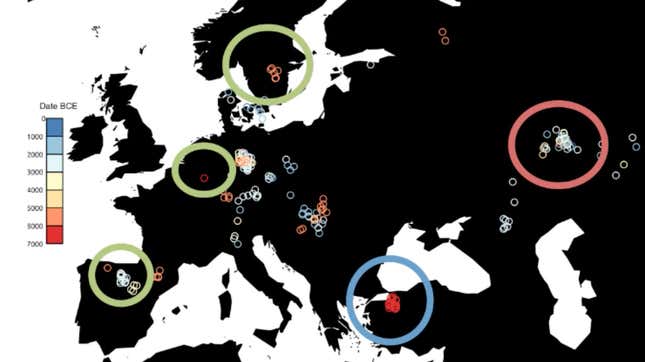
https://i.kinja-img.com/image/upload/c_fit,q_60,w_645/e2742cc71e4dceb4579f6cf22… |
|
European ancestors include hunter gatherers (circled in green), |
|
Eurasian steppe populations (circled in red), and early European |
|
farmers (circled in blue).Image: Harvard Medical School |
|
#Post#: 30342-------------------------------------------------- |
|
Re: Climate refugees |
|
By: Yahweh Date: June 2, 2025, 2:06 am |
|
--------------------------------------------------------- |
|
The German diaspora, mapped |
|
https://www.youtube.com/watch?v=lCAmA2MQpHQ |
|
I personally, a German myself, have never met another German |
|
that does not prefer tropical climate to the climate in Germany. |
|
I'm sure there are many Germans that do enjoy Germany's climate, |
|
I have never met one though...? |
|
***************************************************** |