|
Return Create A Forum - Home |
 |
--------------------------------------------------------- |
|
IL2 Air Combat! |
 |
https://il2freemodding.createaforum.com |
|
--------------------------------------------------------- |
|
***************************************************** |
|
Return to: Plane of the Week Articles |
|
***************************************************** |
|
#Post#: 16699-------------------------------------------------- |
|
Plane of the Week: Beo's Take On The 'Excellent' B-25 Mitchel |
|
By: Beowolff Date: March 25, 2021, 1:12 am |
|
--------------------------------------------------------- |
|
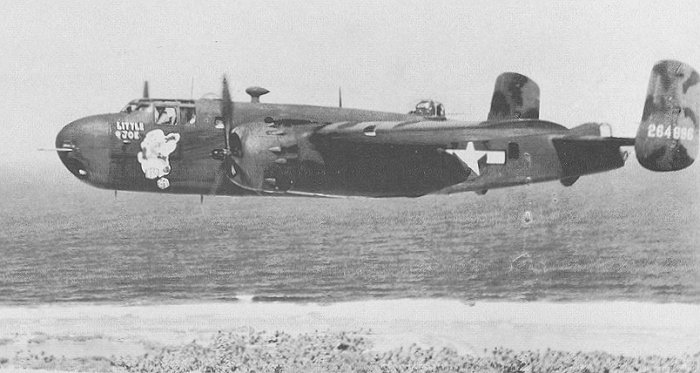
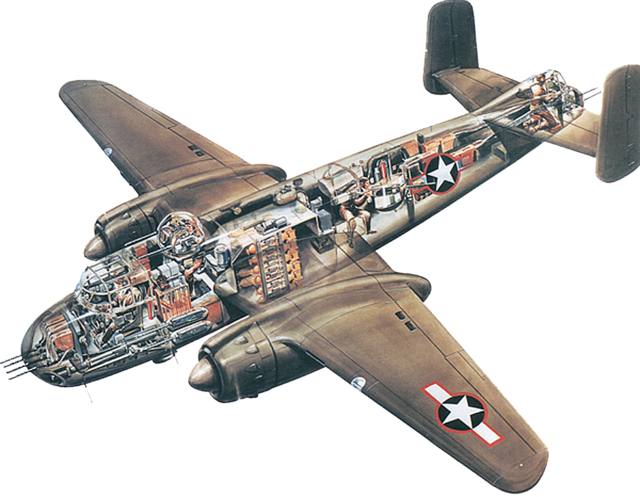
The B-25 Mitchel! |
|
https://i.pinimg.com/600x315/1a/bf/7c/1abf7c772d418421e1676d16b6225697.jpg |
|
https://i.postimg.cc/rm8FqrNV/b25h-cutaway-color-zpsx40zhvxf.png |
|
No matter the model, no matter the armament, no matter the |
|
payload, the fuel load, the mission even... the B-25 Mitchel was |
|
a giant among pygmies! Truly a war-winning, world beating |
|
aircraft of epic proportions. |
|
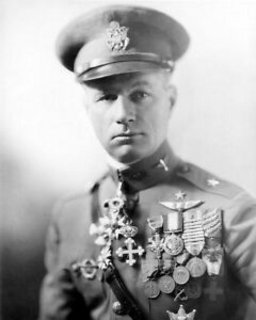
The North American B-25 Mitchell was a WW2 medium bomber that |
|
was introduced in 1941 and named in honor of Major General |
|
William "Billy" Mitchell, a pioneer of U.S. military aviation. |
|
https://i.postimg.cc/3rXVgqhc/s-l300.jpg |
|
Used by many Allied air forces, the B-25 served in every theater |
|
of World War II, and after the war ended, many remained in |
|
service, operating across four decades. Produced in numerous |
|
variants, nearly 10,000 B-25s were built. These included a few |
|
limited models such as the F-10 reconnaissance aircraft, the |
|
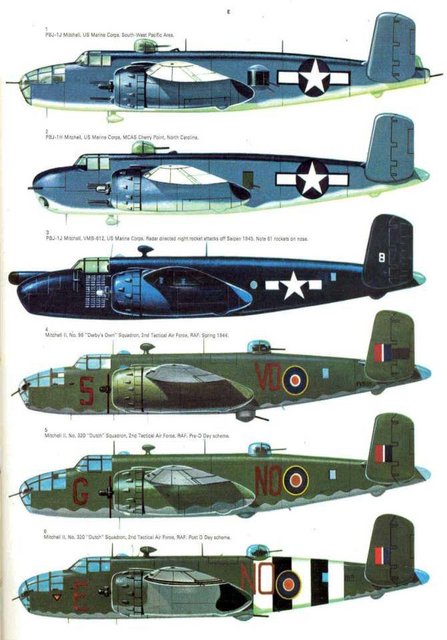
AT-24 crew trainers, and the United States Marine Corps' PBJ-1 |
|
patrol bomber. |
|
If you've been to the VFW's over the years like I have, you'll |
|
know that nearly 'every' multi-engine WW2 pilot at some point |
|
trained on or flew at some time/place a Mitchel! And everybody |
|
liked them! |
|
Asia and the Pacific Theater: |
|
The majority of B-25s in American service were used in the war |
|
against Japan in Asia and the Pacific. The Mitchell fought from |
|
the Northern Pacific to the South Pacific and the Far East. |
|
These areas included the campaigns in the Aleutian Islands, |
|
Papua New Guinea, the Solomon Islands, New Britain, China, Burma |
|
and the island hopping campaign in the Central Pacific. The |
|
aircraft's potential as a ground-attack aircraft emerged during |
|
the Pacific war. The jungle environment reduced the usefulness |
|
of medium-level bombing, and made low-level attack the best |
|
tactic. Using similar mast height level tactics and skip |
|
bombing, the B-25 proved itself to be a capable anti-shipping |
|
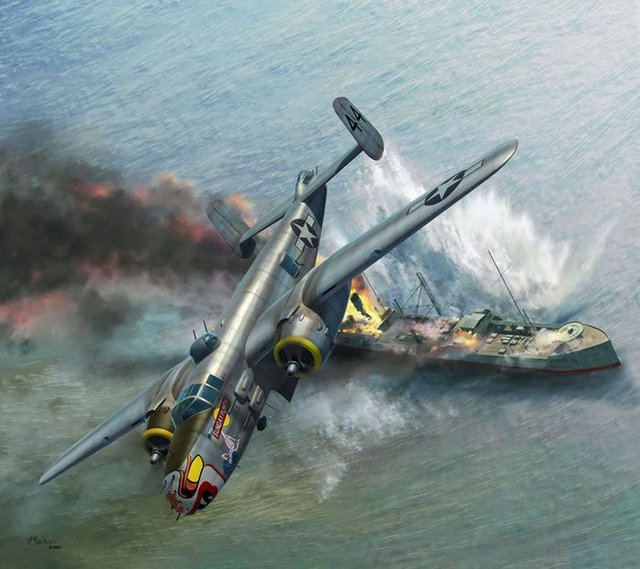
weapon and sank many enemy sea vessels of various types. An |
|
ever-increasing number of forward firing guns made the B-25 a |
|
formidable strafing aircraft for island warfare. The strafer |
|
versions were the B-25C1/D1, the B-25J1 and with the NAA strafer |
|
nose, the J2 subseries. |
|
In Burma, the B-25 was often used to attack Japanese |
|
communication links, especially bridges in central Burma. It |
|
also helped supply the besieged troops at Imphal in 1944. The |
|
China Air Task Force, the Chinese American Composite Wing, the |
|
First Air Commando Group, the 341st Bomb Group, and eventually, |
|
the relocated 12th Bomb Group, all operated the B-25 in the |
|
China Burma India Theater. Many of these missions involved |
|
battle-field isolation, interdiction, and close air support. |
|
Later in the war, as the USAAF acquired bases in other parts of |
|
the Pacific, the Mitchell could strike targets in Indochina, |
|
Formosa, and Kyushu, increasing the usefulness of the B-25. It |
|
was also used in some of the shortest raids of the Pacific War, |
|
striking from Saipan against Guam and Tinian. The 41st Bomb |
|
Group used it against Japanese-occupied islands that had been |
|
bypassed by the main campaign, such as happened in the Marshall |
|
Islands. |
|
Middle East and Italy |
|
The first B-25s arrived in Egypt and were carrying out |
|
independent operations by October 1942. Operations there against |
|
Axis airfields and motorized vehicle columns supported the |
|
ground actions of the Second Battle of El Alamein. Thereafter, |
|
the aircraft took part in the rest of the campaign in North |
|
Africa, the invasion of Sicily, and the advance up Italy. In the |
|
Strait of Messina to the Aegean Sea, the B-25 conducted sea |
|
sweeps as part of the coastal air forces. In Italy, the B-25 was |
|
used in the ground attack role, concentrating on attacks against |
|
road and rail links in Italy, Austria, and the Balkans. The B-25 |
|
had a longer range than the Douglas A-20 Havoc and Douglas A-26 |
|
Invader, allowing it to reach further into occupied Europe. The |
|
five bombardment groups � 20 squadrons � of the Ninth and |
|
Twelfth Air Forces that used the B-25 in the Mediterranean |
|
Theater of Operations were the only U.S. units to employ the |
|
B-25 in Europe. |
|
Europe |
|
The RAF received nearly 900 Mitchells, using them to replace |
|
Douglas Bostons, Lockheed Venturas, and Vickers Wellington |
|
bombers. The Mitchell entered active RAF service on 22 January |
|
1943. At first, it was used to bomb targets in occupied Europe. |
|
After the Normandy invasion, the RAF and France used Mitchells |
|
in support of the Allies in Europe. Several squadrons moved to |
|
forward airbases on the continent. The USAAF did not use the |
|
B-25 in combat in the European theater of operations. |
|
Famous Mission: |
|
The B-25B first gained fame as the bomber used in the 18 April |
|
1942 Doolittle Raid, in which 16 B-25Bs led by Lieutenant |
|
Colonel Jimmy Doolittle attacked mainland Japan, four months |
|
after the bombing of Pearl Harbor. The mission gave a |
|
much-needed lift in spirits to the Americans and alarmed the |
|
Japanese, who had believed their home islands to be inviolable |
|
by enemy forces. Although the amount of actual damage done was |
|
relatively minor, it forced the Japanese to divert troops for |
|
home defense for the remainder of the war. |
|
https://i.postimg.cc/wMDkdnqR/4cd91d087335b0e9a99b87b0272151d2-bud-model-airpla… |
|
https://i.postimg.cc/8C3dfTsr/d3ff946682ace9c423822751a34aa312-airplane-art-wwi… |
|
https://i.postimg.cc/htZTNKL3/70bce0fe7322efdf4c8979c95fd6dab7.jpg |
|
Durability: |
|
The Mitchell was an exceptionally sturdy aircraft that could |
|
withstand tremendous punishment. One B-25C of the 321st Bomb |
|
Group was nicknamed "Patches" because its crew chief painted all |
|
the aircraft's flak hole patches with the bright yellow zinc |
|
chromate primer. By the end of the war, this aircraft had |
|
completed over 300 missions, had been belly-landed six times, |
|
and had over 400 patched holes. The airframe of "Patches" was so |
|
distorted from battle damage that straight-and-level flight |
|
required 8� of left aileron trim and 6� of right rudder, causing |
|
the aircraft to "crab" sideways across the sky. |
|
Flight characteristics |
|
The B-25 was a safe and forgiving aircraft to fly. With one |
|
engine out, 60� banking turns into the dead engine were |
|
possible, and control could be easily maintained down to 145 mph |
|
(230 km/h). The pilot had to remember to maintain engine-out |
|
directional control at low speeds after takeoff with rudder; if |
|
this maneuver were attempted with ailerons, the aircraft could |
|
snap out of control. The tricycle landing gear made for |
|
excellent visibility while taxiing. The only significant |
|
complaint about the B-25 was the extremely high noise level |
|
produced by its engines; as a result, many pilots eventually |
|
suffered from varying degrees of hearing loss. |
|
The high noise level was due to design and space restrictions in |
|
the engine cowlings, which resulted in the exhaust "stacks" |
|
protruding directly from the cowling ring and partly covered by |
|
a small triangular fairing. This arrangement directed exhaust |
|
and noise directly at the pilot and crew compartments. |
|
Navy And Marine Corps: |
|
The U.S. Navy designation for the Mitchell was the PBJ-1 and |
|
apart from increased use of radar, it was configured like its |
|
Army Air Forces counterparts. Under the pre-1962 USN/USMC/USCG |
|
aircraft designation system, PBJ-1 stood for Patrol (P) Bomber |
|
(B) built by North American Aviation (J), first variant (-1) |
|
under the existing American naval aircraft designation system of |
|
the era. The PBJ had its origin in an inter-service agreement of |
|
mid-1942 between the Navy and the USAAF exchanging the Boeing |
|
Renton plant for the Kansas plant for B-29 Superfortress |
|
production. The Boeing XPBB Sea Ranger flying boat, competing |
|
for B-29 engines, was cancelled in exchange for part of the |
|
Kansas City Mitchell production. Other terms included the |
|
interservice transfer of 50 B-25Cs and 152 B-25Ds to the Navy. |
|
The bombers carried Navy bureau numbers (BuNos), beginning with |
|
BuNo 34998. The first PBJ-1 arrived in February 1943, and nearly |
|
all reached Marine Corps squadrons, beginning with Marine |
|
Bombing Squadron 413 (VMB-413). Following the AAFAC format, the |
|
Marine Mitchells had search radar in a retractable radome |
|
replacing the remotely operated ventral turret. Later D and J |
|
series had nose-mounted APS-3 radar; and later still, J and H |
|
series mounted radar in the starboard wingtip. The large |
|
quantities of B-25H and J series became known as PBJ-1H and |
|
PBJ-1J, respectively. These aircraft often operated along with |
|
earlier PBJ series in Marine squadrons. |
|
General characteristics: |
|
Crew: 5 (one pilot, navigator/bombardier, turret |
|
gunner/engineer, radio operator/waist gunner, tail gunner) |
|
Length: 52 ft 11 in (16.13 m) |
|
Wingspan: 67 ft 7 in (20.60 m) |
|
Height: 16 ft 4 in (4.98 m) |
|
Wing area: 618 sq ft (57.4 m2) |
|
Airfoil: root: NACA 23017; tip: NACA 4409R[49] |
|
Empty weight: 19,480 lb (8,836 kg) |
|
Max takeoff weight: 35,000 lb (15,876 kg) |
|
Powerplant: 2 � Wright R-2600-92 Twin Cyclone 14-cylinder |
|
two-row air-cooled radial piston engines, 1,700 hp (1,300 kW) |
|
each |
|
Performance |
|
Maximum speed: 272 mph (438 km/h, 236 kn) at 13,000 ft (4,000 m) |
|
Cruise speed: 230 mph (370 km/h, 200 kn) |
|
Range: 1,350 mi (2,170 km, 1,170 nmi) |
|
Service ceiling: 24,200 ft (7,400 m) |
|
Armament |
|
Guns: 12�18 � .50 in (12.7 mm) machine guns and 75 mm (2.95 in) |
|
T13E1 cannon |
|
Hardpoints: 2,000 lb (900 kg) ventral shackles to hold one |
|
external Mark 13 torpedo[50] |
|
Rockets: racks for eight 5 in (127 mm) high velocity aircraft |
|
rockets (HVAR) |
|
Bombs: 3,000 lb (1,360 kg) bombs |
|
Everybody, and I mean EVERYBODY (as in Allied Service) flew this |
|
great bird. RAF, RAAF, RCF, China, Russia, __you-name-it Allied |
|
Country then they surely flew B-25's somewhere some when... and |
|
loved 'em. |
|
Excellent Combat Footage of this plane: |
|
https://www.youtube.com/watch?v=cEek5IvGYKg |
|
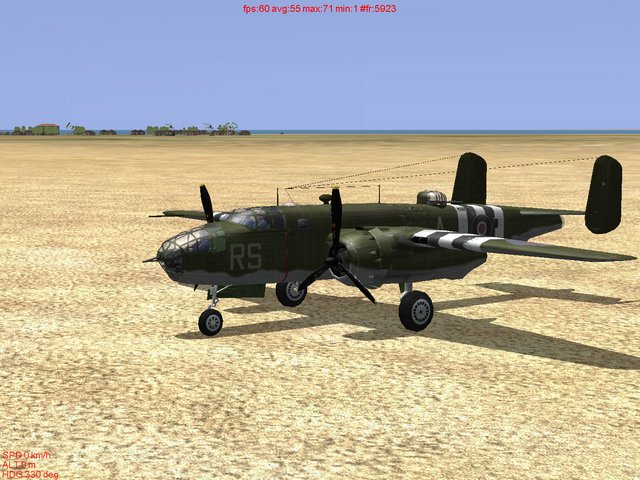
Okay, so how does our beloved IL2 game B-25 stack up to the Real |
|
Deal? |
|
Pretty good actually. I love flying this bird, and true to the |
|
real thing it handles beautifully and performs wonderfully. |
|
I've flown her quite a bit, especially in the early days and |
|
very seldom has she ever let me down. I think Oleg matched |
|
performance specs pretty well with the real plane on this one. |
|
Some, I don't agree with... as the infamous 'Mustang' poor |
|
performance that Oleg swore by but was obviously off to a great |
|
degree! But with the B-25, I personally feel he got it about |
|
right. |
|
https://i.postimg.cc/Rh0Xwg4W/2021-03-25-06-46-12.jpg |
|
There's a LOT more great info out there on this plane, heck, |
|
I've barely scratched the surface of it. With a few quick |
|
searches you'll quickly gather MORE than you can digest in a |
|
year! |
|
If you haven't flown this bird, or haven't flown it in the game |
|
recently... well heck, give 'er a try. Chances are you'll like |
|
it! |
|
S! |
|
Beowolff |
|
#Post#: 16705-------------------------------------------------- |
|
Re: Plane of the Week: Beo's Take On The 'Excellent' B-25 Mitch |
|
el |
|
By: JG51_Ruski Date: March 25, 2021, 7:42 am |
|
--------------------------------------------------------- |
|
Well presented Beo Thanks for sharing! |
|
#Post#: 16709-------------------------------------------------- |
|
Re: Plane of the Week: Beo's Take On The 'Excellent' B-25 Mitch |
|
el |
|
By: E69_Haukka Date: March 25, 2021, 8:22 am |
|
--------------------------------------------------------- |
|
Excellent information. This gives me a lot of ideas ... Thank |
|
you Beo for this work. ;) |
|
#Post#: 16761-------------------------------------------------- |
|
Re: Plane of the Week: Beo's Take On The 'Excellent' B-25 Mitch |
|
el |
|
By: Beowolff Date: March 27, 2021, 4:25 am |
|
--------------------------------------------------------- |
|
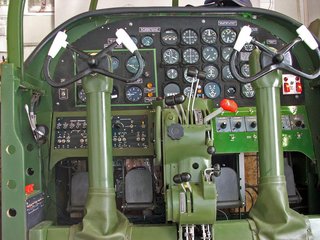
I have been fortunate to actually clamber into and around inside |
|
of a nice, restored B-25 (once while at the Confederate Airforce |
|
in Texas!) and I was amazed how small/cramped it was |
|
inside/outside in comparison to modern 'roomy' aircraft. |
|
Still, it did the job excellently. |
|
I got to sit in the co-pilot's seat on the flight deck even and |
|
actually take the controls there into my hands...it felt |
|
wonderful and powerful and I so wished I could ignite the |
|
engines and fly away! LOL! :o |
|
https://i.postimg.cc/7Lqmkkt8/B25-196.jpg |
|
You all know that the fighters of the war usually get 99 percent |
|
of the attention in this and or any other game (even real life |
|
too to a big extent) and that isn't quite fair as the bombers do |
|
the HEAVY LIFTING against the enemy forces. And certainly the |
|
Mitchel gave an extraordinary amount of 'good' heavy work for |
|
ALL the Allied lads in WW2. |
|
We all should pay homage to the outstanding Bomber lads and |
|
their gallant air warrior steeds! ;D |
|
S! |
|
Beo |
|
#Post#: 16927-------------------------------------------------- |
|
Re: Plane of the Week: Beo's Take On The 'Excellent' B-25 Mitch |
|
el |
|
By: stanislao Date: April 4, 2021, 5:57 am |
|
--------------------------------------------------------- |
|
:D Take a look at this WT jewel, doesn't it make your mouth |
|
water ...? ;) |
|
[img width=1024 height=482] |
|
https://i.imgur.com/IsjVlQS.jpg[/img] |
|
#Post#: 17737-------------------------------------------------- |
|
Re: Plane of the Week: Beo's Take On The 'Excellent' B-25 Mitch |
|
el |
|
By: E69_Haukka Date: June 25, 2021, 6:12 pm |
|
--------------------------------------------------------- |
|
B-25G-NA |
|
https://modelingmadness.com/scott/allies/us/b25gphoto.jpg |
|
History |
|
[justify]The B-25G-NA was designed at the request of the United |
|
States Army. The 75mm cannon, known as the M-4, had been in |
|
development and testing since 1936. In 1938, the M-4 cannon was |
|
successfully installed and tested in a Douglas B-18. The cannon |
|
was demonstrated at Eglin Field in 1940. Commercial firms were |
|
solicited to assist in further development. The improved design |
|
produced a lighter cannon and increased power.[/justify] |
|
[justify]There were a lot of unknowns with the addition of a |
|
cannon to the B-25. Engineer George Wing was set to the task. |
|
The bombardier's crawl tunnel was the perfect location for the |
|
cannon. It provided ample room for recoil as well as space in |
|
the navigators compartment for storage of ammunition. The |
|
forward section of a B-25 was assembled with modifications to |
|
test the new design. In order to fit the cannon, the nose of the |
|
B-25 was shortened by 26 inches. This was considered the most |
|
the nose could be shortened from an aerodynamic standpoint. The |
|
end of the cannon barrel was still just aft of the nose contour. |
|
Fire tests were conducted with progressively increasing |
|
propellant charges. The structure was strengthened until it |
|
could withstand prolonged firing of over-charged |
|
rounds.[/justify] |
|
[justify]B-25C-1-NA SN 41-13296 was modified to the XB-25G. Test |
|
flights were made on October 22, 1942 to test the aircraft's |
|
flight characteristics. On October 23, 1942 the first test shots |
|
were fired from the aircraft. The XB-25G was fully tested by |
|
North American prior to being flown to Eglin Field for further |
|
testing by the Air Corps. After successful testing, the Air |
|
Corps ordered 400 examples to be supplied without lower turrets. |
|
In addition to those 400 aircraft, there were an additional 65 |
|
B-25C-NA bombers modified and re-designated as B-25Gs. The |
|
majority of these modifications were done at the modification |
|
center in Kansas City. It was the production of the B-25G-NA |
|
that marked the beginning of the end of B-25 production in |
|
Inglewood, California. Although another 1,000 B-25H-NA bombers |
|
would be built, the production of P-51 Mustangs was starting. As |
|
the Inglewood, California plant production of B-25s was winding |
|
down, production was ramping up in Kansas City.[/justify] |
|
Other than the experimental aircraft built, The B-25G-NA and |
|
B-25A-NA are the only models that no airframe is known to have |
|
survived the war. Unfortunately, the B-25G-NA was not a popular |
|
aircraft. The firing of the cannon could throw off the |
|
navigational compass by as much as 15 degrees. The lower turret |
|
was never a popular item and was commonly removed in the field. |
|
The Hawaiian Air Depot replaced the cannon with the 8 gun nose |
|
on an unknown number of B-25G-NA bombers. Any remaining aircraft |
|
were sold for scrap at the end of the war. |
|
B-25G-NA Specs |
|
[list] |
|
[li]Model: B-25G-NA[/li] |
|
[li]Total Produced: 463 (63 were modified from B-25Cs)[/li] |
|
[li]Manufacturing Plant: Inglewood, California[/li] |
|
[li]First Test Flight: October 22, 1942[/li] |
|
[li]First Flight Crew: Edward Virgin[/li] |
|
[li]Engines: Wright R-2600-13[/li] |
|
[li]Carburetors: Holley 1685HA[/li] |
|
[li]Fuel Capacity: |
|
[list type=circle] |
|
[li]2 forward wing cells, total 368 gallons[/li] |
|
[li]2 rear wing cells, total 302 gallons[/li] |
|
[li]2 wing auxiliary cells, total 304 gallons[/li] |
|
[li]2 side waist ferry tanks, total 125 gallons[/li] |
|
[li]Droppable bomb bay tank 335 gallons[/li] |
|
[li]1 fixed ferry tank 585 gallons[/li] |
|
[/list] |
|
[/li] |
|
[li]Armament: |
|
[list type=circle] |
|
[li]75mm cannon with 21 rounds[/li] |
|
[li]2 .50 caliber fixed guns in nose with 800 rounds[/li] |
|
[li]2 .50 caliber guns in top turret with 800 rounds[/li] |
|
[li]2 .50 caliber guns in bottom turrett with 700 rounds[/li] |
|
[/list] |
|
[/li] |
|
[li]Armor Protection: |
|
[list type=circle] |
|
[li]3/8 inch behind pilots[/li] |
|
[li]Forward of instrument panel[/li] |
|
[li]Forward of cannoneer's station[/li] |
|
[li]Bulkhead aft of turrets[/li] |
|
[li]Around ammunition rack[/li] |
|
[li]Plate below windshield[/li] |
|
[li]External flak plate on left side[/li] |
|
[/list] |
|
[/li] |
|
[li]Weights: |
|
[list type=circle] |
|
[li]Empty: 19,200 lbs.[/li] |
|
[li]Max: 35,000 lbs.[/li] |
|
[/list] |
|
[/li] |
|
[li]Speed (Max): 280 mph at 15,000 feet[/li] |
|
[li]Service Ceiling: 24,300 ft[/li] |
|
[li]Range: 1,560 miles with 3,000 lbs. bombs[/li] |
|
[li]Crew: |
|
[list type=circle] |
|
[li]Pilot, co-pilot, navigator/cannoneer, 2 gunners[/li] |
|
[/list] |
|
[/li] |
|
[li]Production by year: |
|
[list type=circle] |
|
[li]1943: 400[/li] |
|
[/list] |
|
[/li] |
|
[li]First Airplane Accepted: May 8, 1943[/li] |
|
[li]Last Airplane Accepted: August 24, 1943[/li] |
|
[/list] |
|
Bibliography |
|
https://b-25history.org/hangar/25g.htm |
|
************************************************ |
|
Guys, it's time to practice... ;) |
|
#Post#: 18000-------------------------------------------------- |
|
Re: Plane of the Week: Beo's Take On The 'Excellent' B-25 Mitch |
|
el |
|
By: Beowolff Date: October 10, 2021, 8:32 am |
|
--------------------------------------------------------- |
|
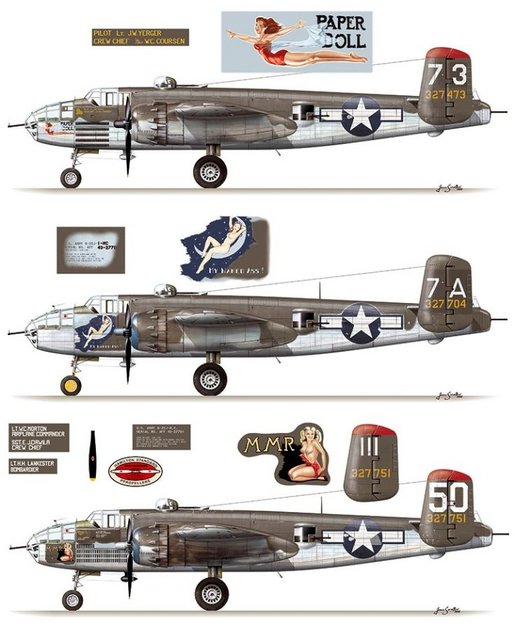
There's something about the B=25 that just looks BOSS. The |
|
style and grace of it somehow... agree? 8) |
|
***************************************************** |



![https://i.imgur.com/IsjVlQS.jpg[/img]](https://i.imgur.com/IsjVlQS.jpg[/img])