|
Return Create A Forum - Home |
 |
--------------------------------------------------------- |
|
IL2 Air Combat! |
 |
https://il2freemodding.createaforum.com |
|
--------------------------------------------------------- |
|
***************************************************** |
|
Return to: Plane of the Week Articles |
|
***************************************************** |
|
#Post#: 16205-------------------------------------------------- |
|
Plane of the Week; the P-38 a revisit (against Germany) |
|
By: Beowolff Date: February 28, 2021, 6:25 am |
|
--------------------------------------------------------- |
|
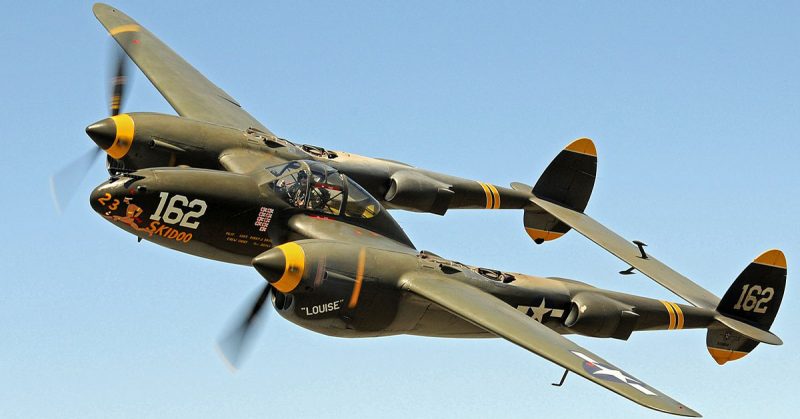
https://www.warhistoryonline.com/wp-content/uploads/2019/02/p-38.jpg |
|
Yes, a revisit as this plane has already been covered (and quite |
|
well, I might add) by Von, some time back. In this particular |
|
POTW though I'm concentrating more on it's use against the |
|
Germans, German/Italians. That's going to put the theaters in |
|
Europe/Mediterranean, African and Middle East Theatres... and so |
|
could entertain 'thousands' of pages of information to even come |
|
close to covering it properly...lol...something not suited for |
|
here. So, I'm just going to nip around the edges of it, |
|
specifying only a tiny bit of the P-38's use in these areas of |
|
hot combat. |
|
Here's a warm-up video of the P-38 in hot action. It has some |
|
amazing shots in it, in particular note some of the 'very cool' |
|
German aircraft shots. There's one in particular of a German |
|
transport (if I remember right) flying over head and some guy |
|
(likely a German solider with a movie camera) directly beneath |
|
it__quite a breathtaking shot! |
|
Germany Suffered Big Losses at the Hands of the P-38 |
|
[iurl= |
|
https://www.youtube.com/watch?v=N4iGbB2vzDs]Germany<br |
|
/>Suffered Big Losses at the Hands of the P-38 - YouTube[/iurl] |
|
Here's a Zeno archive footage that's quite good. |
|
430th footage: |
|
[iurl= |
|
https://www.youtube.com/watch?v=e64O_6XXk-M&pbjreload=101]430th<br |
|
/>FS "Back Door Gang" P-38 Lightnings in action over Germany - |
|
Color, 1945 - YouTube[/iurl] |
|
P-38 in European Theatre |
|
RE: Joe Baugher 1999 |
|
The P-38F-equipped 82nd Fighter Group arrived in Northern |
|
Ireland in November 1942. |
|
After flying 347 practice and sweep sorties during which there |
|
was no contact with the Luftwaffe, the 1st, 14th and 82nd |
|
Fighter Groups were transferred to the 12th Air Force in North |
|
Africa. While in transit from Britain to Algeria, pilots of the |
|
82nd Fighter Group were credited with the destruction of two |
|
Ju-88 bombers over the Bay of Biscay. The Lightnings were soon |
|
in regular combat in the North African theatre. The first of |
|
these took place on November 19, 1942 when the P-38Fs of the 1st |
|
Fighter Group escorted B-17s on a bombing raid on the El Aouina |
|
airfield at Tunis. The three P-38 groups contributed a great |
|
deal toward the establishment of local air superiority in the |
|
area. On April 5, 1943, 26 P-38Fs of the 82nd Fighter Group |
|
claimed the destruction of 31 enemy aircraft as against the loss |
|
of six Lightnings. In these air battles, mixed success was |
|
obtained Because of the tactics of the enemy, the Lightnings |
|
were forced to fight at lower altitudes of 15,000 feet, and in |
|
battles against fighters it was not entirely successful. The |
|
twin engines restricted maneuverability to some extent and the |
|
Lightning had a wheel control instead of the conventional stick, |
|
which may also have restricted maneuverability. Nevertheless, |
|
the Lightning was effective against bombers and had a |
|
sensational zoom climb that could rarely be matched. It wreaked |
|
great havoc among Rommel's air transport well out to sea, |
|
earning for itself the German nickname "der Gabelschwanz |
|
Teufel"--the Fork-Tailed Devil. |
|
All Axis forces in the area surrendered on May 13, 1943, due in |
|
no small part to the contribution of the Lightning in cutting |
|
off Rommel's air supply route. |
|
Already prior to the Axis defeat in Tunisia, the Northwest |
|
African Air Forces (of which the Twelfth Air Force was a |
|
component) had begun preparations for the invasion of Sicily. |
|
Attacks on Sicily, on Pantelleria and on Lampedusa were stepped |
|
up in preparation for Operation Husky, the invasion of Sicily on |
|
July 10, 1943. Lightnings were in the midst of the fray until |
|
Sicily fell on August 17. The three P-38 Fighter Groups then |
|
concentrated their efforts against the Italian mainland. On |
|
November 1, 1943, they were transferred to the 15th Air Force. |
|
By that time, 37 Twelfth Air Force Lightning pilots had made |
|
ace, the top scorer being Lieut W. J. Sloan of the 82nd Fighter |
|
Group with 12 kills. Lieut H. T. Hanna of the 14th Fighter Group |
|
made ace in one day by destroying five Ju 87 dive bombers on |
|
October 9, 1943. |
|
Following their transfer, the 1st, 14th and 82nd Fighter Groups |
|
concentrated on escorting the B-17 and B-24 bombers of the |
|
Fifteenth Air Force in their raids on targets in Austria, the |
|
Balkans, France, Greece, and Italy. However, on occasion, they |
|
escorted the medium bombers of the Twelfth Air Force. |
|
The first Lightning-escorted raids on Germany began in February |
|
1944 with raids on aircraft factories in the southern part of |
|
that country. In April 1944 the Lightnings escorted bombers in |
|
raids on the oil refineries at Ploesti in Rumania. Bomb-carrying |
|
Lightnings also visited Ploesti on June 10, 1944 when 46 |
|
aircraft of the 82nd Fighter Group each carrying 1000-pound |
|
bombs paid a visit to the Romano Americana Oil Refinery under |
|
the protective escort of 48 P-38s of the 1st Fighter Group. On |
|
that raid, good bombing and strafing results were obtained, but |
|
in fighter actions against the Luftwaffe twenty-two P-38s were |
|
lost against 23 enemy aircraft claimed destroyed. |
|
Six weeks later, Lightnings flew their first shuttle mission to |
|
Russia and returned to their Italian base after spending three |
|
days at a Soviet base in the Ukraine. Along with their P-51 |
|
escorts, they shot down thirty German planes and destroyed |
|
twelve on the ground. The last Lightning shuttle mission was |
|
flown on August 4/6 and was marked by the daring rescue of a |
|
downed pilot by Lieut R. J. Andrews who landed his Lightning in |
|
an open field to pick up Capt R. E. Willsie. |
|
The three Lightning Groups also took part in the August 1944 |
|
Allied landings in southern France. After that, they returned to |
|
providing fighter escort for bombers operating against strategic |
|
targets. By the end of the war, 28 of these Lightning pilots had |
|
made ace. |
|
The departure of the 1st and 14th Fighter Groups for North |
|
Africa in November 1942 left the Eighth Air Force without |
|
Lightnings until September 1943, when the 55th Fighter Group |
|
arrived in England with its P-38Hs. It began combat operations |
|
on October 15, 1943, making its first kill on November 2. The |
|
next month, the outfit converted to P-38Js. On March 3, 1944, |
|
the 55th flew to Berlin for the first time, a round trip of 1300 |
|
miles. The 20th, 364th and 479th Fighter Groups soon became |
|
operational in England with P-38s. |
|
However, in air combat over Germany, the Lightning was generally |
|
outclassed by the more maneuverable Fw 190 and the later marks |
|
of the Bf 109, especially at medium and low altitudes. However, |
|
the Lightning had a much faster top speed, a higher rate of |
|
climb and operational ceiling and was much better armed. Once |
|
pilots had perfected fighting tactics which suited the |
|
Lightning's unique characteristics, they had better success. The |
|
usual tactics was for the P-38 to climb to a high altitude and |
|
then dive down on the enemy, attacking him with a burst of |
|
firepower and then zoom back up out of harm's way. The later |
|
versions of the P-38 were equipped with maneuvering flaps, and |
|
when their pilots learned how to use these flaps properly, the |
|
P-38 could hold its own when maneuvering against German |
|
fighters, often being able to turn inside their Fw 190 and Bf |
|
109 opponents. |
|
The large size of the P-38 was both an advantage and a |
|
disadvantage in combat. The P-38 was quite large for a fighter, |
|
and Luftwaffe pilots could usually spot the Lockheed fighter at |
|
much larger distances than they could Allied single-engined |
|
fighters which were appreciably smaller. In addition, the |
|
twin-boomed configuration of the P-38 made it instantly |
|
recognizable to the enemy. However, this ease of recognition was |
|
not always a disadvantage--P-38s would often feel free to pursue |
|
Luftwaffe fighters right through Allied bomber formations with |
|
little fear of receiving friendly fire from the gunners. |
|
The Allison engines of the Lightnings proved to be somewhat |
|
temperamental, with engine failures actually causing more |
|
problems than enemy action. It is estimated that every Lightning |
|
in England changed its engines at least once. Nevertheless, the |
|
ability of the Lightning to return home on one engine was |
|
exceptional and saved the life of the pilot of many a wounded |
|
Lightning. Experienced pilots could handle the Lightning |
|
satisfactorily at high altitude, but too many of the Eighth Air |
|
Force pilots did not have the training or experience to equip |
|
them for flying this temperamentally-powered aircraft in combat. |
|
The powerplant problems were not entirely the Allison engine's |
|
fault. Many of the reliability problems were actually due to the |
|
inadequate cooling system, in particular the cumbersome plumbing |
|
of the turbosupercharger intercooler ducting which directed air |
|
all way from the supercharger out to the wingtips and back. In |
|
addition, the lack of cowl flaps were a problem. In the European |
|
theatre of operation, temperatures at altitude were often less |
|
than 40 degrees below zero and the Lightning's engines would |
|
never get warmed up enough for the oil to be able to flow |
|
adequately. Octane and lead would separate out of the fuel at |
|
these low temperatures, causing the Allisons to eat valves with |
|
regularity, to backfire through the intercooler ducts, and to |
|
throw rods, sometimes causing the engine to catch fire. |
|
These problems bedeviled the Lightnings until the advent of the |
|
J version with its simplified intercooler ducting and the |
|
relocation of the oil cooler to a chin position underneath the |
|
propeller spinner. When the P-38J reached the field, the Allison |
|
engine was finally able to attain its full rated power at |
|
altitude, and the engine failure rate began to go down. |
|
Earlier Lightnings had problems with high-speed dives. When the |
|
airspeed reached a sufficiently high value, the controls would |
|
suddenly lock up and the Lightning would tuck its nose down, |
|
making recovery from the dive difficult. In the worst case, the |
|
wings of the Lightning could be ripped off if the speed got too |
|
high. This problem caused the Lightning often to be unable to |
|
follow its Luftwaffe opponents in a dive, causing many of the |
|
enemy to be able to escape unscathed. The problem was eventually |
|
traced to the formation of a shock wave over the wing as the |
|
Lightning reached transonic speeds, this shock wave causing the |
|
elevator to lose much of its effectiveness. The problem was not |
|
cured until the advent of the P-38J-25-LO, which introduced a |
|
set of compressibility flaps under the wing which changed the |
|
pattern of the shock wave over the wing when they were extended, |
|
restoring the function of the elevator. |
|
The P-38J version of the Lightning cured many of the ills that |
|
had been suffered by the earlier versions of the Lockheed |
|
fighter, producing a truly world-class fighter which could mix |
|
it up with virtually any other fighter in the world. |
|
In April 1944, the Lightnings of the 20th Fighter Group began |
|
low level fighter sweeps over the Continent. That same month, |
|
the 55th Fighter Group used the "Droop Snoot" P-38J for the |
|
first time as a leader for other Lightnings in a bombing raid on |
|
the Coulommiers airfield. Both types of operations proved |
|
successful, and these techniques were later used extensively by |
|
P-38s of the Ninth Air Force. |
|
The P-38s of the Eighth Air Force were rapidly phased out of |
|
service in favor of P-51 Mustangs--The 20th, 55th, and 364th |
|
Fighter Groups converted to P-51s during July 1944, and in |
|
September the 479th Fighter Group traded in its P-38Js for |
|
P-51Ds. |
|
The Ninth Air Force was assigned a tactical role (in contrast to |
|
the strategic role of the Eighth Air Force), and retained its |
|
P-38J/L fighters a bit longer. Its first Lightning group was the |
|
474th, which flew its first combat mission on April 15, 1944. It |
|
was soon joined by the 367th and 370th Fighter Groups. However, |
|
in March of 1945 these two latter groups converted to P-47Ds and |
|
P-51Ds respectively. By V-E day the 474th was the only Fighter |
|
Group still operating P-38s. |
|
More than one in eight Lightnings were either completed by |
|
Lockheed as photographic-reconnaissance aircraft or were so |
|
modified after delivery. Over 1400 F-5 and F-5 aircraft were |
|
delivered to the USAAF. Photographic Lightnings saw widespread |
|
service throughout the war. F-4s were first flown in combat |
|
beginning in November 1942. They were operated initially by the |
|
5th and 12th Photographic Reconnaissance Squadrons. Later, these |
|
units and two other squadrons of the 3rd Photographic |
|
Reconnaissance Group operated various versions of the F-5. In |
|
the North African theatre, the 154th Reconnaissance Squadron |
|
obtained its photographic Lightnings when its maintenance |
|
personnel modified a number of P-38Fs in the field. The |
|
F-5-equipped 5th Photographic Reconnaissance Group was initially |
|
assigned to the Twelfth Air Force and became operational in |
|
September 1943. However it was transferred to the Fifteenth Air |
|
Force thirteen months later. In the European theatre, where the |
|
3rd PRG had briefly been based before transfer to North Africa, |
|
the first operational sorties by photographic Lightnings was |
|
flown by F-4As of the 7th PRG on March 28, 1943. This group |
|
successively operated F-4As, F-5As, F-5Bs, F-5Cs, and finally, |
|
during the last year of the war, F-5Es. Operating initially from |
|
bases in England but later moving to the Continent, the Ninth |
|
Air Force had for Photographic Reconnaissance squadrons (the |
|
30th, 32st, 33rd, and 34th), which flew various versions of the |
|
F-5 from the spring of 1944 until the end of the war. |
|
The F-4/F-5s usually flew alone without fighter escort and in |
|
spite of heavy losses, especially when facing radar-controlled |
|
Luftwaffe fighters, they proved to be of unequalled value. |
|
The Forces Aeriennes Francaises Libres also received |
|
photographic Lightnings. They operated as an attached squadron |
|
with the 3rd PRG of the Twelfth Air Force. One of their pilots |
|
was the well-known author Antoine de Saint-Exupery, who was lost |
|
off southern France on July 31, 1944 while on a combat sortie. |
|
#Post#: 16206-------------------------------------------------- |
|
Re: Plane of the Week; the P-38 a revisit (against Germany) |
|
By: Beowolff Date: February 28, 2021, 6:26 am |
|
--------------------------------------------------------- |
|
More Info on the P-38 in European service: |
|
The P-38 saw service with both the 8th and 9th Air Forces, |
|
initially based in Britain. These were the airforces seen as |
|
allocated to the European Theatre of Operations (ETO). The P-38 |
|
was always the junior partner to the P-47 and P-51 in these air |
|
forces, but did perform some valuable service. |
|
8th Air Force |
|
The P-38 entered service with the 8th Air Force at a crucial |
|
moment in the daylight bombing campaign. 14 October 1943 was the |
|
date of the disastrous raid on the ball bearing factory at |
|
Schweinfurt, well beyond escort range for the P-47. For 370 |
|
miles the B-17s were unescorted. Sixty aircraft were lost, |
|
without making any significant dent on ball bearing production. |
|
For the rest of October the daylight bomber offensive was |
|
virtually suspended. |
|
The next day the 55th Fighter Group flew its first P-38 mission |
|
from Britain, a fighter sweep over the Dutch coast. Equipped |
|
with 75 gallon drop tanks, the P-38 had an effective escort |
|
radius of 520 miles (compared to 375 miles for the P-47). In |
|
February 1944 the P-38 units received 108 gallon drop tanks, |
|
which increased their effective radius of operations to 585 |
|
miles, long enough to reach Berlin. Between October 1943 and |
|
March 1944, the P-38 was the longest range fighter available to |
|
the 8th Air Force (in March 1944 the P-51D finally received drop |
|
tanks that gave it an effective escort range of 650 miles). |
|
These ranges are all significantly shorter than those given for |
|
the various types involved. Even taking into account the smaller |
|
drop tanks in use, one might expect the P-38 to have been able |
|
to reach 700 or more miles into Germany. So where have the |
|
missing miles gone? The answer is that the P-38 could indeed |
|
reach that far into Germany, as demonstrated by the PR models of |
|
the aircraft, but only if it was allowed to fly at its most |
|
efficient cruising speed and height for the entire journey, did |
|
not want to spend any time at its target, and could guarantee |
|
that it would not need to indulge in any aerial combat. In |
|
contrast the escort fighters had to either travel somewhat below |
|
their most fuel efficient speeds or to circle around the bombers |
|
they were guarding. They also needed to be able to spend as long |
|
over the target as the bomber formation they were escorting, and |
|
be able to fight for at least ten minutes. |
|
One problem faced by the 8th Air Force was that many of its |
|
aircraft were shipped across the Atlantic only partly assembled. |
|
On their arrival in Britain they would be assembled at one base, |
|
and then shipped to a second base to be modified. In December |
|
1943 this was partly resolved by the establishment of a |
|
production line at Burtonwood, where newly arrived P-38s could |
|
be assembled and modified in one place. In January 1944 the |
|
Burtonwood base assembled 389 aircraft. |
|
The P-38 also suffered from unexpected engine unreliability |
|
problems when used from Britain. Sometimes attributed to the |
|
British climate, a more likely cause was the different type of |
|
aviation fuel used in Britain (the same engines performed well |
|
in the much more severe climate of the Aleutian Islands). This |
|
caused no problems in British engines (which used mechanical |
|
superchargers), or with the combination of radial engines and |
|
turbo-superchargers used in the B-17, but seems to have caused |
|
problems when the exhaust-driven turbo-superchargers were |
|
combined with Allison in-line engines. |
|
The P-38 was never used in great numbers by the 8th Air Force. |
|
It was always outnumbered by the P-47, and was overtaken by the |
|
P-51 during the Spring of 1944. It was most important |
|
numerically in the summer of 1944, when the 8th Air Force |
|
mustered just over 200 P-38s, 300 P-47s and 300 P-51s. After |
|
that it (and the P-47) were rapidly phased out in favour of the |
|
P-51, which was undoubtedly a better escort fighter than the |
|
P-38, with longer range and better manoeuvrability. It was also |
|
always easier to maintain the single engined P-51 than the twin |
|
engined P-38, especially with the Lightnings well known |
|
reliability problems in Europe. By the end of 1944 no 8th Air |
|
Force Fighter Groups were still using the P-38. In all five 8th |
|
Air Force fighter groups used the P-38 (20th, 55th, 78th, 364th |
|
and 479th). |
|
Despite its limited numbers, the P-38 playing an important part |
|
in the renewed bomber offensive. On 3 November the 55th Fighter |
|
Group flew its first escort mission, guarding a formation of |
|
heavy bombers attacking Wilhelmshaven. Unaware of the presence |
|
of the new long range fighters, the fighters of JG 1 prepared to |
|
attack the bombers. Instead, they were ambushed by the P-38s, |
|
and lost seven aircraft to the new American fighter. |
|
The Germans soon recovered from their initial surprise, shooting |
|
down seventeen P-38s during November. They also developed a |
|
tactic that temporarily reduced the effectiveness of the |
|
Lighting � a small number of German fighters would pretend to |
|
attack the American formation as soon as possible, forcing the |
|
P-38 pilots to drop their fuel tanks to deal with the fighter |
|
threat. With the drop tanks gone, the fighters would no longer |
|
have the range to escort the bomber formation, which would have |
|
to push on unescorted. The eventual solution to this problem was |
|
to give most members of a P-38 formation orders to ignore these |
|
early attacks and fly on with the bombers, while a couple of |
|
P-38s would drop their tanks to chase away the German fighters. |
|
The P-38 was given an important role on D-Day. As the most |
|
instantly recognisable Allied fighter it was given the role of |
|
proving fighter cover over the invasion fleets and the D-Day |
|
beaches. Naval anti-aircraft gunners were notoriously trigger |
|
happy, but the Germans had nothing that looked even slightly |
|
like the P-38, and it was hoped that it would not be the target |
|
of �friendly fire�. In the event the Luftwaffe did not make an |
|
attack on the invasion fleets, nor did it appear in strength |
|
over the beaches and so the P-38 units had a relatively |
|
uneventful day, although they did indeed come under some fire |
|
from the fleet. |
|
9th Air Force |
|
The P-38 equipped three groups of the tactical 9th Air Force. |
|
These groups went operational in the spring of 1944 (474th FG on |
|
25 April 1944, 370th FG on 1 May and 367th FG on 9 May). At |
|
first these groups lent their aircraft to the 8th Air Force, |
|
acting as bomber escorts. They also took part in providing |
|
fighter cover on D-Day. All the units then moved onto the |
|
continent, providing tactical support for the allied armies as |
|
they advanced across France. |
|
By October 1944 all three P-38 groups in the 9th Air Force had |
|
been equipped with the Droop Snoot equipment. This consisted of |
|
a specially modified version of the P-38 with a bombardier in a |
|
glass nose. This single aircraft dropped the bombs of an entire |
|
formation of P-38s. |
|
The 474th FG was the only fighter group in the 8th and 9th Air |
|
Forces to keep the P-38 until VE day. The 370th FG converted to |
|
the P-51 in January 1945 and the 367th FG to the P-47 |
|
Thunderbolt in February. |
|
#Post#: 16207-------------------------------------------------- |
|
Re: Plane of the Week; the P-38 a revisit (against Germany) |
|
By: Beowolff Date: February 28, 2021, 6:49 am |
|
--------------------------------------------------------- |
|
Note; sorry for stringing this POTW post out into several |
|
postings...but there's just SO MUCH info about them that |
|
couldn't be squeezed into one single post. |
|
Here's some more interesting pictures of this bird. |
|
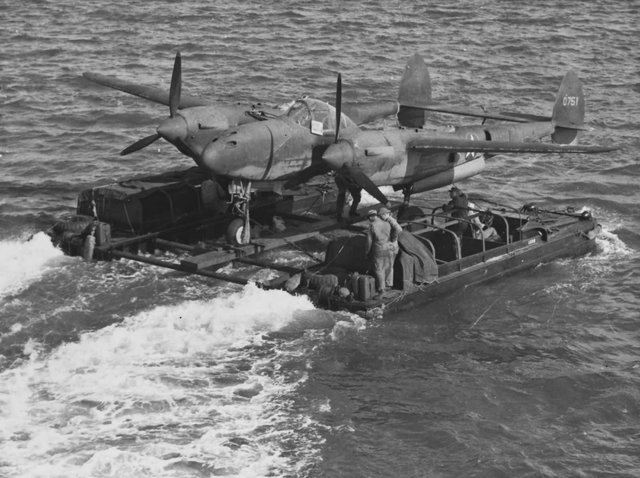
Ever see a P-38 on the water like this? LOL! A very |
|
interesting shot. |
|
https://i.postimg.cc/vm6SBrJz/P-38-Lightning-carried-by-two-DUKWs-0751.jpg |
|
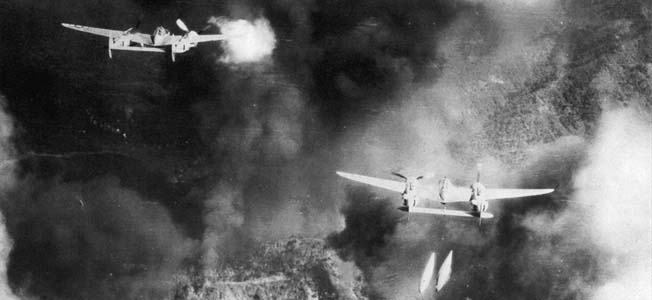
Here's a real life action shot of high flying P-38's. |
|
https://warfarehistorynetwork.com/wp-content/uploads/The-Lockheed-P-38-Lightnin… |
|
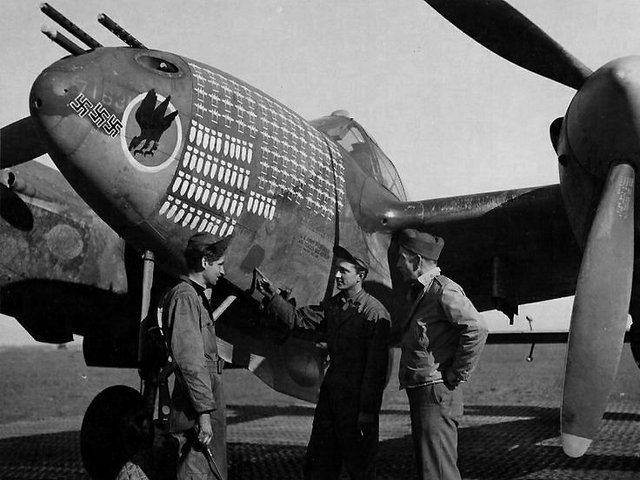
This bad boy (below) caused some heavy havoc to the enemy, note |
|
the mission/bomb nose entries. |
|
https://i.postimg.cc/qqjdLcMK/14232726377-76fc00002a-b.jpg |
|
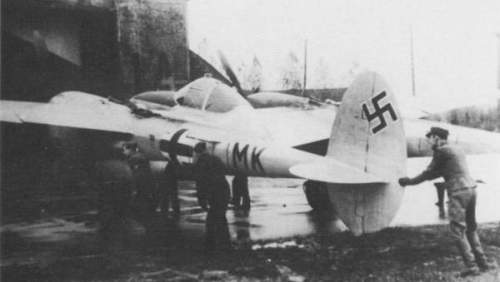
Even the Germans got in on the act (they recognized the P-38's |
|
excellence even with captured examples.) |
|
https://i.postimg.cc/0N80gp8j/g1nazi.jpg |
|
#Post#: 16208-------------------------------------------------- |
|
Re: Plane of the Week; the P-38 a revisit (against Germany) |
|
By: cafs Date: February 28, 2021, 7:24 am |
|
--------------------------------------------------------- |
|
Excellent POTW, Beo! Top. |
|
Designed as a long range interceptor, it struggle against |
|
single-engine fighetrs, as any other WW2 twin-engine |
|
fighter/heavy-fighter, but it excelled with the boom-and-zoom |
|
tactic. |
|
#Post#: 16209-------------------------------------------------- |
|
Re: Plane of the Week; the P-38 a revisit (against Germany) |
|
By: tsisqua Date: February 28, 2021, 7:27 am |
|
--------------------------------------------------------- |
|
Thanks you, Beo! She's been my favorite from the time I was a |
|
little boy, watching the TV go off the air as it used to every |
|
night. They would play the national anthem while showing |
|
military footage, and almost always the 38 was a featured plane. |
|
I giggled with glee when I saw it then and I still do now. Great |
|
essay. |
|
Maj. Jack Ilfrey had some great adventures in the 38J, and |
|
often talked about the lack of any real cockpit heat for the |
|
pilot in the cold weather, something which wasn't an issue in |
|
the PTO. On long missions, pee would freeze in the relief-tub, |
|
and once it couldn't leave the tube, would start to back up in |
|
it. Jack was once jumped from behind by a 109 and pushed the |
|
yoke forward to escape. When he did, all of his pee went zero-g; |
|
and flew up into the cockpit . . . instantly freezing on the |
|
inside of the canopy and destroying his visibility. He did get |
|
away safely, but when the ground crew was helping him out of the |
|
plane the smell was everywhere. And it was on everything. The |
|
chief looked at Jack and said "Did you get a little scared up |
|
there, Sir?". |
|
Thanks again, Sir! I LOVE this plane. |
|
#Post#: 16215-------------------------------------------------- |
|
Re: Plane of the Week; the P-38 a revisit (against Germany) |
|
By: E69_Haukka Date: February 28, 2021, 10:28 am |
|
--------------------------------------------------------- |
|
This article takes ten minutes to read, but it covers thousands |
|
of flight hours, thousands of fights. It is really hard to get |
|
an idea of the scale of the efforts of these people, during the |
|
years that the war lasted. I try to imagine what that pilot who |
|
had to go down in a field to rescue a teammate must have felt, |
|
without knowing if he was going to achieve it, and he succeeded. |
|
Thanks for this research work, Beowolff! |
|
#Post#: 18149-------------------------------------------------- |
|
Re: Plane of the Week; the P-38 a revisit (against Germany) |
|
By: sixstrings Date: December 11, 2021, 4:23 am |
|
--------------------------------------------------------- |
|
Excellent read ! Thanks ! My favorite twin engine fighter of WW |
|
II and one of my all time favorites. Good research... |
|
Regards,Scott |
|
***************************************************** |