 |
Return Create A Forum - Home |
 |
--------------------------------------------------------- |
|
IL2 Air Combat! |
 |
https://il2freemodding.createaforum.com |
|
--------------------------------------------------------- |
|
***************************************************** |
|
Return to: Plane of the Week Articles |
|
***************************************************** |
|
#Post#: 12729-------------------------------------------------- |
|
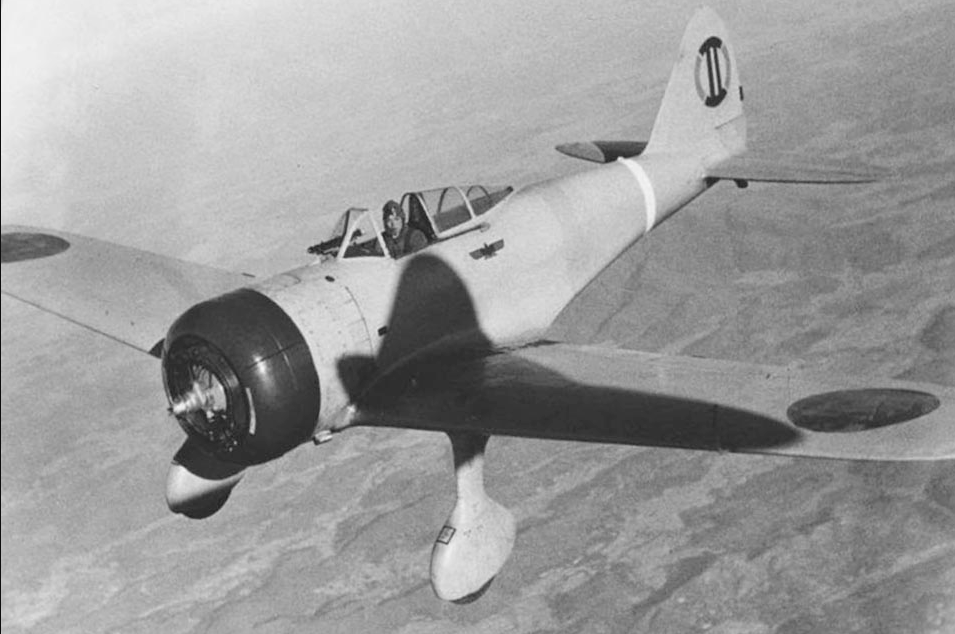
Plane of the Week: Nakajima Ki-27 |
|
By: vonofterdingen Date: September 28, 2020, 4:08 pm |
|
--------------------------------------------------------- |
|
[img width=1024 |
|
height=567] |
|
https://i.postimg.cc/L47T3TYb/Screen-Hunter-423.png[/img] |
|
I have an interest in early war planes, and this is one of |
|
them. Until the appearance of the famed Zero, the Ki-27 was |
|
Japan�s frontline fighter. The phase-out began in 1940, but the |
|
Ki-27 (�Nate� in allied code parlance) saw considerable action |
|
in China, Khalkhin Gol, Singapore, and Burma. Typical of |
|
Japanese fighters throughout the war, it was light weight and |
|
highly maneuverable. The maneuverability came with a cost |
|
however: it was lightly armed and had no pilot protection or |
|
self-sealing fuel tanks. |
|
From Wikipedia |
|
The Nakajima Ki-27 Type 97 Fighter was the main fighter |
|
aircraft used by the Imperial Japanese Army Air Force up until |
|
1940. Its Allied nickname was "Nate", although it was called |
|
"Abdul" in the "China Burma India" (CBI) theater by many post |
|
war sources; Allied Intelligence had reserved that name for the |
|
nonexistent Mitsubishi Navy Type 97 fighter, expected to be the |
|
successor to the carrier-borne Type 96 (Mitsubishi A5M) with |
|
retractable landing gear and an enclosed cockpit. |
|
In 1935, the Imperial Japanese Army held a competition |
|
between Nakajima, Mitsubishi, and Kawasaki to design a low-wing |
|
monoplane to replace the Kawasaki Ki-10 (Army Type 95 Fighter) |
|
biplane. The new fighter was to have also a better performance |
|
than the experimental Mitsubishi Ki-18. |
|
The results were the Nakajima Ki-27, the Kawasaki Ki-28, and |
|
the Mitsubishi Ki-33 (a modification of the Mitsubishi A5M |
|
carrier-based fighter). The Nakajima design was based on its |
|
earlier Ki-11 monoplane fighter which lost to the Ki-10 in the |
|
Type 95 Fighter competition. When the follow-up Nakajima Ki-12 |
|
proposal with a liquid-cooled engine and retractable landing |
|
gear was deemed too complex by the Japanese officials, the Ki-27 |
|
was designed by Koyama Yasushi to have an air-cooled radial |
|
engine and fixed landing gear. The aircraft had the Nakajima |
|
trademark wing with a straight leading edge and tapered trailing |
|
edge which would reappear again on the Ki-43, Ki-44, and Ki-84. |
|
The Ki-27 made its first flight on 15 October 1936. Although |
|
it had a slower top speed and worse climb performance than its |
|
competitors, the Army chose the Nakajima design for its |
|
outstanding turning ability granted by its remarkably low wing |
|
loading. The Army ordered 10 pre-production samples (Ki-27a) for |
|
further testing, which featured an enclosed cockpit with sliding |
|
canopy and larger wings. |
|
The type was officially accepted into service in 1937 as the |
|
Army Type 97 Fighter. In addition to Nakajima, the Ki-27 was |
|
also manufactured by Tachikawa Aircraft Company Ltd and |
|
Manshukoku Hikoki Seizo KK, with a total of 3,368 built before |
|
production ended in 1942. |
|
The Ki-27 was the Imperial Japanese Army Air Force's main |
|
fighter until the start of World War II. When placed into combat |
|
service over northern China in March 1938, the Ki-27 enjoyed air |
|
superiority until the introduction of the faster Soviet-built |
|
Polikarpov I-16 fighters by the Chinese. |
|
In the 1939 Battle of Khalkhin Gol against the USSR in |
|
Mongolia, the Ki-27 faced both Polikarpov I-15 biplane and |
|
Polikarpov I-16 monoplane fighters. In the initial phase of the |
|
conflict, its performance was a match for the early model I-16s, |
|
and was considerably superior to the I-15 biplane. With better |
|
trained Ki-27 pilots, the IJAAF gained aerial superiority. The |
|
Ki-27 was armed with two 7.7 mm (.303 in) Type 89 machine guns |
|
and as with most aircraft of the period, lacked armor protection |
|
for the pilot and self-sealing or fire suppression in the fuel |
|
tanks. |
|
https://i.postimg.cc/Xv3xyYGN/Screen-Hunter-424.png |
|
Later, the Soviet Air Force received improved I-16s. The |
|
faster, more heavily armed (with twin wing-mounted 20mm ShVAK |
|
cannons) and armored I-16 now nullified the Ki-27's advantages |
|
and it could now escape from the Ki-27 in a dive. The VVS |
|
introduced new tactics consisting of flying in large tightly |
|
knit formations, attacking with altitude and/or speed advantage |
|
and hit-and-run (high-energy) tactics much as Claire Chennault |
|
would later formulate for the 1941-era Flying Tigers (likewise |
|
to fly against Japanese forces). |
|
Japanese losses mounted but despite this they claimed 1,340 |
|
aircraft (six times the admitted Soviet losses and three times |
|
as many as Soviet aircraft admitted to being in the theatre). |
|
Japanese losses numbered 120 (including Ki-10s) while the |
|
Russians claimed 215 vs. a peak Japanese strength of 200 |
|
fighters. (Overclaiming remained commonplace through World War |
|
Two, despite gun cameras and expert intelligence assessments.) |
|
Top scoring pilot of the incident and top scoring IJAAF pilot on |
|
the Ki-27 and overall World War II IJAAF ace was Warrant Officer |
|
Hiromichi Shinohara, who claimed 58 Soviet planes (including an |
|
IJAAF record of 11 in one day) whilst flying Ki-27s, only to be |
|
shot down himself by a number of I-16s on 27 August 1939. |
|
The preference of Japanese fighter pilots for the Ki-27's |
|
high rate of turn caused the Army to focus excessively on |
|
maneuverability, a decision which later handicapped the |
|
development of faster and more heavily armed fighters. The Ki-27 |
|
served until the beginning of World War II in the Pacific, |
|
escorting bombers attacking Malaya, Singapore, Netherlands East |
|
Indies, Burma and the Philippines (where it initially fared |
|
poorly against the Brewster F2A Buffalo). |
|
The type also saw extensive action against the American |
|
Volunteer Group in the early months of the war. Soon outclassed |
|
by the American Curtiss P-40 Warhawks, the Ki-27 was replaced in |
|
front line service by the Nakajima Ki-43, while surviving |
|
examples continued to serve as a trainer. |
|
The Ki-27 was also exported for use with Manchukuo and Thai |
|
armed forces, seeing combat with both. In Thai service, Ki-27s |
|
reportedly damaged two North American P-51 Mustangs and shot |
|
down one Lockheed P-38 Lightning. |
|
In the final months of the war, desperate lack of aircraft |
|
forced the Japanese to utilize all available machines and the |
|
Ki-27 and 79 were no exception. Some were equipped with up to |
|
500 kg (1,100 lb) of explosives for kamikaze attacks, but some |
|
were redeployed as fighters, suffering terrible losses as on 16 |
|
February 1945 when the 39th Educational Flight Regiment |
|
scrambled 16 Ki-79 trainers from Yokoshiba Airfield to oppose a |
|
massive air raid from U.S. Task Force 58 carrier group, losing |
|
six aircraft with more damaged and five pilots killed, in return |
|
damaging at least one Hellcat and possibly downing a second. |
|
[img width=1024 |
|
height=500] |
|
https://i.postimg.cc/Jhqx3CZN/Screen-Hunter-425.png[/img] |
|
In game� |
|
My first experience with this aircraft was a Dutch campaign |
|
where the Ki-27 was a stand-in for a Fokker DXXI. Not long after |
|
that I flew it in a Khalkhin Gol campaign. It is highly |
|
maneuverable as advertised, but a bit slow and with a tendency |
|
to ignite when hit. The two rather feeble machine guns make it a |
|
bit difficult to bring down rugged adversaries also; planes like |
|
the I-16 and P-40 can be very difficult to damage. I don�t like |
|
it much as an adversary though. In Flying Tiger campaigns when I |
|
am flying P-40s against the Ki-27, I get a sense of what it must |
|
have been like to box Mohammed Ali. I line up the target, but as |
|
I pull the trigger the target had danced out of view. |
|
|
|
#Post#: 12732-------------------------------------------------- |
|
Re: Plane of the Week: Nakajima Ki-27 |
|
By: JG51_Ruski Date: September 28, 2020, 6:56 pm |
|
--------------------------------------------------------- |
|
Stout little plane and a good article Von Thank You !! |
|
#Post#: 12733-------------------------------------------------- |
|
Re: Plane of the Week: Nakajima Ki-27 |
|
By: ben_wh Date: September 28, 2020, 10:00 pm |
|
--------------------------------------------------------- |
|
Thanks von, for another great write-up. |
|
In-game: With the introduction of this plane and the proper |
|
maps, we got to simulate some very 'exotic' air battles indeed |
|
(flying in 'forgotten battles' is almost a specialty for IL-2 |
|
1946). |
|
You may start with the air battle over Nomonhan, where the match |
|
up between this plane against and the I-15 and I-16 actually |
|
made for some fun dogfight, somewhere between WWI and WWII type |
|
air battle. |
|
And if you want more (and are feeling brave), trying flying with |
|
the Royal Thai Air Force in this plane against P-38s and P-51s |
|
... (more here |
|
http://www.aviationofjapan.com/2013/11/royal-thai-air-force-nates-ki-27-aces.ht… |
|
[img width=1024 |
|
height=736] |
|
https://2.bp.blogspot.com/-B7mtgmIFLPw/UoIBCDJO8nI/AAAAAAAAGew/Nm72yPoj0j4/s160… |
|
|
|
[font=verdana]And the community has provided some great skins |
|
for the Ki-27.[/font] |
|
As you have stated, it is frustrating both flying in and against |
|
this plane. |
|
When you're flying this plane, you have essentially the same |
|
armament as the Sopwith Camel from the last war. You need to |
|
make every shot count. With its durability you've got to watch |
|
your back all the time, but you can do all sorts of acrobatics |
|
with this plane and dance around your enemies. |
|
Flying against the Ki-27, its supreme agility makes hit-and-run |
|
tactic a necessity, even when you're in an I-16 (let alone the |
|
Hawk-81). Surprisingly I found the damage model of this plane |
|
more robust than expected in-game, and it _feels_ more difficult |
|
to bring down than a Ki-43-I. When flying the Hawk-81 against |
|
this over Burma, I learned not only to employ hit-and-run tactic |
|
but to hold fire until very close, aiming for the cockpit/ |
|
engine so that the 0.303 on the Hawk can be effective. |
|
|
|
Cheers, |
|
#Post#: 12736-------------------------------------------------- |
|
Re: Plane of the Week: Nakajima Ki-27 |
|
By: vonofterdingen Date: September 28, 2020, 11:31 pm |
|
--------------------------------------------------------- |
|
My experience with the Hawk 81 is very similar. I would pursue a |
|
Nate and suddenly realize that I had spent all of my ammo. Good |
|
idea to get in close. |
|
#Post#: 12744-------------------------------------------------- |
|
Re: Plane of the Week: Nakajima Ki-27 |
|
By: cafs Date: September 29, 2020, 8:01 am |
|
--------------------------------------------------------- |
|
Great PoW, Von. |
|
The Ki-27 has two quite small fuel tanks, 70 liters each, one |
|
behind the other on each wing, very close to the fuselage, with |
|
a smaller, 50 l, behind the engine. Having a large, but empty, |
|
wing she can 'absorve' a lot of bullets, the same for the |
|
fuselage half end. You need to put all your bullets around the |
|
cockpit and on the nose, the rest is, almost, a waste of ammo, |
|
unless you hit the wing spar with a .50 or 20mm explosive shell, |
|
a really 'lucky hit'. |
|
#Post#: 12747-------------------------------------------------- |
|
Re: Plane of the Week: Nakajima Ki-27 |
|
By: Beowolff Date: September 29, 2020, 8:06 am |
|
--------------------------------------------------------- |
|
Whoa! SUPER nice article here...tons of good info and I like |
|
the pictures too! Great job on this! |
|
S! |
|
Beo |
|
***************************************************** |



![https://i.postimg.cc/L47T3TYb/Screen-Hunter-423.png[/img]](https://i.postimg.cc/L47T3TYb/Screen-Hunter-423.png[/img])
![https://i.postimg.cc/Jhqx3CZN/Screen-Hunter-425.png[/img]](https://i.postimg.cc/Jhqx3CZN/Screen-Hunter-425.png[/img])
