 |
Return Create A Forum - Home |
 |
--------------------------------------------------------- |
|
IL2 Air Combat! |
 |
https://il2freemodding.createaforum.com |
|
--------------------------------------------------------- |
|
***************************************************** |
|
Return to: Plane of the Week Articles |
|
***************************************************** |
|
#Post#: 12383-------------------------------------------------- |
|
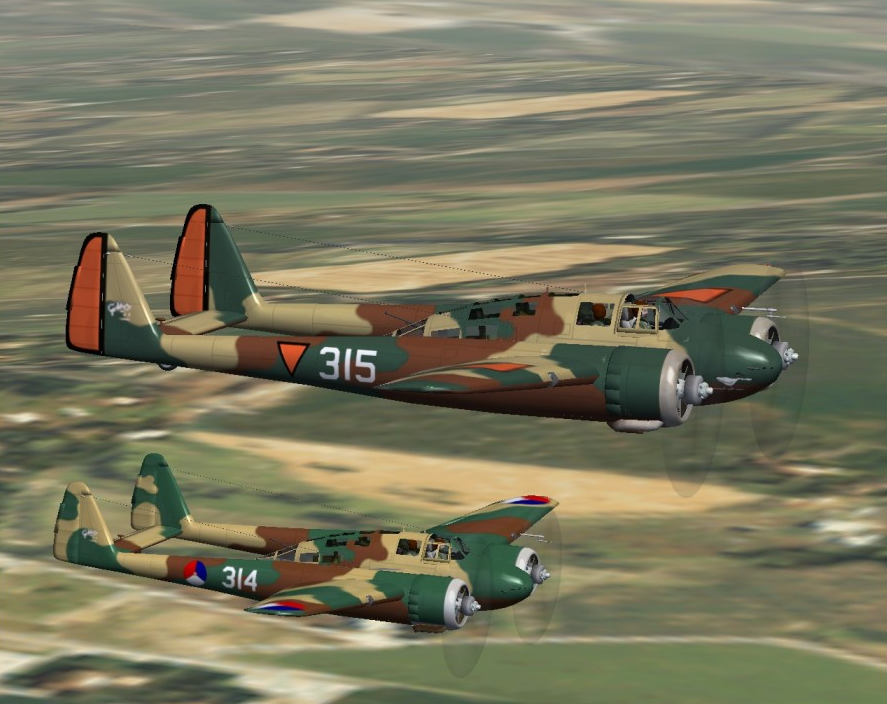
Plane of the week: Fokker G.I |
|
By: vonofterdingen Date: September 1, 2020, 4:32 pm |
|
--------------------------------------------------------- |
|
https://i.postimg.cc/3xgQnKRk/Screen-Hunter-411.png |
|
[font=Verdana] [/font] |
|
Sometimes just looking cool is good enough for me. I love the |
|
look of the Fokker G.I. I have always liked �heavy fighters� |
|
anyway and this might be the best looking one of the lot. I have |
|
also generally liked to fly Fokker aircraft, not just because |
|
they are an iconic military and civilian manufacturer, but also |
|
because their planes fly well and have a design flare. |
|
Unfortunately, this particular Fokker product did not see much |
|
action in WW2 due to the rather quick fall of the Netherlands. |
|
|
|
From Wikipedia |
|
The Fokker G.I was a Dutch twin-engined heavy fighter |
|
aircraft comparable in size and role to the German Messerschmitt |
|
Bf 110. Although in production prior to World War II, its combat |
|
introduction came at a time the Netherlands were overrun by the |
|
Germans. The few G.Is that were mustered into service were able |
|
to score several victories. Some were captured intact after the |
|
Germans had occupied the Netherlands. The remainder of the |
|
production run was taken over by the Luftwaffe for use as |
|
trainers. |
|
The G.I, given the nickname le Faucheur ("The Reaper" in |
|
French), was designed as a private venture in 1936 by Fokker |
|
chief engineer Dr. Schatzki. Intended for the role of |
|
jachtkruiser, "heavy" fighter or air cruiser, able to gain air |
|
superiority over the battlefield as well as being a bomber |
|
destroyer, the G.1 would fulfill a role seen as important at the |
|
time, by advocates of Giulio Douhet's theories on air power. The |
|
Fokker G.I utilized a twin-engined, twin-boom layout that |
|
featured a central nacelle housing two or three crew members (a |
|
pilot, radio operator/navigator/rear gunner or a bombardier) as |
|
well as a formidable armament of twin 23 mm (.91 in) Madsen |
|
cannon and a pair of 7.9 mm (.31 in) machine guns (later eight |
|
machine guns) in the nose and one in a rear turret. |
|
Besides its main mission, the G.1 could be configured for |
|
ground attack and light bombing missions (it could carry a bomb |
|
load of one 400 kg/882 lb bomb or combinations of two 200 kg/441 |
|
lb or 10 26 kg/57 lb bombs). |
|
The design and construction of the prototype (registered as |
|
X-2) was completed in just seven months. At its introduction at |
|
the Paris Air Show in November 1936, even before its first |
|
flight, the G.I was a sensation, appearing in a purple and |
|
yellow finish (evocative of the Spanish Republican colors, |
|
thought to be Fokker's first export customer). |
|
Like all Fokker aircraft of the period, the G.I was of mixed |
|
construction; the front of the central pod were built around a |
|
welded frame, covered with aluminium plating. The back of the |
|
central pod, however, as well as the wings, were completely |
|
constructed with wood. |
|
The G.I prototype, powered by 485 kW (650 hp) Hispano-Suiza |
|
14AB-02/03 engines, had its first flight at Welschap Airfield, |
|
near Eindhoven on 16 March 1937 with Karel Mares at the |
|
controls.[3] Later, Emil Meinecke took over much of the test |
|
flights. The maiden flight went well, but a subsequent test |
|
flight in September 1937 ended with a supercharger explosion |
|
that nearly caused the loss of the prototype.[4] The accident |
|
prompted a replacement of the Hispano-Suiza engines with 559 kW |
|
(750 hp) Pratt & Whitney SB4-G Twin Wasp Junior engines. |
|
During testing, the company received a contract from the |
|
Spanish Republican government for 26 G.1 "export" versions with |
|
Pratt & Whitney engines. Despite receiving payment, the order |
|
was destined never to be fulfilled as the Dutch government |
|
placed an embargo on the sale of military equipment to Spain. |
|
Fokker however continued building the aircraft and a story was |
|
released to the press that they were intended for Finland, hence |
|
the persistent tales about a "Finnish" order. To make matters |
|
more complex, Finland showed great interest in the G.I, but |
|
eventually purchased Bristol Blenheim light bombers. |
|
Besides the Dutch Luchtvaartafdeeling, several foreign air |
|
forces showed an interest in the G.I. as either a fighter or |
|
dive-bomber. In order to test its potential as a dive-bomber, |
|
the G.1 prototype was fitted with hydraulically operated dive |
|
brakes under the wings. Flight tests revealed that the G.1 was |
|
capable of diving at over 644 km/h (400 mph) and demonstrated |
|
aerobatic capabilities. Swedish Air Force officer Captain Bj�rn |
|
Bjuggren tested the G.1 in over 20 dives and reported favourably |
|
on its effectiveness as a dive bomber. Orders for G.1 Wasp |
|
aircraft came from Spain (26 ordered) and Sweden (18), while the |
|
Mercury variant was ordered by Denmark (12) together with a |
|
production license that never came to be used, and Sweden (72). |
|
Although Belgium, Finland, Turkey, Hungary and Switzerland air |
|
forces showed great interest, they never placed firm orders. |
|
The Luchtvaartafdeeling ordered 36 G.I's with 541 kW (825 hp) |
|
Bristol Mercury VIII engines, the standard engine used by the |
|
Dutch Air Force in the Fokker D.XXI fighter, in order to equip |
|
two squadrons. Only the first four examples were built as |
|
three-seaters intended for ground-attack, with the remainder |
|
being completed as two-seat fighters. During the lead-up to |
|
hostilities, a total of 26 G.I's were operational in the 3rd |
|
Jachtvliegtuigafdeling (JaVA) at Rotterdam (Waalhaven Airfield), |
|
and 4th JaVA Fighter Group at Bergen near Alkmaar. The aircraft |
|
were actively involved in border patrols and in order to ensure |
|
neutrality, on 20 March 1940, a G.1 from 4th JaVA forced down an |
|
Armstrong Whitworth Whitley from the RAF's 77 sqn when it |
|
strayed into Dutch air space. |
|
On 10 May 1940, when Nazi Germany invaded the Netherlands, 23 |
|
G.1 aircraft were serviceable while production of Spain's order |
|
of the G.1 Wasp variant continued with a dozen aircraft |
|
completed, awaiting armament. |
|
[img width=1024 |
|
height=598] |
|
https://i.postimg.cc/rpMXHv0Q/Screen-Hunter-412.png[/img] |
|
The German invasion started with an early morning (03:50 |
|
hours) Luftwaffe attack on the Dutch airfields. While the 4th |
|
JaVA received a devastating blow, losing all but one of its |
|
aircraft, eight 3rd JaVA G.1 fighters of the Waalhaven airbase |
|
in Rotterdam, that were already fully fueled and armed, |
|
scrambled in time and successfully engaged several German |
|
aircraft. The surviving aircraft continued to fly, but with |
|
mounting losses, bringing their numbers down to three airworthy |
|
aircraft by the end of the first day. Despite the heavy losses |
|
of 4th JaVA, some of the planes could be kept in the air by |
|
scavenging parts from various planes. In the "Five-day War", the |
|
available G.1 fighters were mainly deployed in ground attack |
|
missions, strafing advancing German infantry units, but also |
|
used to attack Junkers Ju 52/3m transports. Although reports are |
|
fragmentary and inaccurate as to the results, G.1 fighters were |
|
employed over Rotterdam and the Hague, contributing to the loss |
|
of 167 Ju 52s, scoring up to 14 confirmed aerial kills. |
|
[img width=1024 |
|
height=646] |
|
https://i.postimg.cc/tJL8NfGd/Screen-Hunter-410.png[/img] |
|
In game� |
|
I have liked flying this aircraft since it first hit the mod |
|
scene many years ago. I set about to make a campaign for it but |
|
did not do so due to the short operational history. My original |
|
idea was to make a Dutch East Indies campaign for it, but |
|
learned rather quickly the G.I was not operational in the Dutch |
|
East Indies. Though the 5-day war over the Netherlands was |
|
brief, I may yet revisit that approach. The plane is still fun |
|
to fly in single missions. I don�t much like to encounter |
|
Bf-109s in the Fokker G.1, but it will definitely hold its own |
|
against the Bf-110 and Axis bombers and transports. |
|
|
|
#Post#: 12384-------------------------------------------------- |
|
Re: Plane of the week: Fokker G.I |
|
By: JG51_Ruski Date: September 1, 2020, 6:10 pm |
|
--------------------------------------------------------- |
|
Sure is a beauty Von Thanks for helping me learn about planes |
|
I've never heard of |
|
#Post#: 12385-------------------------------------------------- |
|
Re: Plane of the week: Fokker G.I |
|
By: vonofterdingen Date: September 2, 2020, 12:11 am |
|
--------------------------------------------------------- |
|
This one is definitely worth a flight or two in the QMB. |
|
#Post#: 12386-------------------------------------------------- |
|
Re: Plane of the week: Fokker G.I |
|
By: cafs Date: September 2, 2020, 7:33 am |
|
--------------------------------------------------------- |
|
She was a docile plane, almost without any vicious. Dimon's |
|
model is a pleasure to fly. |
|
Great PoW Von, thanks. |
|
#Post#: 12388-------------------------------------------------- |
|
Re: Plane of the week: Fokker G.I |
|
By: E69_Haukka Date: September 2, 2020, 12:08 pm |
|
--------------------------------------------------------- |
|
It is a delightful plane to fly. I had the opportunity to fly it |
|
in a mission of the Fall Gelb campaign, earlier this year, |
|
flying for the Netherlands, a campaign organized by the Spanish |
|
squadron E24F, where pilots from the Patrulla Azul (Blue Patrol) |
|
and Escuadr�n 69 (Squadron 69) participated. On that occasion we |
|
flew with the excellent Ypack 1.2.3. |
|
Thank you very much for this article, Von. |
|
https://www.youtube.com/watch?v=lUS4tv9iShE |
|
#Post#: 12401-------------------------------------------------- |
|
Re: Plane of the week: Fokker G.I |
|
By: larsresult Date: September 3, 2020, 7:03 am |
|
--------------------------------------------------------- |
|
Very interesting clip Haukka. I have always liked YPack123 for |
|
its crisper maps and refined effects. |
|
In addition to Von's excellent write up I have found some more |
|
information. Authors Paul van der Horst and Luuk Boerman |
|
recently released a profile book on the Fokker G1 and have |
|
managed to discover the following: |
|
24 G1s with Mercury engines were serviceable on 10th May 1940. |
|
19 were destroyed on the ground by the Luftwaffe, or the Dutch |
|
staff to prevent them falling into enemy hands. |
|
Only 3 were shot down, one by a Ju52 dorsal gunner. |
|
During the four days of combat they shot down 7 He111s, 3 Ju52s, |
|
3 Bf109s, 1 Do17 and damaged 2 Bf109s, 2 Ju88s, 1 Ju52, 1 Ju87, |
|
and some He111s. |
|
***************************************************** |



![https://i.postimg.cc/rpMXHv0Q/Screen-Hunter-412.png[/img]](https://i.postimg.cc/rpMXHv0Q/Screen-Hunter-412.png[/img])
![https://i.postimg.cc/tJL8NfGd/Screen-Hunter-410.png[/img]](https://i.postimg.cc/tJL8NfGd/Screen-Hunter-410.png[/img])