 |
Return Create A Forum - Home |
 |
--------------------------------------------------------- |
|
IL2 Air Combat! |
 |
https://il2freemodding.createaforum.com |
|
--------------------------------------------------------- |
|
***************************************************** |
|
Return to: Plane of the Week Articles |
|
***************************************************** |
|
#Post#: 12310-------------------------------------------------- |
|
Plane of the Week: Republic P-47 Thunderbolt (aka "Jug" |
|
;) |
|
By: vonofterdingen Date: August 24, 2020, 3:16 pm |
|
--------------------------------------------------------- |
|
[img width=1024 |
|
height=742] |
|
https://i.postimg.cc/Gp3sBq3b/Screen-Hunter-408.png[/img] |
|
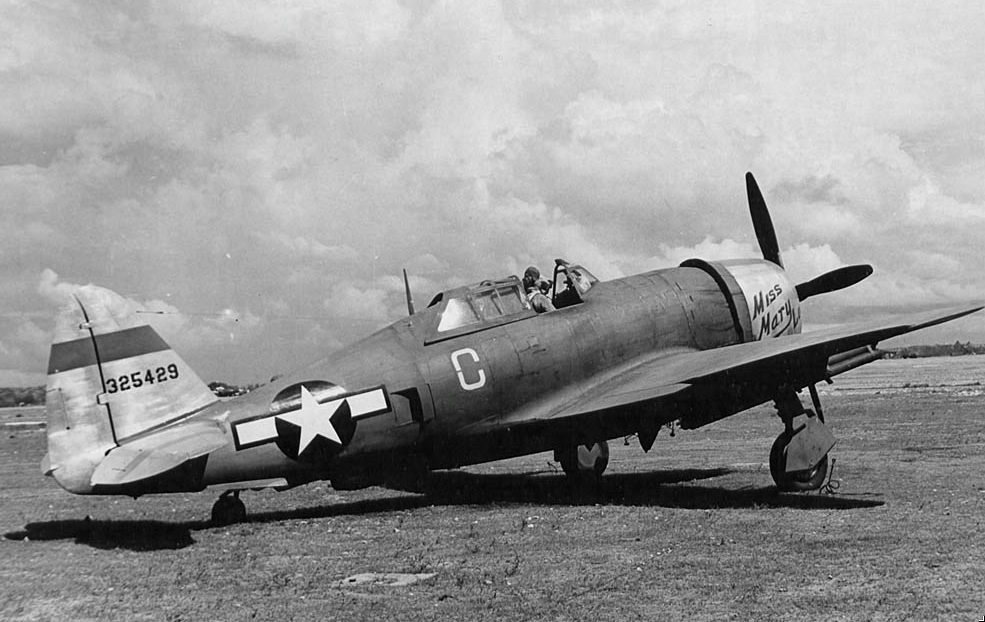
The Republic P-47 Thunderbolt, or �Jug� as US pilots liked to |
|
call it, is an unusual fighter aircraft. When I think of fighter |
|
planes I think of light weight designs with elegant, sleek |
|
lines: planes like the Bf-109, Supermarine Spitfire, Mitsubishi |
|
Zero, Macchi 202, and so on. I don�t think of a plane that |
|
crewman named after large metal jugs used to transport milk in |
|
the US (I am old enough to remember milk jugs). But when you |
|
look at US aircraft design, and Russian too for that matter, in |
|
this period, the design is no surprise. It is big, rugged, |
|
heavily armed, and protective of its pilot. And it is easy to |
|
maintain by trained US ground crews. If the P-47 had a longer |
|
range, we may never have seen the P-51 Mustang. |
|
From Wikipedia |
|
The Republic P-47 Thunderbolt was a World War II-era fighter |
|
aircraft produced by the American aerospace company Republic |
|
Aviation from 1941 through 1945. Its primary armament was eight |
|
.50-caliber machine guns, and in the fighter-bomber |
|
ground-attack role it could carry five-inch rockets or a bomb |
|
load of 2,500 pounds (1,133 kg). When fully loaded, the P-47 |
|
weighed up to eight tons, making it one of the heaviest fighters |
|
of the war. The P-47 was designed around the powerful Pratt & |
|
Whitney R-2800 Double Wasp engine, which was also used by two |
|
U.S. Navy/U.S. Marine Corps fighters, the Grumman F6F Hellcat |
|
and the Vought F4U Corsair. The Thunderbolt was effective as a |
|
short-to medium-range escort fighter in high-altitude air-to-air |
|
combat and ground attack in both the European and Pacific |
|
theaters. |
|
The P-47 was one of the main United States Army Air Forces |
|
(USAAF) fighters of World War II, and also served with other |
|
Allied air forces, including those of France, the United |
|
Kingdom, and the Soviet Union. Mexican and Brazilian squadrons |
|
fighting alongside the USAAF also flew the P-47. |
|
The armored cockpit was relatively roomy and comfortable and |
|
the bubble canopy introduced on the P-47D offered good |
|
visibility. A present-day U.S. ground-attack aircraft, the |
|
Fairchild Republic A-10 Thunderbolt II, takes its name from the |
|
P-47. |
|
Initial response to the P-47 praised its dive speed and |
|
high-altitude performance while criticizing its turning |
|
performance and rate of climb (particularly at low-to-medium |
|
altitudes). The turbosupercharger in the P-47 gave the |
|
powerplant its maximum power at 27,000 ft (8,230 m) and, in the |
|
thin air above 30,000 ft (9,144 m), the Thunderbolt remained |
|
fast and nimble compared to other aircraft. |
|
The P-47 first saw action with the 4th Fighter Group. The |
|
Group's pilots were mainly drawn from the three British Eagle |
|
Squadrons who had previously flown the British Supermarine |
|
Spitfire Mark V, a much smaller and much more slender aircraft. |
|
At first, they viewed their new fighter with misgivings. It was |
|
huge; the British pilots joked that a Thunderbolt pilot could |
|
defend himself from a Luftwaffe fighter by running around and |
|
hiding in the fuselage. Optimized for high altitude work, the |
|
Thunderbolt had 5 feet (1.5 m) more wingspan, a quarter more |
|
wing area, about four times the fuselage volume, and nearly |
|
twice the weight of a Spitfire V. One Thunderbolt pilot compared |
|
it to flying a bathtub around the sky. When his unit (4th |
|
Fighter Group) was equipped with Thunderbolts, ace Don Blakeslee |
|
said, referring to the P-47's vaunted ability to dive on its |
|
prey, "It ought to be able to dive. It certainly can't climb." |
|
(Blakeslee's early-model P-47C had not been fitted with the new |
|
paddle blade propeller). The 4th Fighter Group's commander hated |
|
the P-47, and his prejudices filtered down to the group's |
|
pilots; the 4th had the fewest kills of any of the first three |
|
P-47 squadrons in Europe. |
|
The U.S. ace Jim Goodson, who had flown Spitfires with the RAF |
|
and flew a P-47 in 1943, at first shared the skepticism of other |
|
pilots for their "seven-ton milk-bottles". But Goodson learned |
|
to appreciate the P-47's potential: "There were many U.S. pilots |
|
who preferred the P-47 to anything else: they do not agree that |
|
the (Fw) 190 held an overall edge against it." |
|
The P-47's initial success in combat was primarily due to |
|
tactics, using rolls (the P-47 had an excellent roll rate) and |
|
energy-saving dive and zoom climbs from high altitude to |
|
outmaneuver German fighters. Both the Bf 109 and Fw 190 could, |
|
like the Spitfire, out-turn and out-climb the early model P-47s |
|
at low-to-medium altitude. Once paddle blade propellers were |
|
added to the P-47 in early 1944, climb performance improved |
|
significantly. The Thunderbolt was the fastest-diving American |
|
aircraft of the war�it could reach speeds of 550 mph (480 kn, |
|
885 km/h)[citation needed]. Some P-47 pilots claimed to have |
|
broken the sound barrier, but later research revealed that |
|
because of the pressure buildup inside the pitot tube at high |
|
speeds, airspeed readings became unpredictably exaggerated. But |
|
German pilots gradually learned to avoid diving away from a |
|
Thunderbolt. Kurt B�hligen, a high-scoring German fighter ace |
|
with 112 victories, recalled: |
|
The P-47 was very heavy, too heavy for some maneuvers. We |
|
would see it coming from behind, and pull up fast and the P-47 |
|
couldn't follow and we came around and got on its tail in this |
|
way. |
|
https://i.postimg.cc/13rq5LQW/Screen-Hunter-410.png |
|
The arrival of the new Curtiss paddle blade propeller |
|
significantly increased climb rate at lower altitudes and came |
|
as a surprise to German pilots who had resorted to steep climbs |
|
to evade pursuit by the P-47. Other positive attributes |
|
included the P-47's ruggedness; it could sustain a large amount |
|
of damage and still be able to get its pilot back to base.[Note |
|
6] With eight .50 in (12.7 mm) machine guns, the P-47 carried |
|
more firepower than other single-engined American fighters. P-47 |
|
pilots claimed 20 Luftwaffe Messerschmitt Me 262 jet fighters |
|
and four Arado Ar 234 jet bombers in aerial combat. |
|
In the Pacific, Colonel Neel E. Kearby of the Fifth Air Force |
|
claimed 22 Japanese aircraft and was awarded the Medal of Honor |
|
for an action in which he downed six enemy fighters on a single |
|
mission. He was shot down and killed over Wewak in March 1944. |
|
The P-47 proved to be a formidable fighter-bomber due to its |
|
good armament, heavy bomb load and ability to survive enemy |
|
fire. The P-47's survivability was due in part to its radial |
|
piston engine, which unlike comparable liquid-cooled engines, |
|
had a high tolerance for damage. The Thunderbolt's eight .50 in |
|
(12.7 mm) machine guns were capable against lightly armored |
|
targets, although less so than cannon-armed aircraft of the day. |
|
In a ground attack role, the armor-piercing (AP), armor-piercing |
|
incendiary (API), and armor-piercing incendiary tracer (APIT) |
|
ammunition proved useful in penetrating thin-skinned and lightly |
|
armored German vehicles and exploding their fuel tanks, as well |
|
as occasionally damaging some types of enemy armored fighting |
|
vehicles (AFVs). |
|
P-47 pilots frequently carried two 500 lb (227 kg) bombs, |
|
using skip bombing techniques for difficult targets (skipping |
|
bombs into railroad tunnels to destroy hidden enemy trains was a |
|
favorite tactic). The adoption of the triple-tube M10 rocket |
|
launcher with M8 high-explosive 4.5 in (110 mm) rockets (each |
|
with an explosive force similar to a 105 mm artillery |
|
shell)�much as the RAF's Hawker Typhoon gained when first fitted |
|
with its own two quartets of underwing RP-3 rockets for the same |
|
purposes�significantly increased the P-47's ground attack |
|
capability. Late in the war, the P-47 was retrofitted with more |
|
powerful 5 in (130 mm) HVAR rockets. |
|
By the end of 1942, P-47Cs were sent to England for combat |
|
operations. The initial Thunderbolt flyers, 56th Fighter Group, |
|
was sent overseas to join the 8th Air Force. As the P-47 |
|
Thunderbolt worked up to operational status, it gained a |
|
nickname: the "Jug" (because its profile was similar to that of |
|
a common milk jug of the time). Two Fighter Groups already |
|
stationed in England began introducing the Jugs in January 1943: |
|
the Spitfire-flying 4th Fighter Group, a unit built around a |
|
core of experienced American pilots who had flown in the RAF |
|
Eagle Squadrons prior to the US entry in the war; and the 78th |
|
Fighter Group, formerly flying P-38 Lightnings. |
|
Beginning in January 1943, Thunderbolt fighters were sent to |
|
the joint Army Air Forces � civilian Millville Airport in |
|
Millville, New Jersey in order to train civilian and military |
|
pilots. |
|
The first P-47 combat mission took place 10 March 1943 when |
|
the 4th FG took their aircraft on a fighter sweep over France. |
|
The mission was a failure due to radio malfunctions. All P-47s |
|
were refitted with British radios, and missions resumed 8 April. |
|
The first P-47 air combat took place 15 April with Major Don |
|
Blakeslee of the 4th FG scoring the Thunderbolt's first air |
|
victory (against a Focke-Wulf Fw 190). |
|
By mid-1943, the Jug was also in service with the 12th Air |
|
Force in Italy[14] and against the Japanese in the Pacific, with |
|
the 348th Fighter Group flying missions out of Port Moresby, New |
|
Guinea. By 1944, the Thunderbolt was in combat with the USAAF in |
|
all its operational theaters except Alaska. |
|
P-47s were operated by several Allied air arms during World |
|
War II. The RAF received 240 razorback P-47Ds which they |
|
designated "Thunderbolt Mark I", and 590 bubbletop P-47D-25s, |
|
designated "Thunderbolt Mark IIs". With no need for another |
|
high-altitude fighter, the RAF adapted their Thunderbolts for |
|
ground attack, a task for which the type was well suited. Once |
|
the Thunderbolts were cleared for use in 1944, they were used |
|
against the Japanese in Burma by 16 RAF squadrons of the South |
|
East Asia Command from India. Operations with army support |
|
(operating as "cab ranks" to be called in when needed), attacks |
|
on enemy airfields and lines of communication, and escort |
|
sorties. They proved devastating in tandem with Spitfires during |
|
the Japanese breakout attempt at the Sittang Bend in the final |
|
months of the war. The Thunderbolts were armed with three 500 lb |
|
(227 kg) bombs or, in some cases, British "60 pound" (27 kg) |
|
RP-3 rocket projectiles. Long range fuel tanks gave five hours |
|
of endurance. Thunderbolts flew escort for RAF Liberators in the |
|
bombing of Rangoon. Thunderbolts remained in RAF service until |
|
October 1946. Post-war RAF Thunderbolts were used in support of |
|
the Dutch attempts to reassert control of Batavia. Those |
|
squadrons not disbanded outright after the war re-equipped with |
|
British-built aircraft such as the Hawker Tempest. |
|
During the Italian campaign, the "1� Grupo de Ca�a da For�a |
|
A�rea Brasileira" (Brazilian Air Force 1st Fighter Squadron) |
|
flew a total of 48 P-47Ds in combat (of a total of 67 received, |
|
19 of which were backup aircraft). This unit flew a total of 445 |
|
missions from November 1944 to May 1945 over northern Italy and |
|
Central Europe, with 15 P-47s lost to German flak and five |
|
pilots being killed in action. In the early 1980s, this unit was |
|
awarded the "Presidential Unit Citation" by the American |
|
government in recognition for its achievements in World War II. |
|
From March 1945 to the end of the war in the Pacific�as |
|
Mexico had declared war on the Axis on May 22, 1942�the Mexican |
|
Escuadr�n A�reo de Pelea 201 (201st Fighter Squadron) operated |
|
P-47Ds as part of the U.S. 5th Air Force in the Philippines. In |
|
791 sorties against Japanese forces, the 201st lost no pilots or |
|
aircraft to enemy action. |
|
The French Air Force received 446 P-47Ds from 1943. These |
|
aircraft saw extensive action in France and Germany and again in |
|
the 1950s during the Algerian War of Independence. |
|
After World War II, the Italian Air Force (AMI) received 75 |
|
P-47D-25s sent to 5˚ Stormo, and 99 to the 51˚. These |
|
machines were delivered between 1947 and 1950. However, they |
|
were not well liked, as the Italian pilots were used to much |
|
lighter aircraft and found the controls too heavy. Nevertheless, |
|
the stability, payload and high speed were appreciated. Most |
|
importantly, the P-47 served as an excellent transition platform |
|
to heavier jet fighters, including the F-84 Thunderjet, starting |
|
in 1953. |
|
The type was provided to many Latin American air forces some |
|
of which operated it into the 1960s. Small numbers of P-47s were |
|
also provided to China, Iran, Turkey and Yugoslavia. |
|
[img width=1024 |
|
height=607] |
|
https://i.postimg.cc/g0ML38r8/Screen-Hunter-407.png[/img] |
|
In game� |
|
This is my favorite US ground attack plane. I like it in |
|
aerial combat too, but in most P-47 campaigns, including my own, |
|
you will find yourself in the ground attack role because that |
|
was the historical norm. That being said, however, let�s tip our |
|
caps to Gabby Gabreski, the US P-47 ace. But the 8 .50 caliber |
|
machine guns plus bombs or rockets (I personally prefer rockets) |
|
are devastating to tanks and supply columns. And though the |
|
aircraft is large and heavy, the powerful Pratt and Whitney |
|
engine gives it responsive controls and makes it a very stable |
|
gun platform. |
|
#Post#: 12312-------------------------------------------------- |
|
Re: Plane of the Week: Republic P-47 Thunderbolt (aka "Jug& |
|
quot;) |
|
By: JG51_Ruski Date: August 24, 2020, 4:14 pm |
|
--------------------------------------------------------- |
|
Good post Von..when it comes to moving mud the Jug is the tool |
|
to use,,Thanks |
|
#Post#: 12328-------------------------------------------------- |
|
Re: Plane of the Week: Republic P-47 Thunderbolt (aka "Jug& |
|
quot;) |
|
By: ben_wh Date: August 25, 2020, 6:50 pm |
|
--------------------------------------------------------- |
|
von, |
|
Thank you for another great post. An excellent boom-and-zoom |
|
fighter in game, made better by modders', skinners' and mission |
|
builders' effort: |
|
1) There is a great P-47 documentary on Netflix ('Thunderbolt'), |
|
also available here: |
|
here |
|
https://www.youtube.com/watch?v=Da_gbVd6nzM |
|
If this documentary makes you want to fly interdiction missions |
|
over Italy, DHumphrey made an excellent campaign on this topic |
|
here |
|
http://www.mission4today.com/index.php?name=Downloads3&file=details&id=2633<br |
|
/> |
|
2) In-game, please do not miss the great P-47 Pack + Cockpit |
|
add-on combination here |
|
https://www.sas1946.com/main/index.php/topic,63113.0.html. |
|
This |
|
provides you with access to the high performance late variants |
|
P-47s: P-47M and P-47N, while Poncho's cockpits transform the |
|
P-47 flight experience in-game |
|
3) There are many great skins for the P-47 (e.g. I especially |
|
recommend those from eMeL (Wolf-Pack Collection |
|
http://www.mission4today.com/index.php?name=Downloads2&file=details&id=7032),<br |
|
/>200th_Taro |
|
http://www.mission4today.com/index.php?name=Downloads2&file=details&id=8180,<br |
|
/>sakai |
|
http://www.mission4today.com/index.php?name=Downloads2&file=details&id=7844,<br |
|
/>R0NNC0 |
|
http://www.mission4today.com/index.php?name=Downloads2&file=details&id=5017<br |
|
/>and vpmedia |
|
http://www.mission4today.com/index.php?name=Downloads2&file=details&id=8170<br |
|
/>among others) |
|
Cheers, |
|
#Post#: 12331-------------------------------------------------- |
|
Re: Plane of the Week: Republic P-47 Thunderbolt (aka "Jug& |
|
quot;) |
|
By: DHumphrey Date: August 25, 2020, 7:05 pm |
|
--------------------------------------------------------- |
|
Yet another excellent article Von ... very well done !!! :) |
|
Thanks Ben_wh for the plug on my P-47 Campaign. :) |
|
Here's a decent P-47 flick for those interested. :) |
|
https://www.youtube.com/watch?v=Bmc1uzJ9-i8 |
|
#Post#: 12332-------------------------------------------------- |
|
Re: Plane of the Week: Republic P-47 Thunderbolt (aka "Jug& |
|
quot;) |
|
By: robyfongaro Date: August 26, 2020, 8:38 am |
|
--------------------------------------------------------- |
|
Interesting note: The designer was Alexander Kartveli, an |
|
immigrated Russian (well, he was Georgian, but back then it was |
|
still Soviet Union; Georgia became indipendent only in 1991). |
|
Originally the company started out as the "Seversky Aero |
|
Corporation" as with him there was also Alexander de Seversky, |
|
another immigrated Russian (also from Georgia), which built the |
|
P-35 (that the italians basicaly copied with the Re.2000), but |
|
by 1939, Seversky had left and his company had become the |
|
"Republic Aviation Corporation". |
|
Alexander Kartveli |
|
[img width=933 |
|
height=768] |
|
https://upload.wikimedia.org/wikipedia/commons/8/88/Seversky_Alexander_Kartveli… |
|
#Post#: 12339-------------------------------------------------- |
|
Re: Plane of the Week: Republic P-47 Thunderbolt (aka "Jug& |
|
quot;) |
|
By: vonofterdingen Date: August 26, 2020, 3:09 pm |
|
--------------------------------------------------------- |
|
It's amazing to me how many great contributions to US science |
|
and culture have been made by our various immigrant populations. |
|
Kartveli and Seversky are two such contributors. And that is an |
|
absolutely great model of a P-47 in the picture! |
|
***************************************************** |



![https://i.postimg.cc/Gp3sBq3b/Screen-Hunter-408.png[/img]](https://i.postimg.cc/Gp3sBq3b/Screen-Hunter-408.png[/img])
![https://i.postimg.cc/g0ML38r8/Screen-Hunter-407.png[/img]](https://i.postimg.cc/g0ML38r8/Screen-Hunter-407.png[/img])
