 |
Return Create A Forum - Home |
 |
--------------------------------------------------------- |
|
IL2 Air Combat! |
 |
https://il2freemodding.createaforum.com |
|
--------------------------------------------------------- |
|
***************************************************** |
|
Return to: Plane of the Week Articles |
|
***************************************************** |
|
#Post#: 11901-------------------------------------------------- |
|
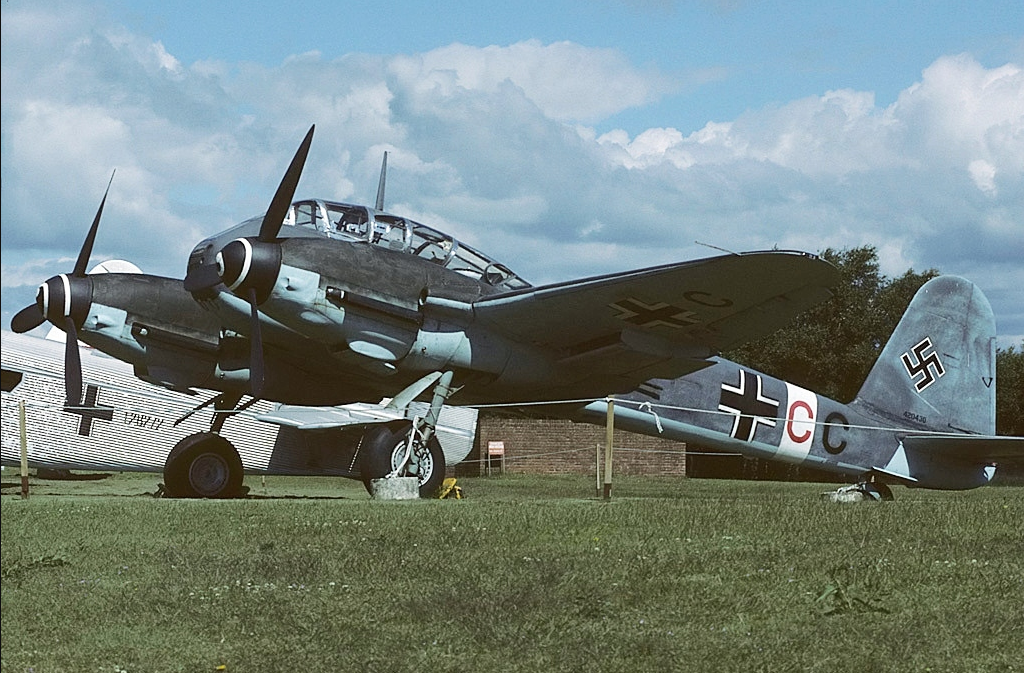
Plane of the week: the Messerschmitt Me 410 Hornisse |
|
By: vonofterdingen Date: July 20, 2020, 4:13 pm |
|
--------------------------------------------------------- |
|
https://i.postimg.cc/SKyrNTZM/Screen-Hunter-358.png |
|
The Luftwaffe�s attempts to update the obsolete Bf-110 have |
|
always fascinated me. Granted, getting the concept of heavy |
|
fighter correct was elusive for many aircraft makers. Perhaps |
|
only the US P-38 was genuinely successful. But Messerschmitt�s |
|
initial update to the Bf-110, the Me-210, was a big |
|
disappointment. And though the next iteration, our plane of the |
|
week the Me-410 was better, it was not really better enough. Not |
|
all aircraft designs work as expected. |
|
From Wikipedia: |
|
The Messerschmitt Me 410 Hornisse (Hornet) was a German heavy |
|
fighter and Schnellbomber used by the Luftwaffe during World War |
|
II. Though an incremental improvement of the Me 210, it had a |
|
new wing plan, longer fuselage and engines of greater power. The |
|
changes were significant enough for the aircraft to be renamed |
|
the Me 410. |
|
Development of the Me 210 had been underway since 1939 but |
|
the aircraft proved unstable and was never considered for |
|
full-scale production. Modifications to the layout produced the |
|
Me 210C and 210D, which proved somewhat superior. As studies |
|
progressed on the Me 210D, and with a separate parallel attempt |
|
to improve upon the 210 with the Messerschmitt Me 310 in the |
|
second half of 1943 � which provided almost no aerodynamic |
|
improvement over the 210's risky handling qualities � it was |
|
instead decided to introduce a new model, the Me 410. |
|
The major change between the Me 210 and 410 was the |
|
introduction of the larger (at 44.5 litre, 2,715 in3 |
|
displacement) and more powerful Daimler-Benz DB 603A engines, |
|
which increased power to 1,750 PS (1,730 hp, 1,290 kW) compared |
|
to the 1,475 PS DB 605s used on the Me 210C - the interim Me 310 |
|
design experiment actually used the DB 603 powerplant choice |
|
first. The engine performance increased the Me 410's maximum |
|
speed to 625 km/h (388 mph), greatly improved rate of climb, |
|
service ceiling, and most notably the cruising speed which |
|
jumped to 579 km/h (360 mph). It also improved payload |
|
capability to the point where the aircraft could lift more war |
|
load than could fit into the bomb bay under the nose. To address |
|
this, shackles were added under the wings for four 50 kg (110 |
|
lb) bombs. The changes added an extra 680 kg (1,500 lb) to the |
|
Me 210 design, but the extra engine power more than made up for |
|
the difference. As with the Me 210, the 410's rear gunner used |
|
the same pair of Ferngerichtete Drehringseitenlafette FDSL |
|
131/1B turrets mounted on each side of the aircraft, each still |
|
armed with a 13 mm (.51 in) MG 131 machine guns, retaining the |
|
same pivoting handgun-style grip, trigger and gunsight to aim |
|
and fire the ordnance as the 210 did. |
|
[img width=1024 |
|
height=564] |
|
https://i.postimg.cc/pLQCvbBv/Screen-Hunter-357.png[/img] |
|
The new version included a lengthened fuselage and new, |
|
automatic leading edge slats, both of which had been tested on |
|
Me 210s and were found to dramatically improve handling. The |
|
slats had originally been featured on the earliest Me 210 |
|
models, but had been removed on production models due to poor |
|
handling. When entering a steep turn, the slats had a tendency |
|
to open due to the high angle of attack, analogous to the |
|
opening of the slats during the landing approach. (This problem |
|
was first observed on the Bf 109V14 and V15 prototypes for the |
|
Bf 109E), which added to the problems keeping the aircraft |
|
flying smoothly. However, when the problems with the general |
|
lateral instability were addressed, this was no longer a real |
|
problem. The wing panels of the earlier Me 210 had been designed |
|
with a planform geometry that placed the aerodynamic center in a |
|
rearwards direction in comparison to the earlier Bf 110, giving |
|
the outer sections of the wing planform beyond each engine |
|
nacelle a slightly greater, 12.6� leading edge sweepback angle |
|
than the inner panels' 6.0� leading edge sweep angle. This |
|
resulted in unreasonable handling characteristics in flight for |
|
the original Me 210 design. The new Me 410 outer wing panels had |
|
their planform geometry revised to bring the aerodynamic center |
|
further forwards in comparison to the Me 210, thus making the |
|
leading edge sweepback of the outer panels identical to the |
|
inner wing panels with both having identical 5.5� sweepback |
|
angles, which improved handling. |
|
Deliveries began in January 1943, two years late and |
|
continued until September 1944, by which point a total of 1,160 |
|
of all versions had been produced by Messerschmitt Augsburg and |
|
Dornier M�nchen. When it arrived, it was liked by its crews, |
|
even though its improved performance was not enough to protect |
|
it from the swarms of high performance Allied fighters they |
|
faced at this stage of the war. |
|
The Me 410 night bomber proved to be an elusive target for |
|
the RAF night fighters. The first unit to operate over the UK |
|
was V./KG 2, which lost its first Me 410 on the night of 13�14 |
|
July 1943, when it was shot down by a de Havilland Mosquito of |
|
No. 85 Squadron RAF. |
|
The Me 410 was also used as a bomber destroyer against the |
|
daylight bomber formations of the USAAF, upgraded with |
|
Umr�st-Baus�tze factory conversion kits, all bearing a /U |
|
suffix, for the design � these suffixes could vary in meaning |
|
between subtypes. As one example, the earlier Me 410 A-1/U1 |
|
designation signified a camera-fitting in the under-nose |
|
ordnance bay for reconnaissance use (as the A-3 was meant to do |
|
from its start), while the same /U1 designation or the later Me |
|
410 B-2 signified a mount of a pair of the long barreled, 30mm |
|
calibre MK 103 cannon in the undernose ordnance bay. The /U2 |
|
suffix designated a fitment of two additional 20 mm MG 151/20 |
|
cannons in the under-nose ordnance bay instead � the A-1/U4 |
|
subtype fitted the massive, 540 kg (1,190 lb) weight Bordkanone |
|
series 50 mm (2 in) BK 5 cannon, loaded with 21 rounds in the |
|
same undernose ordnance bay in place of either the /U1's cameras |
|
or MK 103s, or the /U2's added pair of MG 151/20 autocannon. For |
|
breaking up the bomber formations, many Me 410s also had four |
|
underwing tubular launchers, two per wing panel, firing |
|
converted 21 cm (8 in) Werfer-Granate 21 infantry barrage |
|
rockets. Two Geschwader, Zerst�rergeschwader 26 and 76, were |
|
thus equipped with the Me 410 by late 1943. |
|
They were moderately successful against unescorted bombers |
|
through 1943, with a considerable number of kills against USAAF |
|
day bomber formations being achieved. However, the Me 410 was no |
|
match in a dogfight with the lighter Allied single-engine |
|
fighters such as the North American P-51 Mustang and Supermarine |
|
Spitfire. In early 1944, the Me 410 formations encountered |
|
swarms of Allied fighters protecting the bomber streams, usually |
|
flying far ahead of the combat box formations as an air |
|
supremacy move in clearing the skies of any Luftwaffe |
|
opposition, resulting in the Me 410's previous successes against |
|
escorted bombers now often being offset by their losses. An |
|
example of this � as part of a campaign started two days earlier |
|
by the USAAF � was on 6 March 1944 during an attack on Berlin by |
|
750 8th AF heavy bombers, when 16 Me 410s were shot down in |
|
return for eight B-17s and four P-51s (which were destroyed by |
|
Bf 109 and Fw 190 fighters escorting the Me 410s). The following |
|
month on 11 April, with 8th AF raids hitting Sorau, Rostock and |
|
Oschersleben, II./ZG 26's Me 410s accounted for a rare clear |
|
success, initially bringing down 10 B-17s without any losses. |
|
During the course of the same raid, their second sortie was |
|
intercepted by P-51s that destroyed eight Me 410s and three Bf |
|
110s. Sixteen crewmen were killed and three wounded. |
|
From mid-1944, despite being Hitler's favourite bomber |
|
destroyer, the Me 410 units were taken from Defence of the Reich |
|
duties and production was phased out in favour of heavily armed |
|
single-engine fighters as dedicated bomber destroyers, with the |
|
Me 410s remaining in service flying on reconnaissance duties |
|
only. Some Me 410s were used with Junkers Ju 188s during the |
|
Battle of Normandy, for high-altitude night reconnaissance. |
|
[img width=1024 |
|
height=604] |
|
https://i.postimg.cc/43B1K6MF/Screen-Hunter-359.png[/img] |
|
In game� |
|
I enjoy flying the Me-410 in game, but only in certain roles. |
|
Even with the rear gunnery the Hornisse is no match for Allied |
|
fighters of the period. As a bomber attack aircraft, however, it |
|
does quite well. So when flying the Me-410 my recommendation is |
|
to look for missions or campaigns that feature it in opposition |
|
to unescorted bomber formations. Even then though I personally |
|
would rather be in a Bf-109 or FW-190. |
|
|
|
#Post#: 11903-------------------------------------------------- |
|
Re: Plane of the week: the Messerschmitt Me 410 Hornisse |
|
By: cafs Date: July 20, 2020, 7:21 pm |
|
--------------------------------------------------------- |
|
Thanks for another great PoW, Von. You bring back to life |
|
another forgoten WW2 plane. Kudos for that. |
|
After finishing my M-113 APC 1960-75, US, ARVN and Australian |
|
variants on Vietnam book, I'll start the Me-210/410 Zestorer |
|
Units of WW2. |
|
👍🏆 |
|
#Post#: 11905-------------------------------------------------- |
|
Re: Plane of the week: the Messerschmitt Me 410 Hornisse |
|
By: vonofterdingen Date: July 20, 2020, 11:23 pm |
|
--------------------------------------------------------- |
|
That would be great Cafs, when time allows. The 210 and 410 are |
|
a little under-represented in the game in my opinion. I believe |
|
that they were also used by other axis air forces. |
|
#Post#: 11907-------------------------------------------------- |
|
Re: Plane of the week: the Messerschmitt Me 410 Hornisse |
|
By: larsresult Date: July 21, 2020, 5:50 am |
|
--------------------------------------------------------- |
|
Good write up Von.The Hungarians were successful with their |
|
Me210Ca-1 dive bomber variant, although not much has been |
|
written about them in English. Despite this, I don't believe |
|
they received any Me410s. The Me410 in Luftwaffe service had |
|
little chance to show its potency as a bomber destroyer as it |
|
arrived in 1943 only a few months before the long range Allied |
|
fighters appeared such as the P51 Mustang. As Von says if you |
|
catch an unescorted bomber unit you can create mayhem. |
|
On 2nd July 1944 20 Me410s of I/ZG76 attacked a lone combat wing |
|
of 15th USAAF B-17s over Budapest. They claimed 13 B-17s for the |
|
loss of one Me410. In fact 4 B-17s were lost but the rest were |
|
badly damaged. |
|
Osprey recently released a well written book Me210/410 Zerstorer |
|
Units by Robert Forsyth which covers Luftwaffe and Hungarian |
|
usage. |
|
#Post#: 11909-------------------------------------------------- |
|
Re: Plane of the week: the Messerschmitt Me 410 Hornisse |
|
By: JG51_Ruski Date: July 21, 2020, 11:26 am |
|
--------------------------------------------------------- |
|
Good post Von thank you!! |
|
#Post#: 11911-------------------------------------------------- |
|
Re: Plane of the week: the Messerschmitt Me 410 Hornisse |
|
By: ben_wh Date: July 21, 2020, 7:53 pm |
|
--------------------------------------------------------- |
|
Thanks again for a good post, von. |
|
As you pointed out, twin-engine fighters had a mix record in |
|
WW2. The twin engine design allowed the designers to pack a |
|
lot of firepower along the center line of the plane, which can |
|
be a strong positive factor for an interceptor. However the |
|
twin engine fighters were often less agile than the contemporary |
|
single engine ones, which caused problems in a 1:1, few:few |
|
situation. |
|
P-38s in the Pacific was an exception, but this was partly due |
|
to the sizable speed advantage of the P-38 over the Zeroes or |
|
Ki-43s (not to mention G4Ms or Ki-21s). |
|
Cheers, |
|
#Post#: 11912-------------------------------------------------- |
|
Re: Plane of the week: the Messerschmitt Me 410 Hornisse |
|
By: DHumphrey Date: July 22, 2020, 12:34 pm |
|
--------------------------------------------------------- |
|
Good post Von, very good article, learned something today ... |
|
today is a good day. :) |
|
***************************************************** |



![https://i.postimg.cc/pLQCvbBv/Screen-Hunter-357.png[/img]](https://i.postimg.cc/pLQCvbBv/Screen-Hunter-357.png[/img])
![https://i.postimg.cc/43B1K6MF/Screen-Hunter-359.png[/img]](https://i.postimg.cc/43B1K6MF/Screen-Hunter-359.png[/img])