 |
Return Create A Forum - Home |
 |
--------------------------------------------------------- |
|
IL2 Air Combat! |
 |
https://il2freemodding.createaforum.com |
|
--------------------------------------------------------- |
|
***************************************************** |
|
Return to: Plane of the Week Articles |
|
***************************************************** |
|
#Post#: 11809-------------------------------------------------- |
|
Plane of the Week: the Yokosuka MXY-7 Ohka |
|
By: vonofterdingen Date: July 6, 2020, 3:49 pm |
|
--------------------------------------------------------- |
|
[img width=1024 |
|
height=568] |
|
https://i.postimg.cc/LshqdPzq/Screen-Hunter-311.png[/img] |
|
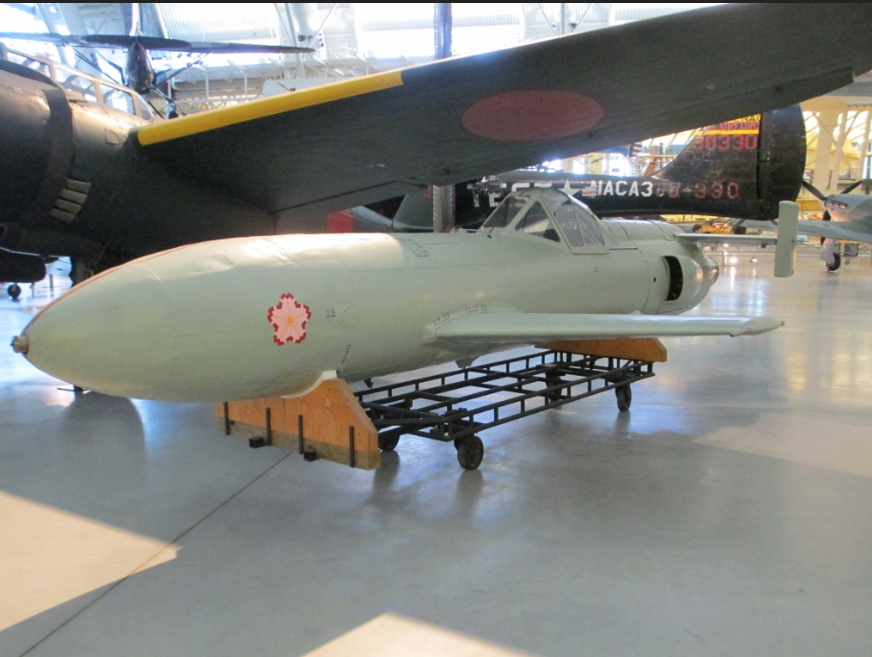
I had a model kit of the Yokosuka MXY-7 Ohka as a boy. On the |
|
box it was named �the Baka Bomb,� a name that always stuck with |
|
me. I had the opportunity to see one at the USAF Museum in |
|
Dayton Ohio many years ago; it was a tiny little flying coffin. |
|
It gave me chills then and still does. What a terrifying weapon |
|
both for the attacker and the target. The idea that military |
|
planners and engineers would design an aircraft specifically as |
|
a suicide weapon is chilling in itself. As a friend of mine used |
|
to say, �there�s a fine line between bravery and stupidity.� |
|
From Wikipedia: |
|
The Yokosuka MXY-7 was a purpose-built, rocket-powered |
|
human-guided kamikaze attack aircraft employed by Japan against |
|
Allied ships towards the end of the Pacific War during World War |
|
II. Although extremely fast, the very short range of the Ohka |
|
meant that it had to be carried into action as a parasite |
|
aircraft by a much larger bomber, which was itself vulnerable to |
|
carrier-borne fighters. In action during the Battle of Okinawa |
|
in 1945, Ohkas were able to sink or damage some escort vessels |
|
and transport ships but no major warships were ever hit. |
|
Improved versions which attempted to overcome the aircraft's |
|
shortcomings were developed too late to be deployed. The Allied |
|
reporting name for the Ohka was "Baka". |
|
The MXY-7 Navy Suicide Attacker Ohka was a manned flying bomb |
|
that was usually carried underneath a Mitsubishi G4M2e Model 24J |
|
"Betty" bomber to within range of its target. On release, the |
|
pilot would first glide towards the target and when close enough |
|
he would fire the Ohka's three solid-fuel rockets, one at a time |
|
or in unison, and fly the missile towards the ship that he |
|
intended to destroy. |
|
The design was conceived by Ensign Mitsuo Ohta of the 405th |
|
Kokutai, aided by students of the Aeronautical Research |
|
Institute at the University of Tokyo. Ohta submitted his plans |
|
to the Yokosuka research facility. The Imperial Japanese Navy |
|
decided the idea had merit and Yokosuka engineers of the |
|
Yokosuka Naval Air Technical Arsenal (Dai-Ichi Kaigun Koku |
|
Gijitsusho, or in short Kugisho) created formal blueprints for |
|
what was to be the MXY7. The only variant which saw service was |
|
the Model 11, and it was powered by three Type 4 Mark 1 Model 20 |
|
rockets. 155 Ohka Model 11s were built at Yokosuka, and another |
|
600 were built at the Kasumigaura Naval Air Arsenal. |
|
The final approach was difficult for a defender to stop |
|
because the aircraft gained high speed (650 km/h (400 mph) in |
|
level flight and 930 km/h (580 mph) or even 1,000 km/h (620 mph) |
|
in a dive. Later versions were designed to be launched from |
|
coastal air bases and caves, and even from submarines equipped |
|
with aircraft catapults, although none were actually used in |
|
this way. The USS Mannert L. Abele was the first Allied ship to |
|
be sunk by Ohka aircraft, near Okinawa on 12 April 1945. Over |
|
the course of the war, Ohkas sank or damaged three ships beyond |
|
repair, significantly damaged three more ships, with a total of |
|
seven U.S. ships damaged or sunk by Ohkas. |
|
The only operational Ohka was the Model 11. Essentially a |
|
1,200-kilogram (2,600 lb) bomb with wooden wings, powered by |
|
three Type 4 Model 1 Mark 20 solid-fuel rocket motors, the Model |
|
11 achieved great speed, but with limited range. This was |
|
problematic, as it required the slow, heavily laden mother |
|
aircraft to approach within 37 km (20 nmi; 23 mi) of the target, |
|
making them very vulnerable to defending fighters. There was one |
|
experimental variant of the Model 11, the Model 21, which had |
|
thin steel wings manufactured by Nakajima. It had the engine of |
|
the Model 11 and the airframe of the Model 22. |
|
The Yokosuka MXY7 Ohka was used mostly against U.S. ships |
|
invading Okinawa, and if launched from its mothership, could be |
|
effective because of its high speed in the dive. In the first |
|
two attempts to transport the Ohkas to Leyte Gulf using aircraft |
|
carriers, the carriers Shinano and Unryu were sunk by the U.S. |
|
submarines Archerfish and Redfish. |
|
[img width=1024 |
|
height=508] |
|
https://i.postimg.cc/NMH5FwCB/Screen-Hunter-310.png[/img] |
|
Attacks intensified in April 1945. On 1 April 1945, six |
|
"Bettys" attacked the U.S. fleet off Okinawa. At least one made |
|
a successful attack; its Ohka was thought to have hit one of the |
|
406 mm (16 in) turrets on the battleship West Virginia, causing |
|
moderate damage. Postwar analysis indicated that no hits were |
|
recorded and that a near-miss took place. The transports Alpine, |
|
Achernar, and Tyrrell were also hit by kamikaze aircraft, but it |
|
is unclear whether any of these were Ohkas from the other |
|
"Bettys". None of the "Bettys" returned. |
|
The U.S. military quickly realized the danger and |
|
concentrated on extending their "defensive rings" outward to |
|
intercept the "Betty"/Ohka combination aircraft before the |
|
suicide mission could be launched. On 12 April 1945, nine |
|
"Bettys" attacked the U.S. fleet off Okinawa. The destroyer |
|
Mannert L. Abele was hit, broke in two, and sank, witnessed by |
|
LSMR-189 CO James M. Stewart. Jeffers destroyed an Ohka with AA |
|
fire 45 m (50 yd) from the ship, but the resulting explosion was |
|
still powerful enough to cause extensive damage, forcing Jeffers |
|
to withdraw. The destroyer Stanly was attacked by two Ohkas. One |
|
struck above the waterline just behind the ship's bow, its |
|
charge passing completely through the hull and splashing into |
|
the sea, where it detonated underwater, causing little damage to |
|
the ship. The other Ohka narrowly missed (its pilot probably |
|
killed by anti-aircraft fire) and crashed into the sea, knocking |
|
off the Stanly's ensign in the process. One Betty returned. On |
|
14 April 1945, seven "Bettys" attacked the U.S. fleet off |
|
Okinawa. None returned. None of the Ohkas appeared to have been |
|
launched. Two days later, six "Bettys" attacked the U.S. fleet |
|
off Okinawa. Two returned, but no Ohkas had hit their targets. |
|
Later, on 28 April 1945, four "Bettys" attacked the U.S. fleet |
|
off Okinawa at night. One returned. No hits were recorded. |
|
https://i.postimg.cc/CKtRwKNc/Screen-Hunter-308.png |
|
May 1945 saw another series of attacks. On 4 May 1945, seven |
|
"Bettys" attacked the U.S. fleet off Okinawa. One Ohka hit the |
|
bridge of a destroyer, Shea, causing extensive damage and |
|
casualties. Gayety was also damaged by an Ohka's near miss. One |
|
"Betty" returned. On 11 May 1945, four "Bettys" attacked the |
|
U.S. fleet off Okinawa. The destroyer Hugh W. Hadley was hit and |
|
suffered extensive damage and flooding. The vessel was judged |
|
beyond repair. On 25 May 1945, 11 "Bettys" attacked the fleet |
|
off Okinawa. Bad weather forced most of the aircraft to turn |
|
back, and none of the others hit targets. |
|
On 22 June 1945, six "Bettys" attacked the fleet. Two |
|
returned, but no hits were recorded. Postwar analysis concluded |
|
that the Ohka's impact was negligible, since no U.S. Navy |
|
capital ships had been hit during the attacks because of the |
|
effective defensive tactics that were employed. In total, of the |
|
300 Ohka available for the Okinawa campaign, 74 actually |
|
undertook operations, of which 56 were either destroyed with |
|
their parent aircraft or in making attacks. The Allied nickname |
|
for the aircraft was "Baka", a Japanese word meaning "foolish" |
|
or "idiotic". |
|
[img width=1024 |
|
height=573] |
|
https://i.postimg.cc/4yRnhFjt/Screen-Hunter-307.png[/img] |
|
In game� |
|
Every April Fool�s day a think about announcing my new |
|
12-mission campaign for the Ohka. Still haven�t done it. I have |
|
never flown the Ohka and don�t particularly care to. From the |
|
other side, it is a real challenge to bring down once it is in |
|
flight. As the Wiki article mentions, the best approach is to |
|
catch it while still in the Betty bomber. Even Mustangs or |
|
Corsairs can�t keep up. If you do happen to get into a shooting |
|
position, you need to treat it somewhat like a German V-1; if |
|
you are too close and you hit it, the explosion will take out |
|
both of you. |
|
#Post#: 11810-------------------------------------------------- |
|
Re: Plane of the Week: the Yokosuka MXY-7 Ohka |
|
By: ben_wh Date: July 6, 2020, 4:58 pm |
|
--------------------------------------------------------- |
|
von, |
|
Thank you for the write up of this very interesting 'plane' |
|
(weapon?) that came out of some of the most devastating years of |
|
human history. So much has been/ can be written about kamikaze |
|
in real life that I am not sure what I can add here. |
|
In game: this is certainly a rare occasion that a flyable Ohka |
|
is included in the game. Your 12-mission campaign is not such |
|
an outlandish idea: one can imagine a campaign for a pilot that |
|
migrate from flight school to some air-to-air actions, then |
|
transfer to the Tokubetsu Kōgekitai and ultimately to a |
|
'fiery conclusion'. |
|
Should you choose to make this a reality, these books may |
|
present some useful perspective: |
|
Kamikaze Diaries: Reflections of Japanese Student Soldiers by |
|
Emiko Ohnuki-Tierney |
|
Kamikaze: A Japanese Pilot's Own Spectacular Story of the Famous |
|
Suicide Squadrons by Gordon T. Allred and Yasuo Kuwahara |
|
Blossoms in the Wind: Human Legacies of the Kamikaze by M.G. |
|
Sheftall |
|
Finally, you may also try searching online for 'The Cockpit |
|
Anime Part 2' by Leiji Matsumoto. |
|
Cheers, |
|
#Post#: 11812-------------------------------------------------- |
|
Re: Plane of the Week: the Yokosuka MXY-7 Ohka |
|
By: vonofterdingen Date: July 6, 2020, 9:18 pm |
|
--------------------------------------------------------- |
|
I had not thought of that approach for a campaign. Good idea. It |
|
would make for a hell of a final mission, wouldn't it? |
|
#Post#: 11814-------------------------------------------------- |
|
Re: Plane of the Week: the Yokosuka MXY-7 Ohka |
|
By: ben_wh Date: July 7, 2020, 12:00 pm |
|
--------------------------------------------------------- |
|
Yes, it would. |
|
Suggestion for potential mission maker: include an excerpt from |
|
the final personal letter from the pilot to his family as the |
|
last part of the mission briefing. |
|
***************************************************** |



![https://i.postimg.cc/LshqdPzq/Screen-Hunter-311.png[/img]](https://i.postimg.cc/LshqdPzq/Screen-Hunter-311.png[/img])
![https://i.postimg.cc/NMH5FwCB/Screen-Hunter-310.png[/img]](https://i.postimg.cc/NMH5FwCB/Screen-Hunter-310.png[/img])
![https://i.postimg.cc/4yRnhFjt/Screen-Hunter-307.png[/img]](https://i.postimg.cc/4yRnhFjt/Screen-Hunter-307.png[/img])