 |
Return Create A Forum - Home |
 |
--------------------------------------------------------- |
|
IL2 Air Combat! |
 |
https://il2freemodding.createaforum.com |
|
--------------------------------------------------------- |
|
***************************************************** |
|
Return to: Plane of the Week Articles |
|
***************************************************** |
|
#Post#: 11507-------------------------------------------------- |
|
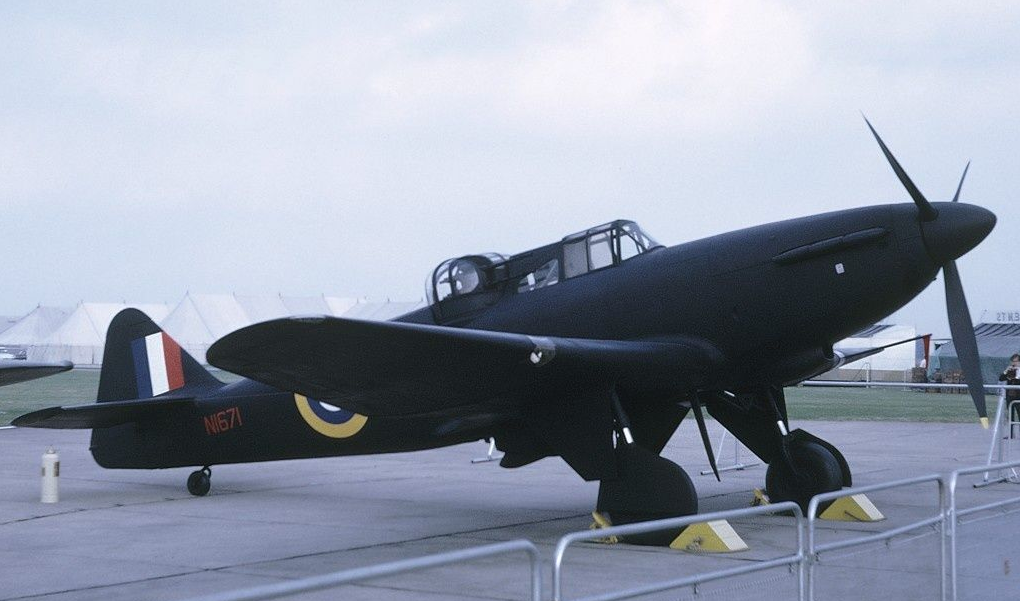
Plane of the Week: the Bolton Paul Defiant |
|
By: vonofterdingen Date: June 8, 2020, 2:31 pm |
|
--------------------------------------------------------- |
|
[img width=1024 |
|
height=645] |
|
https://i.postimg.cc/50hz8gB7/Screen-Hunter-287.png[/img] |
|
|
|
Let�s just say that not all aircraft designs work as |
|
expected. This week�s Plane of the Week is such an example. The |
|
idea seems sound, a fighter that uses a large multi-gun turret |
|
rather than forward-facing wing or nose guns. Can�t miss. Well, |
|
it did miss indeed. Was it a complete failure? Perhaps it was; |
|
theory did not translate into good practice in this instance. |
|
From Wikipedia: |
|
During the 1930s, the increasing speed of military aircraft |
|
posed a particular challenge to anti-aircraft defences. Advances |
|
in aircraft design achieved during the 1920s and 1930s had |
|
resulted in a generation of multi-engined monoplane bombers that |
|
were substantially faster than their contemporary single-engined |
|
biplane fighters then in service. The RAF came to believe that |
|
its new generation of turret-armed bombers, such as the Vickers |
|
Wellington, would be capable of readily penetrating enemy |
|
airspace and of defending themselves without any accompanying |
|
fighter escort, but also recognised that the bombers of other |
|
European air forces, such as the Luftwaffe, would similarly be |
|
able to penetrate |
|
During 1935, the concept of a turret-armed defensive fighter |
|
to counter the bomber threat emerged during a time in which the |
|
RAF anticipated having to defend Great Britain against massed |
|
formations of unescorted enemy bombers. In theory, turret-armed |
|
fighters would approach an enemy bomber from below or from the |
|
side and coordinate their fire. The separation of the tasks of |
|
flying the aircraft and firing the guns would allow the pilot to |
|
concentrate on putting the fighter into the best position for |
|
the gunner to engage the enemy. However, manually-traversed |
|
turrets were viewed as having becoming more problematic and |
|
increasingly inadequate to effectively respond to ever-faster |
|
hostile aircraft, thus there was considerable interest in using |
|
a power-augmented turret. |
|
The earlier Hawker Demon biplane had tested the concept with |
|
59 of the fighters, which had been manufactured by Boulton Paul |
|
under a sub-contract, having been equipped with a |
|
hydraulically-powered rear turret, while a number of aircraft |
|
already built were also converted as such. Boulton Paul and its |
|
managing director John Dudley North had gained considerable |
|
experience with defensive turrets from producing several earlier |
|
aircraft, including the Boulton Paul Overstrand bomber, and had |
|
devised a four-gun power-operated turret, the concept and |
|
development work of which would later be a core part of the |
|
Defiant design. |
|
In April 1935, the Air Ministry released Specification |
|
F.9/35, which required a two-seater day and night "turret |
|
fighter" capable of 290 miles per hour (470 km/h) at 15,000 feet |
|
(4,600 m). The aircraft was to feature a clean design, |
|
concentrating its armament within a power-operated turret, and |
|
the accepted performance was to be only slightly beneath that of |
|
other emergent fighter designs of the period, along with a |
|
sufficient fuel capacity to allow it to perform standing |
|
patrols. In particular, the powered turret was to offer |
|
considerable flexibility, possessing both a 360-degree upper |
|
hemisphere field of fire and be able to engage enemy bombers |
|
from a range of quarters, including below the aircraft itself. |
|
Specification F.9/35 had followed the earlier Specification |
|
F.5/33, which had sought a pusher design combined with a |
|
forward-set turret; F.5/33 had been unceremoniously abandoned as |
|
the proposals had offered little in terms of performance gains |
|
over existing fighters, and the corresponding Armstrong |
|
Whitworth AW.34 design which had been ordered was not completed. |
|
In October 1939, No. 264 (Madras Presidency) Squadron was |
|
reformed at RAF Sutton Bridge to operate the Defiant. Initial |
|
training, formal squadron acceptance, and development of tactics |
|
began with other aircraft as it received its first Defiants only |
|
in early December at Martlesham Heath. In February 1940, the |
|
Defiant commenced night fighter training operations; the |
|
squadron tested its tactics against British medium bombers � |
|
Hampdens and Blenheims � and 264's CO flew against Robert |
|
Stanford Tuck in a Spitfire, showing that the Defiant could |
|
defend itself by circling and keeping its speed up. It became |
|
clear during these trials that the Defiant was suited only to |
|
performing bomber-destroyer duties. |
|
By March 1940, 264 Squadron had two flights operational with |
|
Defiants and No. 141 Squadron received its first Defiant. When |
|
the Defiant was first introduced to the public, the RAF put out |
|
a disinformation campaign, stating that the Defiant had 21 guns: |
|
four in the turret, 14 in the wings and three cannon in the |
|
nose. On 12 May 1940, the first operational sortie occurred as a |
|
flight of six Defiants flew with six Spitfires of 66 Squadron |
|
over the English Channel to the coastline in the vicinity of The |
|
Hague, Netherlands; during this flight, a single Ju 88, which |
|
had been in the process of attacking a destroyer, was shot down. |
|
The following day, in a patrol that was a repetition of the |
|
first, Defiants claimed four Junkers Ju 87 Stuka dive bombers, |
|
but were subsequently attacked by a flight of Bf 109Es. The |
|
escorting Spitfires were unable to prevent five of the six |
|
Defiants being shot down by a frontal attack. |
|
During the evacuation of the British Expeditionary Force from |
|
Dunkirk, the squadron was based at RAF Manston, as one of the 16 |
|
squadrons that No. 11 Group had for the evacuation. On 27 May |
|
264 Squadron claimed three He 111 and two damaged. On 28 May, |
|
shortly after take-off, 10 Defiants were attacked by about 30 Bf |
|
109s � forming a circle, they claimed six German fighters for |
|
the loss of three Defiants. The Defiant was initially successful |
|
against enemy aircraft and its best day was 29 May, when No. 264 |
|
Squadron claimed 37 kills in two sorties: 19 Ju 87 Stukas, |
|
mostly picked off as they came out of their dives, nine |
|
Messerschmitt Bf 110 twin-engined heavy fighters, eight Bf 109s |
|
and a Ju-88; one Defiant gunner was lost after he bailed out, |
|
although the aircraft made it back to its base to be repaired. |
|
On 31 May, seven Defiants were lost in one day. |
|
https://i.postimg.cc/JnDJyvkH/Screen-Hunter-288.png |
|
Luftwaffe fighters suffered losses when "bouncing" flights of |
|
Defiants from the rear, apparently mistaking them for |
|
Hurricanes. The German pilots were unaware of the Defiant's |
|
rear-firing armament and encountered concentrated defensive |
|
fire. The Luftwaffe changed tactics, to outmanoeuvre the Defiant |
|
and attack from below or dead ahead, where the turret guns |
|
offered no defence. Defiant losses quickly mounted, particularly |
|
among the gunners, who were often unable to leave stricken |
|
aircraft. The additional weight of the turret and the second |
|
crewman plus the aerodynamic drag gave the Defiant a lower |
|
performance than conventional single-seat fighter aircraft. |
|
264 Squadron developed a counter against single-seat aircraft |
|
such as the Bf 109. By flying in an ever-descending Lufbery |
|
circle, Defiant crews sacrificed the advantage of height but |
|
eliminated the possibility of attack from underneath, while |
|
giving 360� of defensive fire. This tactic was used by 264 |
|
Squadron, but when the Defiants of 141 Sqn were committed to |
|
combat a few months later during the Battle of Britain, it chose |
|
to ignore their advice. On 19 July, seven out of nine 141 |
|
Squadron Defiants sent to cover a convoy off Folkestone were |
|
shot down by Bf 109s of JG 51, and the remaining two survived, |
|
one badly damaged, thanks only to the intervention of Hurricanes |
|
of 111 Sqn. The Hurricane pilots reported that the Defiants had |
|
shot down four Bf 109s. Although 264 Squadron claimed 48 kills |
|
in eight days over Dunkirk, the cost was high with 14 Defiants |
|
lost. Actual German losses were no more than 12�15 enemy |
|
aircraft; the turret's wide angle of fire meant that several |
|
Defiants could engage the same target at one time, leading to |
|
multiple claims. |
|
On 22 August, in response to an urgent demand for aircraft to |
|
defend Britain's airspace, 264 Squadron relocated to RAF |
|
Hornchurch, Essex, while also using RAF Manston as a forward |
|
base. On 24 August, nine Defiants of 264 scrambled from Manston |
|
to engage an incoming German force; in the ensuing engagement, |
|
three Ju 88s and a single Bf 109E were shot down for the loss of |
|
two Defiants. Later that same day, another cluster of bombers |
|
appeared and were engaged by seven Defiants that had been in the |
|
process of refuelling; three Ju 88s and two Bf 109Es were downed |
|
while one Defiant was in turn downed along with another damaged. |
|
On 26 August 264 Squadron engaged a formation of 12 Dornier |
|
Do 17 bombers over north-eastern Kent but was attacked by a |
|
large formation of Bf 109s. Three aircraft were lost (two to ace |
|
Hpt. Gunther Lutzow of JG 3) but six Do 17s and a Bf 109 were |
|
shot down. Three of those victories were awarded to one Defiant, |
|
crewed by Flight Sergeants E. R. Thorn (pilot) and F. J. Barker |
|
(air gunner). They shot down two Do 17s but were then engaged by |
|
a Bf 109, which set their Defiant on fire; they managed to shoot |
|
down the German fighter before making a forced landing. For |
|
this, they were awarded a bar to the Distinguished Flying Medal. |
|
The squadron lost a further five aircraft (to JG 26) on 28 |
|
August, with nine crew killed, and effectively ended operations, |
|
withdrawing to RAF Duxford the following day. With these losses, |
|
the Defiant�which had been intended from the start as a day and |
|
night fighter�was transferred to night operations instead. The |
|
type had proven unsuited to the demands of the day fighter when |
|
set against the likes of the Bf 109E, and was less capable than |
|
other RAF aircraft such as the Hurricane and the Spitfire. By 31 |
|
August, over half the delivered Defiants had been shot down by |
|
Luftwaffe aircraft, a rate that was deemed to be unacceptable. |
|
On 1 July, 141 Squadron despatched L6997 on the first Defiant |
|
night patrol. In August, the squadron was operating both by day |
|
and night; on 15 August, the first possible nighttime success by |
|
a Defiant was recorded, and from September onwards, the squadron |
|
principally operated at night. In September, as a response to |
|
the commencement of heavy attacks upon London by the Luftwaffe, |
|
known as the Blitz, B Flight of No. 141 moved to RAF Biggin |
|
Hill, Bromley, while A Flight relocated to Gatwick Airport, West |
|
Sussex in October prior to moving to RAF Gravesend, Kent. |
|
Successful claimed interceptions took place, such as two He 111s |
|
being claimed on 15/16 September; the first confirmed kill by |
|
Defiant of the squadron was made on 22 December, of a single He |
|
111. |
|
The Defiant night fighters had initially lacked airborne |
|
interception radar, thus enemy aircraft were spotted and |
|
attacked via the eyes of the crew alone, aided by ground-based |
|
searchlights intended to illuminate attacking bombers. In the |
|
opening months of 1941, as the German night bombing campaign |
|
reached its peak, increasing numbers of Defiant night |
|
fighter-equipped squadrons became operational and commenced |
|
night patrols although, according to Bowyers, there were |
|
relatively few claims across many Defiant sorties. As a |
|
counterpoint, aviation author John Taylor noted that during the |
|
Blitz on London of 1940�41, the four Defiant-equipped squadrons |
|
were responsible for shooting down more enemy aircraft than any |
|
other type in the theatre. |
|
The improved Defiant Mk II model was fitted with the AI Mk. |
|
IV radar and a Merlin XX engine, increasing the aircraft's |
|
performance, particularly at night time. In September 1941, 264 |
|
Squadron became the first to receive the Defiant Mk II, bringing |
|
them into operational use by mid-September. The principal users |
|
of the Mk II night fighter were 96, 151, and 262 Squadrons. As |
|
the radar-equipped Defiants began filtering through to |
|
operational squadrons, the Luftwaffe's bombing campaign petered |
|
out as German forces had become heavily engaged on the Eastern |
|
Front as they embarked upon the Operation Barbarossa the |
|
invasion of the Soviet Union. |
|
Defiant night fighters typically attacked enemy bombers from |
|
below, in a similar manoeuvre to the later German Schr�ge Musik |
|
method. Defiants attacked more often from slightly ahead or to |
|
one side, rather than from directly under the tail. The |
|
turret-fighter concept was not immediately discarded and the |
|
fitting of Defiant-type turrets to Beaufighter and Mosquito |
|
night fighters was tried to enable these aircraft to duplicate |
|
these methods but the deleterious effect on performance proved |
|
drastic and the idea was abandoned. |
|
[img width=1024 |
|
height=646] |
|
https://i.postimg.cc/qq23wKQk/Screen-Hunter-289.png[/img] |
|
In game� |
|
I have only flown the Defiant in the FMB and then only out of |
|
curiosity. Even then it is most enjoyable to switch seats and |
|
fly as the gunner. The AI however does not really know what to |
|
do with the plane and tends to fly it like a Hurricane, which |
|
can be lethal. It really needs a human pilot. |
|
My most common use of the plane is for visual effect in early |
|
Battle of Britain scenarios. In that role it is a lot of fun to |
|
watch, but not fly. I am not a night fighter fan, so I have |
|
never tried it in that role. With Mace�s new target and banner |
|
mod, this plane also makes for a very interesting tow tug in |
|
training missions. |
|
#Post#: 11509-------------------------------------------------- |
|
Re: Plane of the Week: the Bolton Paul Defiant |
|
By: ben_wh Date: June 8, 2020, 2:47 pm |
|
--------------------------------------------------------- |
|
von, |
|
A very interesting choice. |
|
This is one of the aviation evolution deadend that I am not sure |
|
was accurately modeled in terms of behavior in any air combat |
|
sim. For this to work properly in IL-2, you'll need a proper |
|
'Turret Fighter' class, which is likely only applicable to two |
|
planes (if we are only look at operational ones): the Defiant |
|
and the Roc. |
|
Given how accurate the tail gunners in IL-2 can be, with the |
|
proper class it may make for an effective Luftwaffe bomber |
|
hunter in an early war, BoB scenarios. |
|
Cheers, |
|
#Post#: 11511-------------------------------------------------- |
|
Re: Plane of the Week: the Bolton Paul Defiant |
|
By: vonofterdingen Date: June 8, 2020, 2:51 pm |
|
--------------------------------------------------------- |
|
Good point, Ben. The game designers and modders can't be |
|
expected to anticipate every aircraft design and as you point |
|
out the Defiant is unorthodox in the extreme. |
|
#Post#: 11512-------------------------------------------------- |
|
Re: Plane of the Week: the Bolton Paul Defiant |
|
By: cafs Date: June 8, 2020, 3:00 pm |
|
--------------------------------------------------------- |
|
An interesting idea, that not materialized indeed. |
|
You're right Ben, we need a real Defiant/Roc mod. |
|
Any ideas Beo, Dimon and company? :o :o ::) ::) ::) ;D ;D |
|
#Post#: 11518-------------------------------------------------- |
|
Re: Plane of the Week: the Bolton Paul Defiant |
|
By: ben_wh Date: June 9, 2020, 12:18 pm |
|
--------------------------------------------------------- |
|
von and cafs, |
|
That was not really a request - which I know would be too much |
|
of an ask for a 'niche within a niche' mod, unless a modder |
|
wants an intellectual challenge. |
|
Before we even start talking about modding, what were the |
|
Defiant and Roc pilots instructed to do anyway? 'When you see a |
|
fighter, turn around and present your six, then fly steadily to |
|
allow your gunner a clean shot'? Would be interesting to learn |
|
about RAF/ FAA pilots' reaction at the time. |
|
Cheers, |
|
#Post#: 11520-------------------------------------------------- |
|
Re: Plane of the Week: the Bolton Paul Defiant |
|
By: Beowolff Date: June 9, 2020, 1:31 pm |
|
--------------------------------------------------------- |
|
For sure we NEED a real plane! Dimon???? |
|
S! |
|
Beo |
|
PS, great read here Von! ;D |
|
#Post#: 11522-------------------------------------------------- |
|
Re: Plane of the Week: the Bolton Paul Defiant |
|
By: larsresult Date: June 9, 2020, 1:43 pm |
|
--------------------------------------------------------- |
|
Hi Ben. The following tactics were developed by 264 Squadron and |
|
the Air Fighting Development Unit in the early months of 1940. |
|
To combat bombers there were three methods |
|
1.Overtake on a parallel course and fire at the fuselage |
|
2. Converge on a beam attack. |
|
3.Dive across the front of a bomber formation. |
|
To combat fighters |
|
Form a defensive circle (which was the tactic favoured by |
|
several air forces including Bf110s of the Luftwaffe) |
|
Up to Dunkirk Defiants were successful but then the Luftwaffe |
|
fighters realised they had no front guns and were not so agile |
|
and then they started to suffer heavy losses. They resurfaced as |
|
a good interim night fighter then as an ASR aircraft. |
|
#Post#: 11524-------------------------------------------------- |
|
Re: Plane of the Week: the Bolton Paul Defiant |
|
By: herbarnold99 Date: June 9, 2020, 2:50 pm |
|
--------------------------------------------------------- |
|
Just adding my two cents, but I've found the AI behavior of the |
|
current Defiant in the game isn't too bad! Maybe not |
|
sufficiently aggressive sometimes, but plausible. And when |
|
you're the pilot, your gunner will gamely shoot at targets if |
|
you can position yourself appropriately (true, not always easy). |
|
But wow! Surely the 3D model can be improved? Don't get me |
|
wrong, it's better than not having the plane at all, but I know |
|
I would fly it much more if it looked more realistic. It's an |
|
operational type that saw significant combat, and truly deserves |
|
some love. Hope it can happen! |
|
Cheers |
|
Herb |
|
#Post#: 11526-------------------------------------------------- |
|
Re: Plane of the Week: the Bolton Paul Defiant |
|
By: ben_wh Date: June 9, 2020, 8:05 pm |
|
--------------------------------------------------------- |
|
[quote author=larsresult link=topic=1664.msg11522#msg11522 |
|
date=1591728193] |
|
Hi Ben. The following tactics were developed by 264 Squadron and |
|
the Air Fighting Development Unit in the early months of 1940. |
|
To combat bombers there were three methods |
|
1.Overtake on a parallel course and fire at the fuselage |
|
2. Converge on a beam attack. |
|
3.Dive across the front of a bomber formation. |
|
To combat fighters |
|
Form a defensive circle (which was the tactic favoured by |
|
several air forces including Bf110s of the Luftwaffe) |
|
Up to Dunkirk Defiants were successful but then the Luftwaffe |
|
fighters realised they had no front guns and were not so agile |
|
and then they started to suffer heavy losses. They resurfaced as |
|
a good interim night fighter then as an ASR aircraft. |
|
[/quote] |
|
Thanks larsresult, |
|
To incorporate a turret fighter in game, one then has to |
|
overcome these challenges: |
|
The 'Turretfighter' class coding challenge: |
|
- code this intercept behavior above against bombers |
|
- code a defensive circle behavior (Lufbery? or other form?) |
|
against fighters (could be useful for other early war fighters?) |
|
And an additional challenge: add a frontal attack behavior for |
|
'regular' fighter class when going against a turret fighter ... |
|
Not an easy problem to solve. |
|
Cheers, |
|
#Post#: 11529-------------------------------------------------- |
|
Re: Plane of the Week: the Bolton Paul Defiant |
|
By: dandolo513 Date: June 10, 2020, 12:52 pm |
|
--------------------------------------------------------- |
|
Hallo. |
|
I wonder if a mod exist? |
|
Best regards |
|
***************************************************** |
|
Next Page |



![https://i.postimg.cc/50hz8gB7/Screen-Hunter-287.png[/img]](https://i.postimg.cc/50hz8gB7/Screen-Hunter-287.png[/img])
![https://i.postimg.cc/qq23wKQk/Screen-Hunter-289.png[/img]](https://i.postimg.cc/qq23wKQk/Screen-Hunter-289.png[/img])