HOLIDAY RECAP
It's funny how bad I am at writing phlog posts on these holidays.
Tiredness, lack of time, and the tiny keyboard on my Eee PC combine
to produce the most attrocious nonsense which I only post because
I'm too tired and rushed to read over it before uploading. At least
I only subjected you to one of those this last holiday, where I not
only had my location wrong but changed back and forth about how to
spell that wrong location as I wrote. But that part's just honest
really, since in real time I'm truely hopeless with remembering
names for anything - places, people, and with particular
inconvenience, roads. But on that trip, accompanied by six pages of
handwritten instructions for weaving the Jag GPS-less through all
sorts of empty backroads for about 1,000Km, I can pretty much
proclaim success. By stopping so frequently at the various dams and
studying the maps and route plan before setting off each time, I
managed only one minor moment of thorough locational befuddlement
on the roads. On the other hand between planing and revising the
route I'm certain I spent far more time in preparation than in the
actual driving. But since the driving was generally such fun,
through all sorts of interesting countryside and terrain, with very
little of the joy-killing stress that even light traffic causes me,
I can't complain at all. Actually most of the roads were so
deserted that it almost seemed weird at times.
On the dam front, I washed through twelve dams/reservoirs overall.
I had fifteen marked on my route, but as evidenced by the state of
that phlog post, I was wearing thin by the last day and just
vistied one more after Lake Eildon instead of the possible four
along the journey back home. At least the impressive turning
spillway of that last dam, at the Upper Coliban Reservoir, was well
worth the stop-over. I also went via the Alexandra Tramway Museum
at the old Alexandra railway station (closed since the 1970s),
which wasn't properly open but can be accessed any time, and had
plenty of old machinery to ogle at including many of the tram
engines which used to service the abandoned tramlines I'd walked
along the day before at the Rubicon Hydroelectric Scheme.
I miss shooting film, but I did quickly fall into the "photograph
everything" mode which digital photography encourages. At least up
to the frustrating "photograph nothing" mode enforced by a dead
battery at one point. At least with digital I get to see the
results before the long-awaited day when I finally get into
developing film, so here I've uploaded a small selection of those
snapshots:
gopher://aussies.space/1/~freet/photos/dam_holiday_2025/
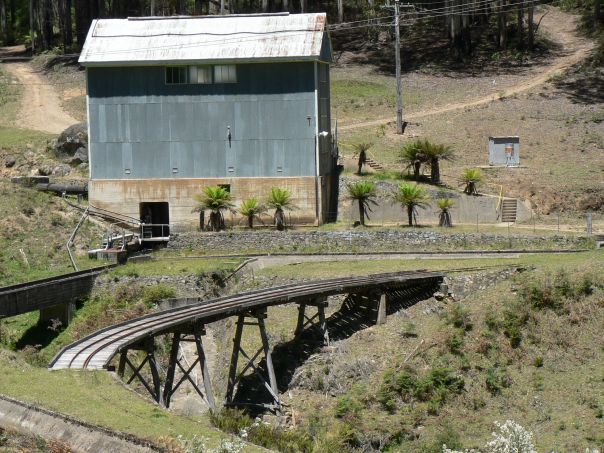
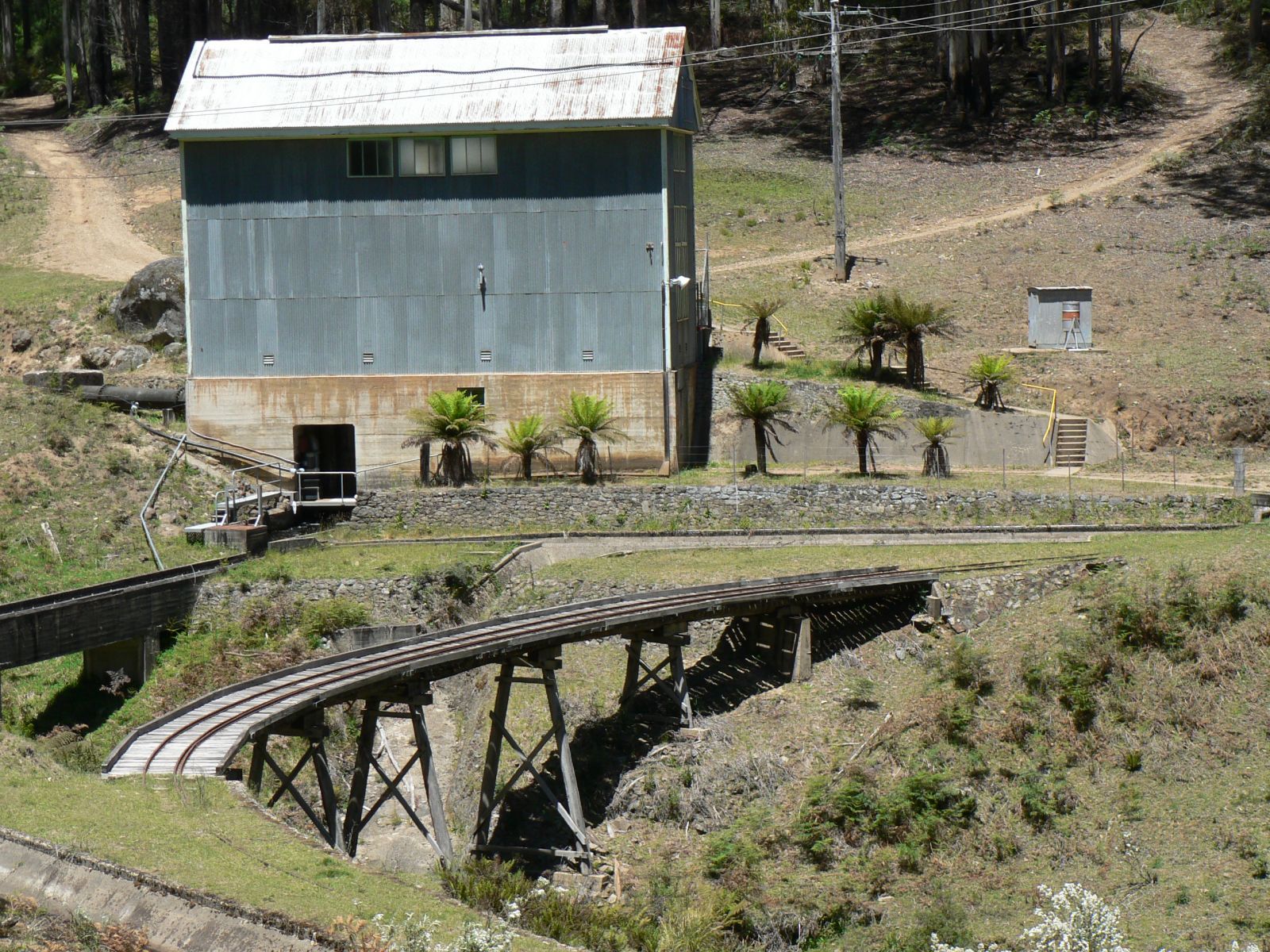
The hydroelectric scheme was a big highlight of the trip, even
though the walk to the Rubicon Falls Dam turned out quite hard
going uphill, and cold/wet for the walk back down. I could be
wrong, but the Roysten power station seemed to the the only one of
the four power stations in operation even though it's the time of
year that they're meant to work. The power line to the Rubicon
Falls Power Station seemed to have been brought down in a storm and
the broken wires were just cable-tied to the bottom of a pole. The
Rubicon and Lower Rubicon power stations were just suspicously
quiet compared to the whine and the torrent of water gushing from
below the less-powerful Royston Power Station. I couldn't
photograph that one due to the flat camera, but since it's the only
power station along an official walking trail there are already
ample photos online such as this one:
Small (80KB)
https://www.exploreoutdoors.vic.gov.au/__data/assets/image/0028/526357/varieties/image_gallery_thumb.jpg
Large (496KB)
https://www.exploreoutdoors.vic.gov.au/__data/assets/image/0028/526357/varieties/image_gallery_large.jpg
But the best access is certainly to the Rubicon Power Station,
located by the bridge on the Rubicon River Road heading to the
Rubicon Falls Power Station and Dam where the road is seasonally
closed (actually in any season you'd want to be pretty brave to
drive a vehicle through all those narrow twists and turns climbing
along the steep river valley). It's the largest power station in
terms of generation capacity - 9.2MW from two generators, and
like the whole scheme still largely to the original 1920s design.
Unfortunately I didn't think to take a photo from the same spot,
but it's fun to compare then-and-now with the 1940s photo on
Wikipedia:
https://en.wikipedia.org/wiki/File:Rubicon-power-station-incline.jpg
gopher://aussies.space/I/~freet/photos/dam_holiday_2025/rubicon_hydroelectric_scheme/rubicon_ps1.jpg
gopher://aussies.space/I/~freet/photos/dam_holiday_2025/rubicon_hydroelectric_scheme/rubicon_ps2.jpg
There's even a little bridge out the back with the white wooden
railings still there:
gopher://aussies.space/I/~freet/photos/dam_holiday_2025/rubicon_hydroelectric_scheme/rubicon_ps3.jpg
The biggest change seems to be that the large transformers in the
yard beside the power plant have been diconnected from the power
lines and apparantly superceeded by that tall white transportable
unit in front, which was actually buzzing loudly even though the
power station itself was silent. Maybe the power from the Roysten
power station goes through it too?
But my favourite view was through the grubby windows facing the
road, where I was able to get this shot of some beautifully
old-fashioned equipment inside:
gopher://aussies.space/I/~freet/photos/dam_holiday_2025/rubicon_hydroelectric_scheme/rubicon_ps_through_window.jpg
Ignoring the reflections off the glass, I think that's a full view
of one of the two hydroelectric "pelton wheel" generators, still
with all the cast-iron handles, rivets, and brass guages
characteristic of early 20th century engineering. There even look
to still be rows of big old-fashioned panel meters in the
background. Those unsure of what a pelton wheel is can reference
the old one on display outside the power station, conveniently
reflected in the top left of the photo. A high-pressure jet of
water efficiently spins one of those around inside the big circular
enclosure in the centre of the photo, to drive the generator on the
left. I think. It would be great to see inside properly, but I
don't think it's ever open for public tours.
Lots more photos of the scheme and other features such as Rubicon
Falls and Dam, a long tramway trestle bridge, and the abandoned
sawmill used to maintain those wooden structures, are here:
gopher://aussies.space/1/~freet/photos/dam_holiday_2025/rubicon_hydroelectric_scheme/
This is a very useful map showing the roads, tracks, tramline, and
key features around the area. It doesn't show the Rubicon Heritage
walking track though:
https://www.victoriashighcountry.com.au/wp-content/uploads/sites/65/FS0055-Rubicon-State-Forest.pdf
At Eildon there's a bigger power station which works during the
summer months when the Rubicon river doesn't have enough flow. It
was replaced in the 1950s and unfortunately I couldn't see anything
through its windows even with binoculars from the fenceline, but
here's a pic of it:
gopher://aussies.space/I/~freet/photos/dam_holiday_2025/lake_eildon/power_station.jpg
And a close up of some old turbines on (distant) display outside:
gopher://aussies.space/I/~freet/photos/dam_holiday_2025/lake_eildon/power_station_old_turbines.jpg
I don't know what inspired them to build an extra security fence
out front just to keep people out of their office. I doubt it was
too many tourists like me nagging for tours, though I might have
been tempted.
Details on the scheme at Wikipedia:
https://en.wikipedia.org/wiki/Rubicon_Hydroelectric_Scheme
Annoying security fences were the feature of my other great
highlight, a visit to the site of the Radio Australia shortwave
transmitter in Shepparton. Radio Australia was shut down in 2017
and the land under its huge antennas which once directed shortwaves
from down under to the other continents of the world, has been sold
to property developers, who are expected to soon pull them down to
make way for more of the Shepparton suburbia which seems to be
rapidly enveloping the area. The buildings themselves are aparantly
under heritage protection to save them from such a fate, but plans
by the local amateur radio club to make it into a museum haven't
materialised and currently the only use made of them is by a
carpentry business leasing the old generator building.
The site is very heavily fenced off to stop people from going in
and getting zapped while it was pumping out shortwaves with 100Kw
tansmitters. These days I discovered it's actually far more
dangerous walking along the outside of the fence to try and get
good angles to look at the fancinating arrays of antenna wires with
my binoculars and camera. There's a busy road, a deep drain, and a
narrow overgrown space between the drain and the fence which seemed
like the best place to walk along, until my entire leg suddenly
disappeared into the cavity of an old drain running under the fence
which was completely covered from above by the long grass. I walked
away from that with just a bruised knee, but it was frustrating
with a gravel road and mown grass taunting me from just the other
side of the fence. My little camera's zoom was far away from the
capacity of my big binoculars, so unfortunately I haven't captured
the view I saw of the antennas very well. But with lots of tweaking
of gamma and contrast I managed to extract a couple of shots
showing parts of the arrays here:
gopher://aussies.space/1/~freet/photos/dam_holiday_2025/radio_australia/
Besides the danger of the drains, a new secondary school on the
other side of the road contributes yet more risk for enthusients of
radio engineering. A bloke caught walking next to a school with
camera and binoculars these days risks getting locked up for life!
I had to be careful I wasn't seen facing the wrong way.
It was great to see the antennas before they're demolished, but it
would have been really great to see inside the transmitter building
too. The radio club claims all the equiment has been stripped out,
but I've got to wonder if that's partly just to deter thieves from
breaking in to nick their planned museum exhibits. Old videos show
there was a _lot_ inside. One newly uploaded video on YouTube by a
passing tourist gave me some hope because they met someone who let
them through the gate, and apparantly even got a look inside the
transmitter building. Unfortunately their rubbish video doesn't
show inside, or much at all really, but it encouraged me to linger
conspicuously around the security gate hoping, seeing as it was a
weekday, to catch someone coming in, but the place remained more
dead than a cemetery.
Here's that recent tourist's video:
https://www.youtube.com/watch?v=2swDbkvGhLo
And much better ones touring the site while it was still in
operation:
https://www.youtube.com/watch?v=BZuThNVJ1vo
https://www.youtube.com/watch?v=0tck8lSe6tg
Plus the day of the shutdown in 2017, after 80 years of operation:
https://www.youtube.com/watch?v=PKUsl7PZNr4
Those better videos are by radio ham VK3ASE, who for a few years
has run his own sort-of tribute to Radio Australia with Shortwave
Australia, a hobby shortwave station which I've been tuning into
myself from time to time. I brought my big old shortwave
cassette/radio and tried tuning in from the motel in Tatura to see
if reception was much better closer to his transmitter in "central
Victoria" than at home, but I think all the electrical noise from
the town, which I don't have out on my own at home, compensated
since the reception really wasn't much different at all.
http://shortwave.crossbandradio.com
Anyway that's enough babbling. I was frustrated that even though I
ended my holiday before the weekend with the intention to catch up
on my usual chores over the weekend rather than end up in a mess
for the next week like I usually have after a weekend trip, I ended
up with extra jobs to do that weekend which left me in a mess
anyway. Now I'm wasting the current weekend writing this. Indeed
reconsidering my use of time (or at least time when I've got some
energy left in me) has been part of what's caused me to be quieter
with my phlog posting lately. It's a luxury I can't really afford.
And on the topic of what I can't afford, I'll finish off with a
tally of roughly how much I spent on this three-night trip,
particularly to compare with the $356 my 3-night holiday by train
two years ago cost. Travelling by car is just _so_ much nicer (not
to mention _possible_, since trains barely ever seem to actually
run in the first place these days), but I suspect I've paid for
it...
Ouch, $664 all up. Only $192 for fuel though, after roughly
subtracting $60 for the amount gained at the end from the fuel
level when I set off. Although I was able to find a hotel with "pub
style" (shared bathroom) rooms for the two nights at Alexandra, it
was still $100/night compared to $60/night at the hotel in Pyramid
Hill on my last holiday. Plus $130 for the night at the Tatura
Country Motel, which seemed to be about the cheapest place around
Shepparton. Compared to the pub at Pyramid Hill, the room at The
Corner Hotel in Alexandra did have the extra points of heating and
a TV, but no bath tub. I gave up on the bath thing this time anyway
though, it makes picking cheap accommodation way too hard, and I'm
still somewhat satisfied from my two baths last time. Other costs
were $122 for food and $20 entry to the huge Museum of Vehicle
Evolution in Shepparton which, although featuring a telephone/radio
exhibit as a sideline, had surprisingly little from the Radio
Australia site.
- The Free Thinker
PS. Here's a silent film of the Rubicon and Sugarloaf hydro schemes
(the latter now replaced by the Eildon dam and power station)
from the 1920s. It's amazing how little has changed, including
a look at the same generator I saw through the window at the
Rubicon Power Station:
https://www.youtube.com/watch?v=id4jBAlCMYQ